The Story
Plant Bio
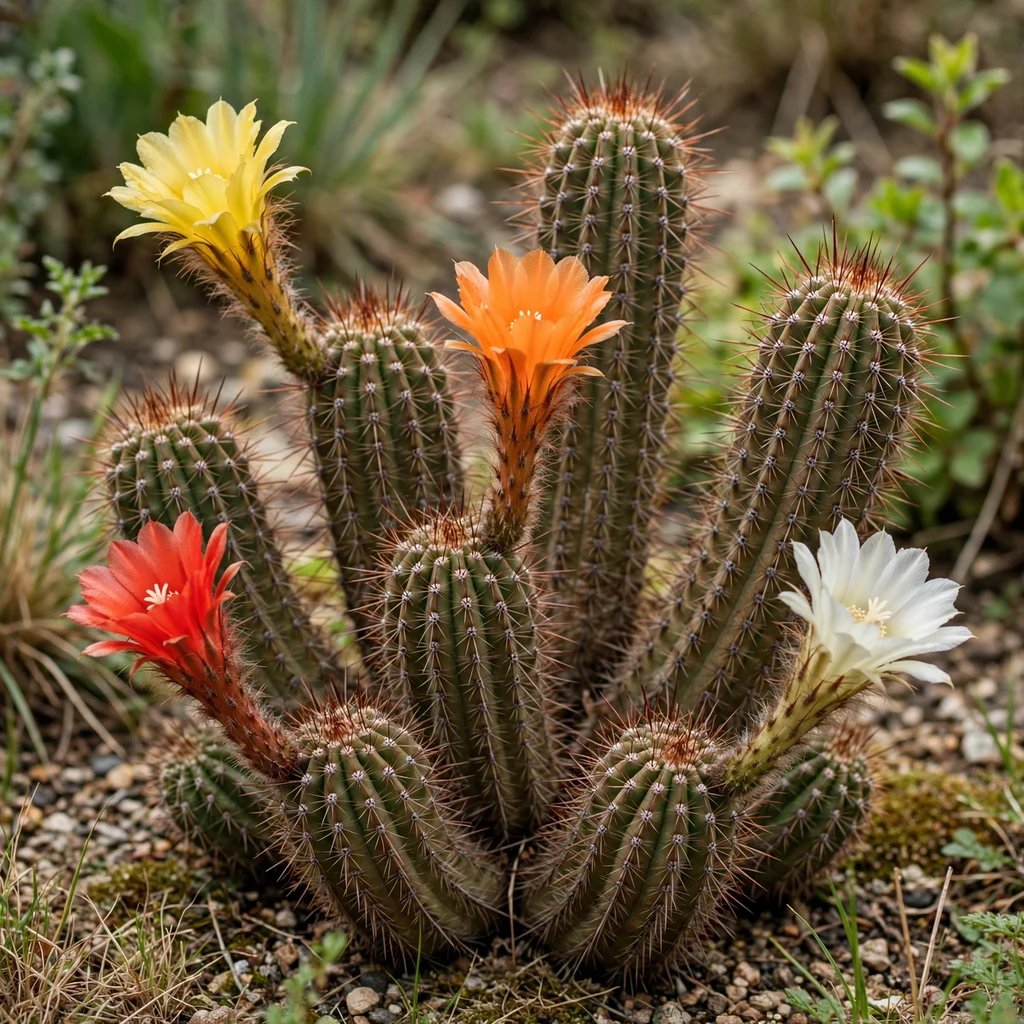
Echinopsis huascha is a small columnar cactus from northwest Argentina that forms clumps of upright green stems to about three feet tall, each with twelve to eighteen ribs lined with yellow areoles. It carries no leaves; photosynthesis occurs in the stems, which are armed with one to three central spines and nine to eleven radials that mature from yellow to brown.
Flowers open in spring to summer as scentless tubular funnels two to three inches long in red, orange or yellow within the same population, each lasting one to three days before forming yellow fruits. Unlike many desert cacti it grows actively with deep summer water when dry, then requires a cool, completely dry winter rest above 25F to avoid rot and stretched growth.
Uses & Benefits:
Essentials
At a Glance
Plant Type
Cactus Succulent
Height
35"
Width
35"
Light
Full Sun
Zones
9, 10
Water
Low
Humidity
Low
Lifespan
Long-lived perennial
Native To
NW Argentina
Toxicity
Non-toxic
Bloom period
Spring – Summer
In flower about 6 months of the year
Planting
How to Grow
- Plant in a very gritty mix with 50-80% pumice, coarse sand or crushed stone in a pot with drainage holes.
- Place in full sun for 6 or more hours; indoors give the brightest south or west window.
- Water deeply only when the mix is fully dry in spring and summer, then withhold all water in winter.
- Overwinter cool and bright above 40F indoors where winters are cold to prevent soft, stretched growth.
Pro Tip
Give it more water in summer than a desert cactus would want, then keep it bone-dry and cool in winter; winter wet kills it before cold does.
Keep It Thriving
Care Guide
Do
- Provide sharp drainage and a mineral, low-organic mix that dries quickly.
- Water deeply in summer only after the soil dries, allowing slight softening between waterings.
- Overwinter cool, bright and completely dry to keep stems compact.
Don't
- Do not water at all in winter or leave pots sitting in cold, wet soil.
- Do not use moisture-retentive potting soil or pots without drainage holes.
- Do not expect seed-grown flower color to match the parent; colors segregate red to orange to yellow.
Seasonal Care Calendar
| Task | Jan | Feb | Mar | Apr | May | Jun | Jul | Aug | Sep | Oct | Nov | Dec |
|---|---|---|---|---|---|---|---|---|---|---|---|---|
| Pest Check | ||||||||||||
| Plant | ||||||||||||
| Propagate | ||||||||||||
| Spring Cleanup | ||||||||||||
| Winter Prep |
Watch Out For
Pests & Diseases
Common Pests
Common Diseases
In the Garden
Landscape Uses & Companions
Landscape Uses
Multiply
Propagation Methods
Good to Know
Common Questions
Red Torch Cactus questions
What zones can Red Torch Cactus grow in?
Red Torch Cactus is hardy in USDA Zones 9–10: in that range it survives winter in the ground. Colder than Zone 9, grow it in a container you can move to shelter for the winter, or as an annual.
When does Red Torch Cactus bloom?
Red Torch Cactus typically blooms from spring to summer. Exact timing shifts a week or two with your zone — Sow's bloom calendar maps it to your garden.
Does Red Torch Cactus need full sun?
Red Torch Cactus does best in full sun (6+ hours).
Is Red Torch Cactus drought tolerant?
Yes — once established (usually after the first full season), Red Torch Cactus handles dry spells with minimal watering. Water deeply its first year to build the root system that makes that possible.
More Echinopsis to compare
Keep exploring
Explore the genus
Hardy in your zone?
Grow Red Torch Cactus with confidence
See it in a design of your actual yard, get zone-matched care reminders, and track it season by season in your garden journal.