The Story
Plant Bio
Combretum indicum is a vigorous, woody scrambling vine native to tropical regions of Asia and Africa, capable of climbing up to thirty feet with support. The foliage consists of bright green, opposite elliptic leaves, providing a dense canopy throughout the warm growing season.
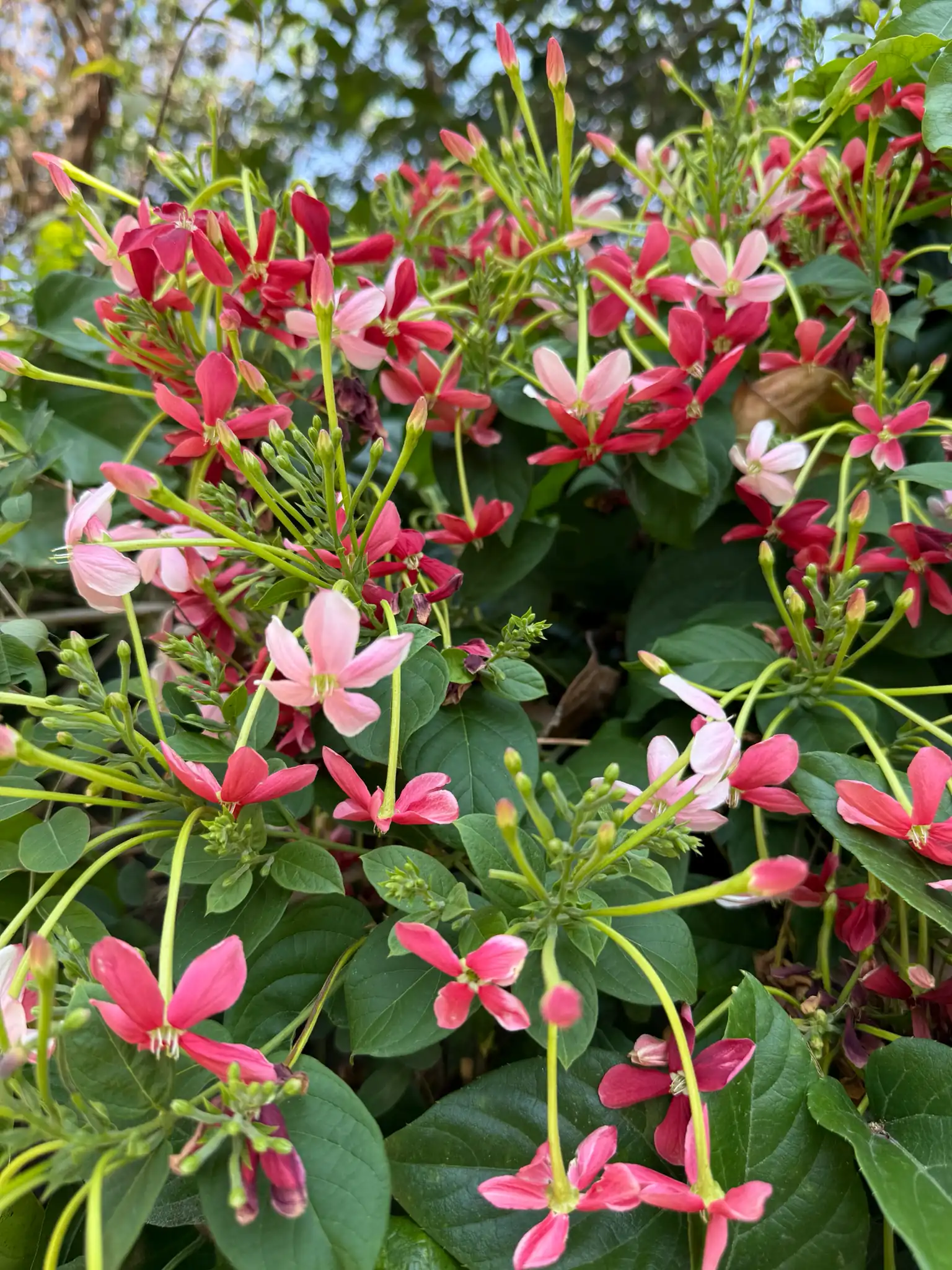
The fragrant, tubular flowers open white, transition to pink, and mature into deep red, producing multi-colored clusters from summer into fall. These nectar-rich blooms open in terminal clusters that draw hummingbirds, butterflies, and bees.
Uses & Benefits:
Essentials
At a Glance
Plant Type
Vine
Height
394"
Width
157"
Light
Full Sun, Partial Sun
Zones
9, 10
Water
Moderate
Humidity
High
Lifespan
Perennial
Native To
Tropical Asia and Africa
Toxicity
Seeds and sap are toxic/irritating
Bloom period
Summer – Fall
In flower about 6 months of the year
Planting
How to Grow
- Select a planting site in full sun with fertile, well-draining soil and a soil pH between 6.0 and 7.0.
- Install a sturdy, heavy-duty arbor, pergola, or fence capable of supporting dense, heavy woody growth.
- Plant at the same depth as the nursery container, firming the soil around the root ball and watering thoroughly.
- Tie young, flexible stems loosely to the support structure to direct initial upward growth.
Pro Tip
Prune structurally immediately after flowering finishes; avoid cutting back severely into old, leafless woody stems, as they lack dormant buds to generate fresh growth.
Keep It Thriving
Care Guide
Do
- Plant in full sun to ensure maximum flower production.
- Water regularly during active growth while maintaining high soil drainage.
- Prune structural stems annually after flowering concludes.
Don't
- Do not over-apply high-nitrogen fertilizers, which promote leafy growth at the expense of blossoms.
- Do not allow soil around the roots to remain saturated or waterlogged.
- Do not cut heavily into old, bare, woody stems where buds will not break.
Seasonal Care Calendar
| Task | Jan | Feb | Mar | Apr | May | Jun | Jul | Aug | Sep | Oct | Nov | Dec |
|---|---|---|---|---|---|---|---|---|---|---|---|---|
| Fertilize | ||||||||||||
| Mulch | ||||||||||||
| Pest Check | ||||||||||||
| Prune | ||||||||||||
| Stake |
Watch Out For
Pests & Diseases
Common Pests
Common Diseases
In the Garden
Landscape Uses & Companions
Landscape Uses
Multiply
Propagation Methods
Good to Know
Common Questions
Rangoon Creeper questions
What zones can Rangoon Creeper grow in?
Rangoon Creeper is hardy in USDA Zones 9–10: in that range it survives winter in the ground. Colder than Zone 9, grow it in a container you can move to shelter for the winter, or as an annual.
Is Rangoon Creeper deer resistant?
Not reliably. Deer may browse Rangoon Creeper, especially tender spring growth — plan on repellents or fencing where pressure is high.
When does Rangoon Creeper bloom?
Rangoon Creeper typically blooms from summer to fall. Exact timing shifts a week or two with your zone — Sow's bloom calendar maps it to your garden.
Does Rangoon Creeper need full sun?
Rangoon Creeper does best in full sun to part shade. In hot climates, afternoon shade keeps blooms fresher longer.
Is Rangoon Creeper drought tolerant?
Yes — once established (usually after the first full season), Rangoon Creeper handles dry spells with minimal watering. Water deeply its first year to build the root system that makes that possible.
More Combretum to compare
Keep exploring
Explore the genus
Hardy in your zone?
Grow Rangoon Creeper with confidence
See it in a design of your actual yard, get zone-matched care reminders, and track it season by season in your garden journal.