The Story
Plant Bio
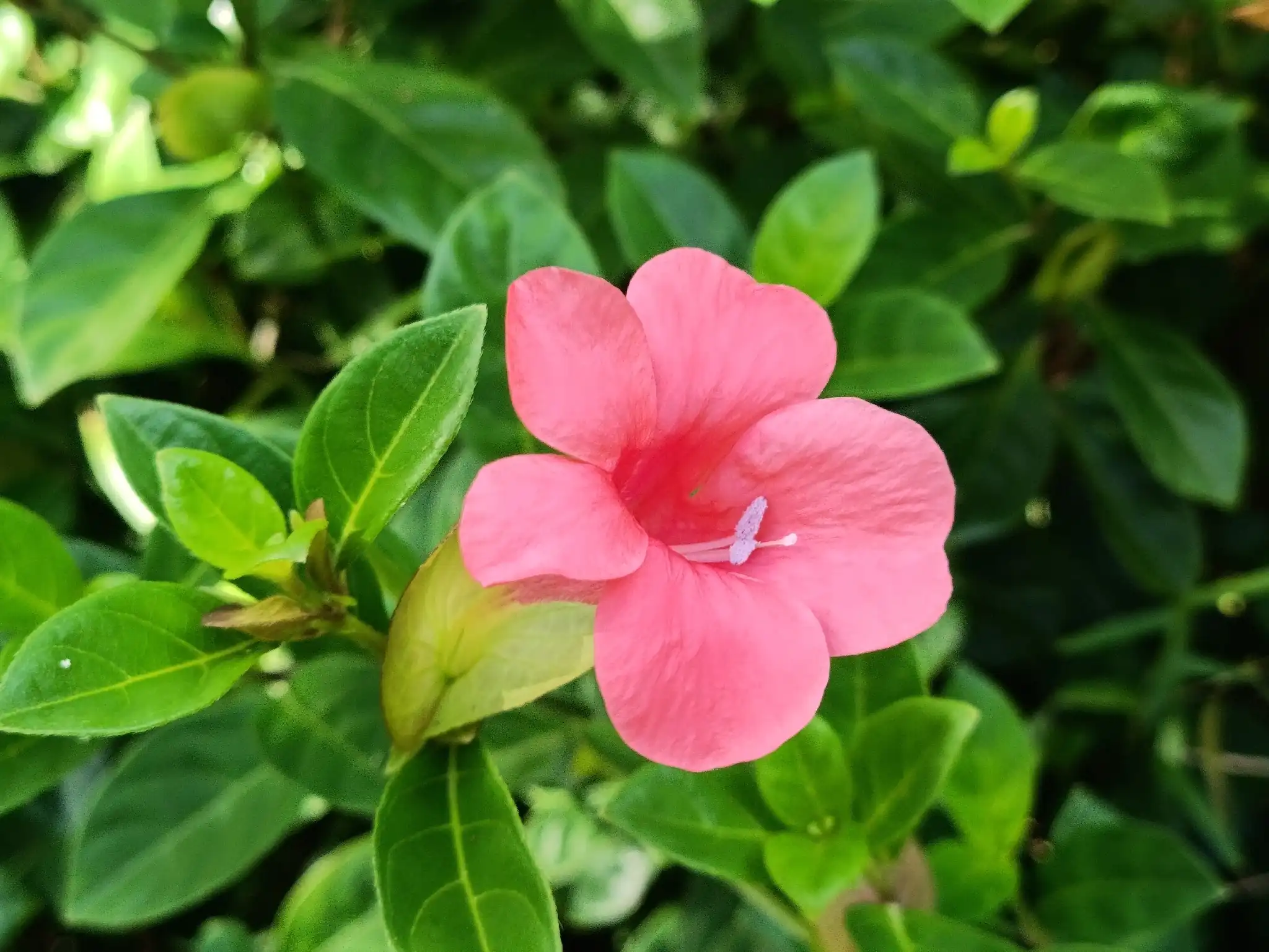
Barleria repens is an evergreen sprawling shrub from sub-Saharan Africa that roots where its stems touch soil, forming a rounded mound one to two feet high and three feet wide. The stems carry small rounded glossy dark green leaves and creep outward to root at the nodes.
What sets it apart is the tubular flower flared into five spreading lobes to two inches long, colored coral-red to salmon-pink and deep purple-mauve with only two stamens. Bloom runs from late spring through fall in frost-free ground, with stems able to scramble six feet up into adjacent shrubs if left unclipped.
Uses & Benefits:
Essentials
At a Glance
Plant Type
Groundcover
Height
24"
Width
36"
Light
Full Sun, Partial Sun
Zones
8, 9, 10
Water
Average
Humidity
Tolerant
Lifespan
Evergreen shrub
Native To
Sub-Saharan Africa
Toxicity
Non-toxic
Bloom period
Late spring – Autumn
In flower about 7 months of the year
Planting
How to Grow
- Plant in spring after frost in full sun to light shade where air moves freely.
- Set into rich light soil amended with compost that holds moisture yet drains sharply, pH 6.1-7.8.
- Water deeply after planting and through summer, then cut back in winter and never leave the crown waterlogged.
- Pinch young shoot tips to force branching and cut back hard once after fall bloom to contain size.
- Pull runners that root beyond bounds and renew mulch to suppress self-sown seed.
Pro Tip
Cut back hard once after flowering finishes and pull any node-rooted runners; planting in deep shade or in wet soil gives lanky growth with few flowers and rotted roots.
Keep It Thriving
Care Guide
Do
- Give full sun to light shade for dense growth and heavy bloom.
- Provide compost-enriched soil with excellent drainage.
- Water well in summer heat and much less in winter.
- Prune hard once a year after flowering to renew the mound.
Don't
- Do not plant in deep shade where stems turn lanky and flower poorly.
- Do not keep soil soggy or heavy, which rots the roots.
- Do not shear repeatedly through summer, which removes leaf-axil flower buds.
Seasonal Care Calendar
| Task | Jan | Feb | Mar | Apr | May | Jun | Jul | Aug | Sep | Oct | Nov | Dec |
|---|---|---|---|---|---|---|---|---|---|---|---|---|
| Fertilize | ||||||||||||
| Pest Check | ||||||||||||
| Pinch | ||||||||||||
| Plant | ||||||||||||
| Prune |
Watch Out For
Pests & Diseases
Common Pests
Common Diseases
In the Garden
Landscape Uses & Companions
Landscape Uses
Companion Plants
Multiply
Propagation Methods
Good to Know
Common Questions
Small Bush Violet questions
What zones can Small Bush Violet grow in?
Small Bush Violet is hardy in USDA Zones 8–10: in that range it survives winter in the ground. Colder than Zone 8, grow it in a container you can move to shelter for the winter, or as an annual.
When does Small Bush Violet bloom?
Small Bush Violet typically blooms from late spring to late fall. Exact timing shifts a week or two with your zone — Sow's bloom calendar maps it to your garden.
Does Small Bush Violet need full sun?
Small Bush Violet does best in full sun to part shade. In hot climates, afternoon shade keeps blooms fresher longer.
Is Small Bush Violet drought tolerant?
Yes — once established (usually after the first full season), Small Bush Violet handles dry spells with minimal watering. Water deeply its first year to build the root system that makes that possible.
More Barleria to compare
Keep exploring
Explore the genus
Hardy in your zone?
Grow Small Bush Violet with confidence
See it in a design of your actual yard, get zone-matched care reminders, and track it season by season in your garden journal.