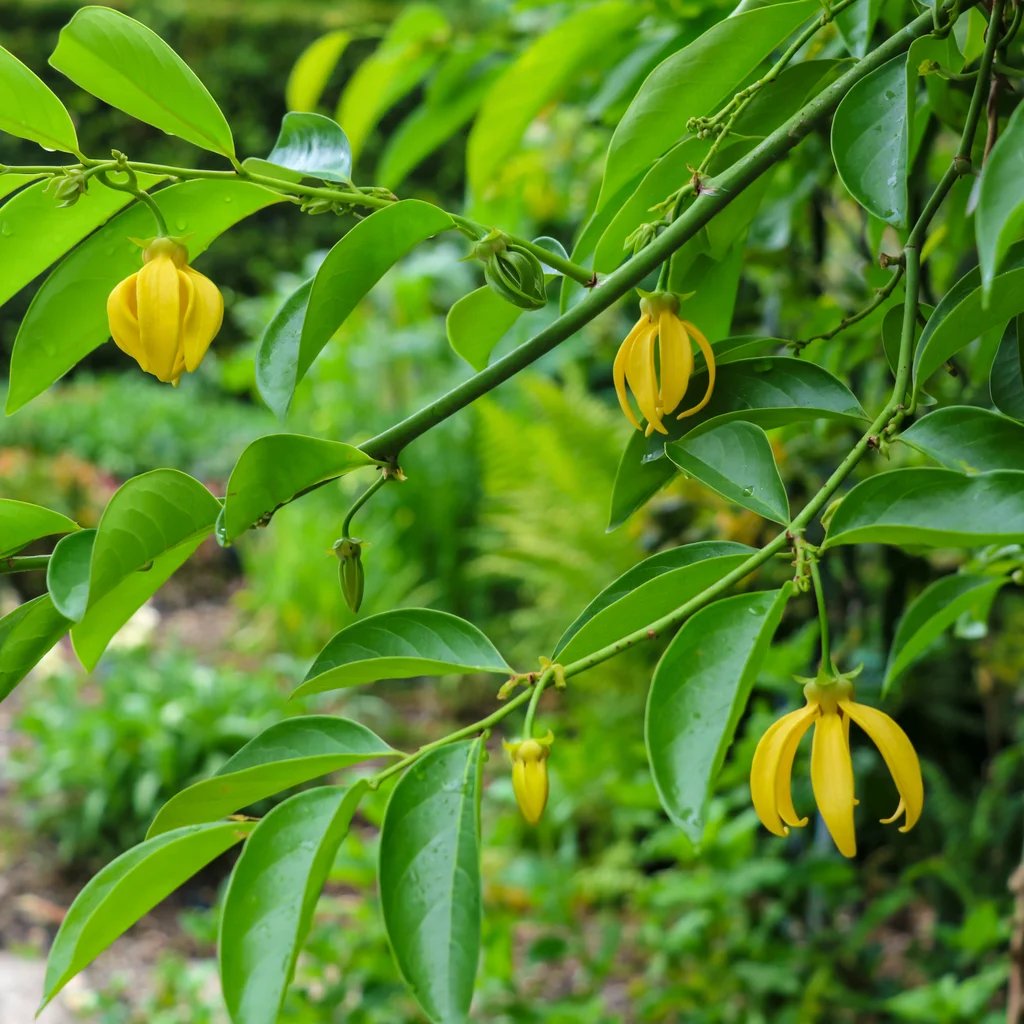
The Story
Plant Bio
Artabotrys siamensis is a large evergreen woody vine from tropical Asia that climbs by hooked tendrils, reaching 7 to 26 feet where frost does not check it. The smooth oval leaves clothe long scrambling stems that must have support to rise, otherwise they sprawl and mound.
Flowers hang singly on thin green stalks and open lime-green and scentless, then turn yellow to yellow-orange for one to two days when the lemon-like perfume develops. The yellow stage is the peak, not a spent flower, and bloom repeats profusely from mid-spring to late summer.
Uses & Benefits:
Essentials
At a Glance
Plant Type
Vine
Height
315"
Width
144"
Light
Full Sun, Partial Sun
Zones
9, 10
Water
Moderate
Humidity
Unknown
Lifespan
Woody perennial vine
Native To
Tropical Asia
Toxicity
Unknown
Bloom period
Mid-spring – Late summer
In flower about 5 months of the year
Planting
How to Grow
- Plant after frost danger in full sun to partial shade in freely draining soil, giving afternoon shade in hot Florida summers.
- Set a sturdy trellis, fence, or arbor at planting and tie long shoots up from the start.
- Water moderately, allowing the top of the soil to dry before watering again.
- Prune after heavy bloom to keep as a shrub or small tree, or to keep climbing growth within bounds.
- Protect from freezing; move large containers under cover or indoors when frost threatens.
Pro Tip
Train stems to a trellis from planting and pick for scent only at the yellow stage; green flowers are not yet scented and the scent fades after a day or two.
Keep It Thriving
Care Guide
Do
- Give full sun with some shade in summer heat.
- Allow the top of the soil to dry between waterings.
- Tie new shoots to support early to build a climbing frame.
Don't
- Don't leave it unsupported to sprawl across the ground.
- Don't pick green flowers expecting scent; wait for the yellow stage.
- Don't expose to frost or freezing wind.
Seasonal Care Calendar
| Task | Jan | Feb | Mar | Apr | May | Jun | Jul | Aug | Sep | Oct | Nov | Dec |
|---|---|---|---|---|---|---|---|---|---|---|---|---|
| Fertilize | ||||||||||||
| Pest Check | ||||||||||||
| Prune | ||||||||||||
| Stake | ||||||||||||
| Winter Prep |
Watch Out For
Pests & Diseases
Common Pests
In the Garden
Landscape Uses & Companions
Landscape Uses
Multiply
Propagation Methods
Good to Know
Common Questions
Climbing Ylang-Ylang questions
What zones can Climbing Ylang-Ylang grow in?
Climbing Ylang-Ylang is hardy in USDA Zones 9–10: in that range it survives winter in the ground. Colder than Zone 9, grow it in a container you can move to shelter for the winter, or as an annual.
When does Climbing Ylang-Ylang bloom?
Climbing Ylang-Ylang typically blooms from mid-spring to late summer. Exact timing shifts a week or two with your zone — Sow's bloom calendar maps it to your garden.
Does Climbing Ylang-Ylang need full sun?
Climbing Ylang-Ylang does best in full sun to part shade. In hot climates, afternoon shade keeps blooms fresher longer.
Keep exploring
Explore the genus
Hardy in your zone?
Grow Climbing Ylang-Ylang with confidence
See it in a design of your actual yard, get zone-matched care reminders, and track it season by season in your garden journal.