The Story
Plant Bio
Quisqualis indica, now botanically Combretum indicum, is a fast-growing woody vine that climbs with support to 25 feet and scrambles through thickets in its tropical range. In gardens it makes a shrubby liana that needs a strong trellis and dies back in winter where frost occurs.
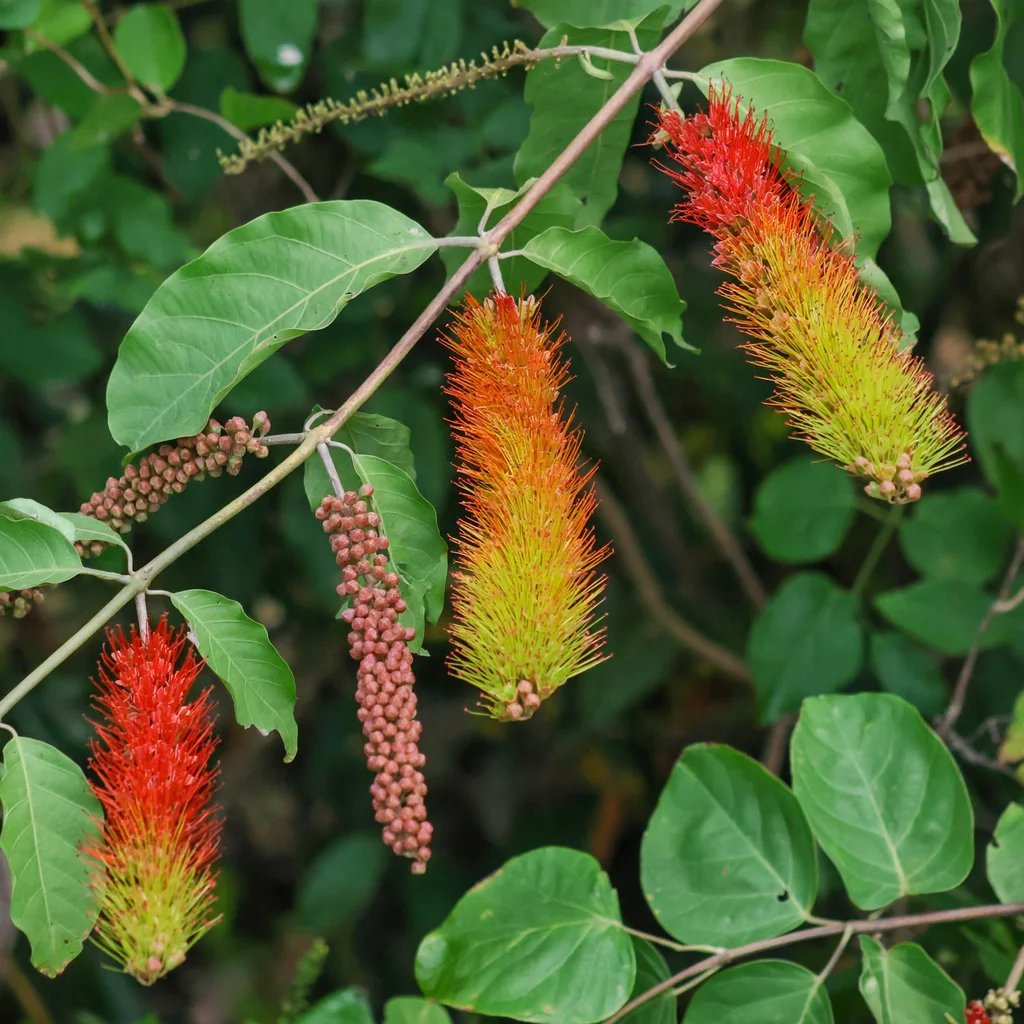
The sweetly fragrant tubular flowers are carried in tight terminal heads on a 2- to 3-inch tube, opening white then turning pink the second day and red to crimson the third. White, pink and red flowers thus sit side by side on the same cluster from summer into fall, which is ripening rather than disease.
Uses & Benefits:
Essentials
At a Glance
Plant Type
Vine
Height
300"
Width
144"
Light
Full Sun, Partial Sun
Zones
9, 10
Water
Evenly moist
Humidity
High
Lifespan
Woody perennial vine
Native To
Tropical Africa to Asia
Toxicity
Toxic seeds
Bloom period
Summer – Fall
In flower about 6 months of the year
Planting
How to Grow
- Plant in full sun with at least 6 to 7 hours daily after all frost danger, in fertile loamy soil that drains freely.
- Set a strong trellis, arbor or wires at planting and tie stems up as they lengthen.
- Water to establish a deep root system, then keep soil evenly moist but never soggy.
- Cut back after the summer to fall bloom to control size and remove dead wood.
- Grow in a large container and move indoors before first frost where winters drop below zone 9.
Pro Tip
Prune hard right after flowering to keep it off the roof; expect the white to pink to red fade and never eat the seed.
Keep It Thriving
Care Guide
Do
- Give full sun for best bloom, at least 6 hours daily.
- Provide a sturdy trellis and tie new shoots regularly.
- Prune after flowering to control vigor and shape.
Don't
- Do not plant in soggy soil that stays wet.
- Do not let it scramble unchecked into shrubs or eaves.
- Do not eat seeds or fruit; they cause vomiting and drowsiness.
Seasonal Care Calendar
| Task | Jan | Feb | Mar | Apr | May | Jun | Jul | Aug | Sep | Oct | Nov | Dec |
|---|---|---|---|---|---|---|---|---|---|---|---|---|
| Pest Check | ||||||||||||
| Plant | ||||||||||||
| Propagate | ||||||||||||
| Prune | ||||||||||||
| Winter Prep |
Watch Out For
Pests & Diseases
Common Pests
Common Diseases
In the Garden
Landscape Uses & Companions
Landscape Uses
Multiply
Propagation Methods
Good to Know
Common Questions
Rangoon Creeper questions
What zones can Rangoon Creeper grow in?
Rangoon Creeper is hardy in USDA Zones 9–10: in that range it survives winter in the ground. Colder than Zone 9, grow it in a container you can move to shelter for the winter, or as an annual.
When does Rangoon Creeper bloom?
Rangoon Creeper typically blooms from summer to fall. Exact timing shifts a week or two with your zone — Sow's bloom calendar maps it to your garden.
Does Rangoon Creeper need full sun?
Rangoon Creeper does best in full sun to part shade. In hot climates, afternoon shade keeps blooms fresher longer.
Keep exploring
Explore the genus
Hardy in your zone?
Grow Rangoon Creeper with confidence
See it in a design of your actual yard, get zone-matched care reminders, and track it season by season in your garden journal.