The Story
Plant Bio
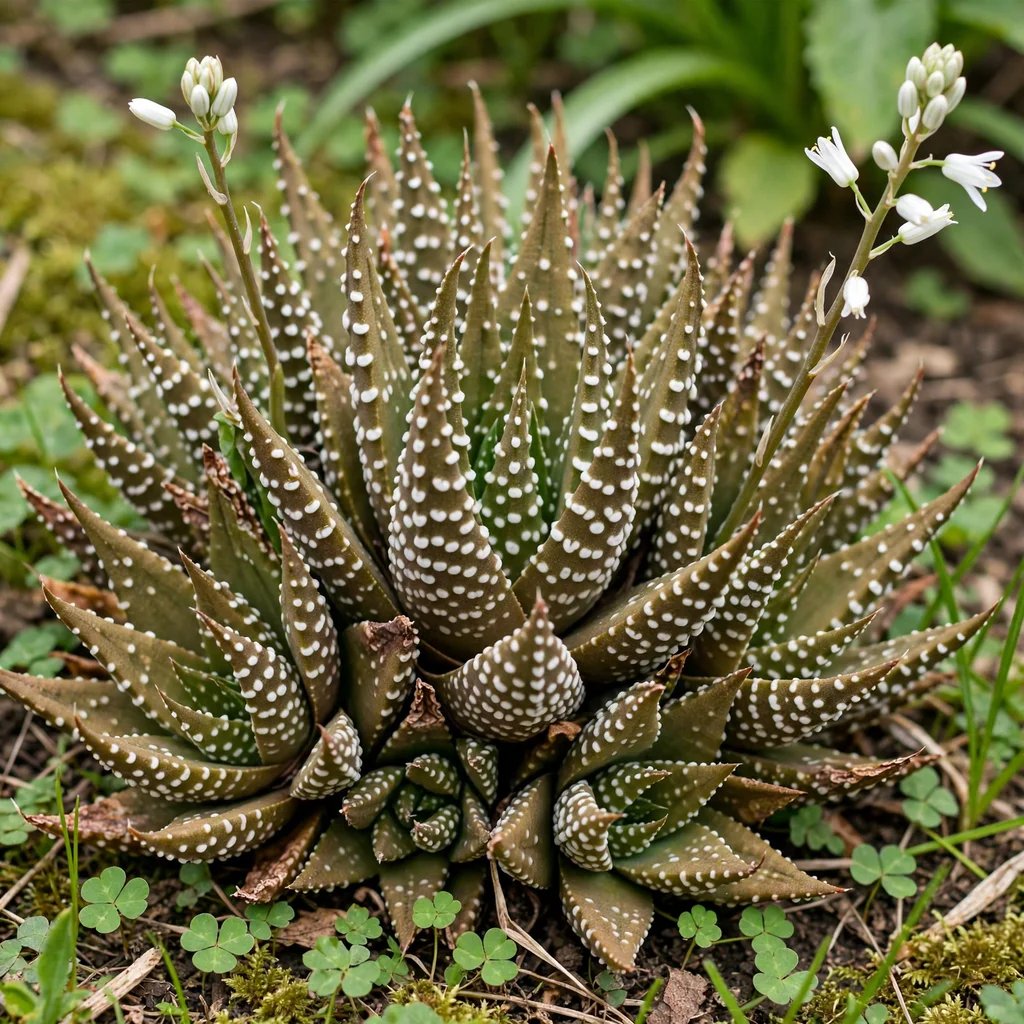
Haworthia margaritifera, accepted as Tulista pumila, is a stemless slow-growing succulent from the winter-rainfall Karoo of South Africa's Western Cape, forming an erect to spreading rosette 6 to 10 inches tall and wide. The thick pointed olive-green to brownish leaves store water and bear raised rounded white tubercles that stay separate and pearl-like across the leaf surface.
Unlike banded zebra-type Haworthiopsis, this species carries discrete round white pearls dotted over the leaves rather than transverse white bars. Mature rosettes offset sparingly to form small clusters and send up a thin 16-inch spike of waxy tubular brownish-white to pink-white flowers in summer.
Uses & Benefits:
Essentials
At a Glance
Plant Type
Cactus Succulent
Height
10"
Width
6"
Light
Full Sun, Partial Sun
Zones
9, 10
Water
Low
Humidity
Moderate, 65-80F indoors
Lifespan
Long-lived perennial
Native To
South Africa, Western Cape
Toxicity
Unknown; possible mild stomach upset if ingested
Bloom period
Early summer – Summer
In flower about 3 months of the year
Planting
How to Grow
- Set in the brightest window available with filtered sun, outdoors only in zones 9-11.
- Pot in a very porous cactus-succulent mix in a pot with a drainage hole, keeping the crown at soil level.
- Water deeply only when the surface is dry, then let the mix dry completely before watering again.
- Feed lightly with diluted succulent fertilizer in spring and summer only, withholding in fall and winter.
- Keep above 28F, with 65-80F indoors ideal, and empty saucers so the pot never stands in water.
Pro Tip
Let the mix dry right through between waterings and hold it in bright filtered light; it takes full sun once acclimated but rots fast in wet soil.
Keep It Thriving
Care Guide
Do
- Give bright indirect to filtered light with good air flow.
- Use a gritty, fast-draining mix and a pot that empties fully.
- Remove only the spent flower spike at the base.
Don't
- Do not overwater or leave water sitting in the rosette.
- Do not cut leaves from the rosette to shape it.
- Do not repot into dense garden soil or a pot without drainage.
Seasonal Care Calendar
| Task | Jan | Feb | Mar | Apr | May | Jun | Jul | Aug | Sep | Oct | Nov | Dec |
|---|---|---|---|---|---|---|---|---|---|---|---|---|
| Fertilize | ||||||||||||
| Pest Check | ||||||||||||
| Propagate | ||||||||||||
| Prune |
Watch Out For
Pests & Diseases
Common Pests
Common Diseases
In the Garden
Landscape Uses & Companions
Landscape Uses
Companion Plants
Multiply
Propagation Methods
Good to Know
Common Questions
Pearl Plant questions
What zones can Pearl Plant grow in?
Pearl Plant is hardy in USDA Zones 9–10: in that range it survives winter in the ground. Colder than Zone 9, grow it in a container you can move to shelter for the winter, or as an annual.
When does Pearl Plant bloom?
Pearl Plant typically blooms in summer. Exact timing shifts a week or two with your zone — Sow's bloom calendar maps it to your garden.
Does Pearl Plant need full sun?
Pearl Plant does best in full sun to part shade. In hot climates, afternoon shade keeps blooms fresher longer.
Is Pearl Plant drought tolerant?
Yes — once established (usually after the first full season), Pearl Plant handles dry spells with minimal watering. Water deeply its first year to build the root system that makes that possible.
More Haworthia to compare
Keep exploring
Explore the genus
Hardy in your zone?
Grow Pearl Plant with confidence
See it in a design of your actual yard, get zone-matched care reminders, and track it season by season in your garden journal.