The Story
Plant Bio
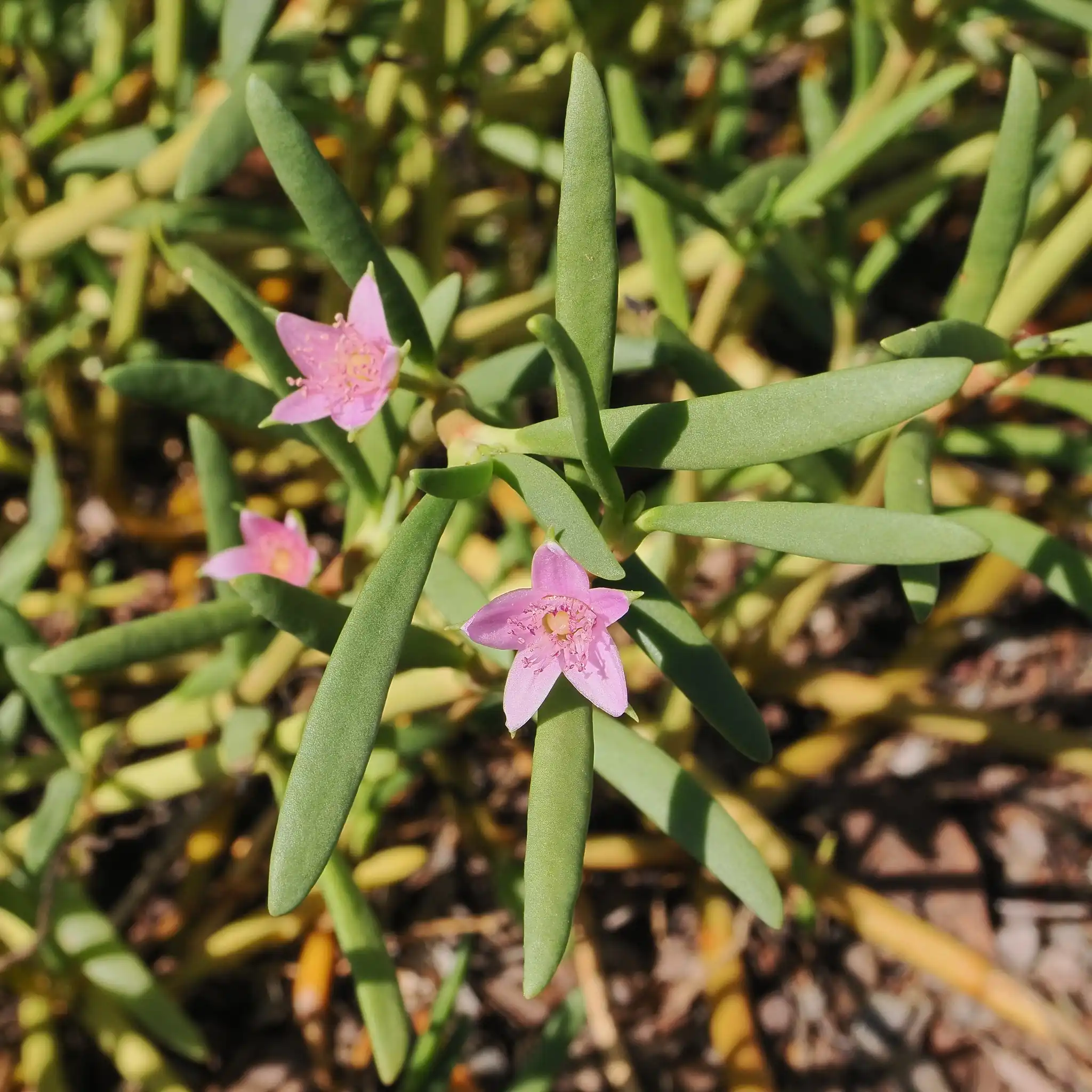
Sesuvium portulacastrum is a spreading prostrate succulent perennial that roots at the nodes to form mats to four feet wide and about a foot tall. The smooth fleshy leaves are glossy green and linear to lanceolate, one to seven centimeters long, turning red to yellow with maturity while new growth stays reddish-green.
It differs from garden purslanes by tolerating direct salt spray, seawater flooding and sand burial on dunes and mangrove edges where most groundcovers drown or desiccate. The small solitary pink to purple starry flowers sit in the leaf axils on short stalks and open in all seasons where frost does not intervene.
Uses & Benefits:
Essentials
At a Glance
Plant Type
Groundcover
Height
12"
Width
48"
Light
Full Sun, Partial Sun
Zones
9, 10
Water
Low
Humidity
Tolerant
Lifespan
Perennial
Native To
Southeastern U.S., Gulf Coast, Hawaii
Toxicity
Non-toxic
Bloom period
Year round
In flower about 12 months of the year
Planting
How to Grow
- Plant in full sun in sandy, well-drained soil after all frost danger has passed.
- Space plugs 18 to 24 inches apart to allow stems to root at the nodes and knit.
- Water to settle in, then withhold irrigation except in prolonged drought.
- Do not fertilize; lean sand keeps growth compact and salt-tolerant.
- Cut back wandering stems in spring if they overrun paths.
Pro Tip
Treat it as a seaside dune stabilizer, not a bedding plant; excess fertilizer and water in cool, moist shade bring snails and rot.
Keep It Thriving
Care Guide
Do
- Plant in full sun with sharp sand drainage
- Allow stems to root at nodes to stabilize soil
- Wash leaves and boil to remove salt if eating
Don't
- Do not overwater or fertilize to force growth
- Do not plant in cool wet shade
- Do not expect hardiness below zone 9
Seasonal Care Calendar
| Task | Jan | Feb | Mar | Apr | May | Jun | Jul | Aug | Sep | Oct | Nov | Dec |
|---|---|---|---|---|---|---|---|---|---|---|---|---|
| Pest Check | ||||||||||||
| Plant | ||||||||||||
| Propagate | ||||||||||||
| Prune |
Watch Out For
Pests & Diseases
Common Pests
Common Diseases
In the Garden
Landscape Uses & Companions
Landscape Uses
Multiply
Propagation Methods
Good to Know
Common Questions
Shoreline Seapurslane questions
What zones can Shoreline Seapurslane grow in?
Shoreline Seapurslane is hardy in USDA Zones 9–10: in that range it survives winter in the ground. Colder than Zone 9, grow it in a container you can move to shelter for the winter, or as an annual.
When does Shoreline Seapurslane bloom?
Shoreline Seapurslane typically blooms year-round. Exact timing shifts a week or two with your zone — Sow's bloom calendar maps it to your garden.
Does Shoreline Seapurslane need full sun?
Shoreline Seapurslane does best in full sun to part shade. In hot climates, afternoon shade keeps blooms fresher longer.
Is Shoreline Seapurslane drought tolerant?
Yes — once established (usually after the first full season), Shoreline Seapurslane handles dry spells with minimal watering. Water deeply its first year to build the root system that makes that possible.
Keep exploring
Explore the genus
Hardy in your zone?
Grow Shoreline Seapurslane with confidence
See it in a design of your actual yard, get zone-matched care reminders, and track it season by season in your garden journal.