The Story
Plant Bio
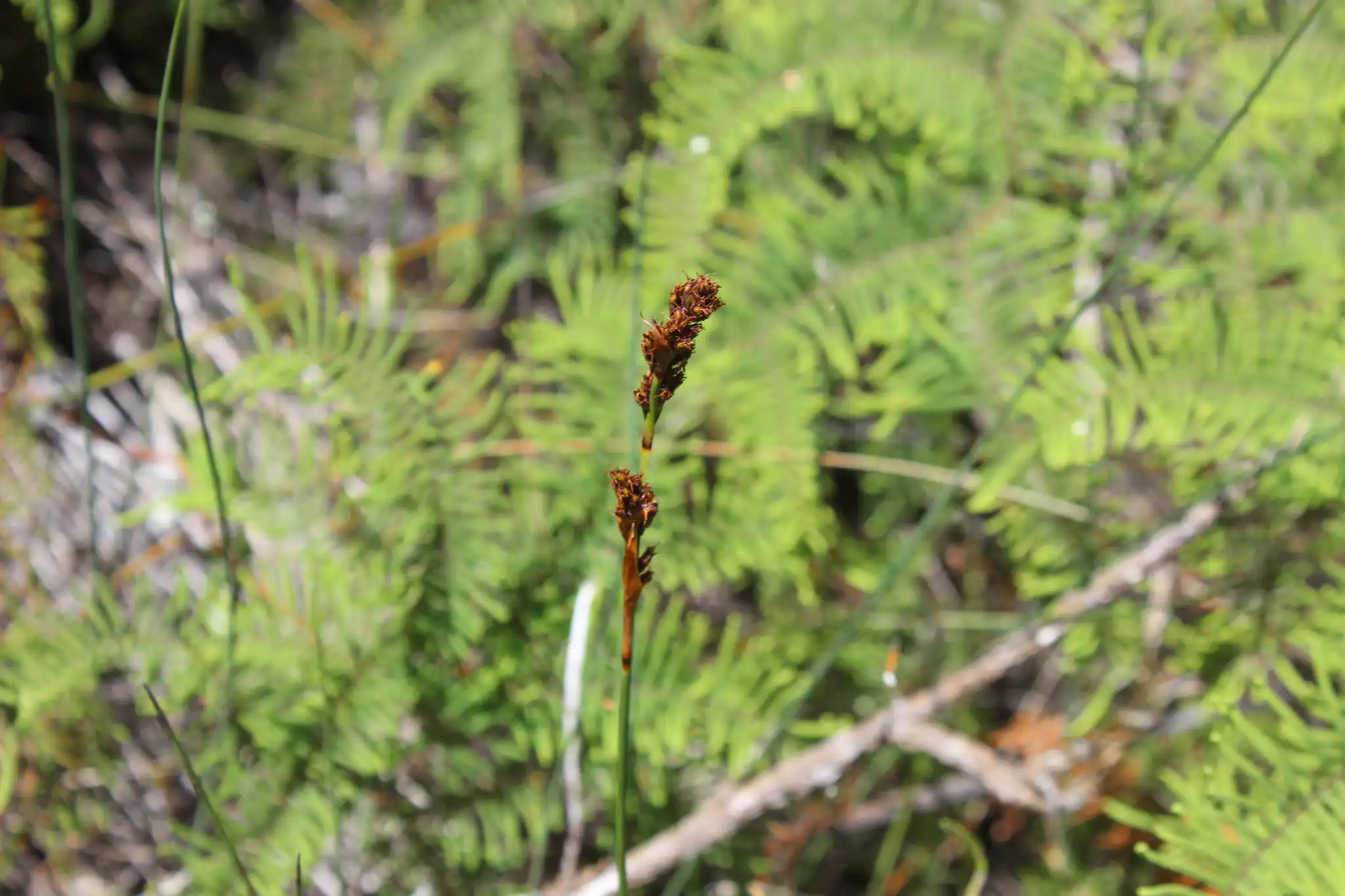
Machaerina rubiginosa is a rhizomatous perennial sedge that forms dense basal clumps and spreads by short stout rhizomes and long stolons into colonies. Rigid erect culms reach 20 to 43 inches, with flattened basal blades 1.5 to 7 mm wide that often overtop the culms and a narrow interrupted panicle of red-brown spikelets.
It holds with its crown base saturated, tolerating 1 to 6 inches of standing water over the crown in sand, loam or clay acid soil below pH 6.0. Fertile glumes ripen red-brown with pale red-brown to bright orange nuts, and the narrow 7 to 25 cm panicle carries dense clusters of 2 to 3-flowered spikelets.
Uses & Benefits:
Essentials
At a Glance
Plant Type
Perennial
Height
30"
Width
18"
Light
Full Sun, Partial Sun
Zones
7, 8, 9, 10
Water
High - moist to standing water
Humidity
Tolerant of high humidity
Lifespan
Long-lived perennial
Native To
Asia-Pacific, Australia and New Zealand
Toxicity
Unknown - no toxicity reported
Bloom period
Fall
In flower about 3 months of the year
Planting
How to Grow
- Plant in spring after frost in full sun to partial shade in acid sand, loam or clay.
- Set the crown at or just below the saturated zone, with 1 to 6 inches of water over the crown for pond or bog planting.
- Space divisions to allow colony spread and top with mulch to hold moisture.
- Water to keep the base constantly moist; once rooted it tolerates brief dry spells in free-draining soil.
- Remove dried stems once yearly in late winter and do not cut hard into live crowns.
Pro Tip
Set the crown base saturated in acid soil in full sun; dry alkaline soil or shade turns blades faded and floppy.
Keep It Thriving
Care Guide
Do
- Grow in full sun in constantly moist to saturated acid soil.
- Hold pond pots with 1 to 6 inches of water over the crown.
- Remove dried stems once yearly in late winter.
Don't
- Do not plant dry, alkaline or deeply shaded.
- Do not cut hard annually into live crowns like Lomandra.
- Do not let new divisions dry out before rooted.
Seasonal Care Calendar
| Task | Jan | Feb | Mar | Apr | May | Jun | Jul | Aug | Sep | Oct | Nov | Dec |
|---|---|---|---|---|---|---|---|---|---|---|---|---|
| Divide | ||||||||||||
| Pest Check | ||||||||||||
| Plant | ||||||||||||
| Propagate | ||||||||||||
| Prune |
Watch Out For
Pests & Diseases
Common Pests
Common Diseases
In the Garden
Landscape Uses & Companions
Landscape Uses
Multiply
Propagation Methods
Good to Know
Common Questions
Soft Twig Rush questions
What zones can Soft Twig Rush grow in?
Soft Twig Rush is hardy in USDA Zones 7–10: in that range it survives winter in the ground. Colder than Zone 7, grow it in a container you can move to shelter for the winter, or as an annual.
When does Soft Twig Rush bloom?
Soft Twig Rush typically blooms in fall. Exact timing shifts a week or two with your zone — Sow's bloom calendar maps it to your garden.
Does Soft Twig Rush need full sun?
Soft Twig Rush does best in full sun to part shade. In hot climates, afternoon shade keeps blooms fresher longer.
More Machaerina to compare
Keep exploring
Explore the genus
Hardy in your zone?
Grow Soft Twig Rush with confidence
See it in a design of your actual yard, get zone-matched care reminders, and track it season by season in your garden journal.