The Story
Plant Bio
Mansoa alliacea is an evergreen semi-woody liana from humid Neotropical forest, climbing by tendrils from opposite bifoliate leaves on quadrangular young stems. The leaves are paired ovate leaflets 4 to 8 inches long with a leathery glossy surface that release a strong garlic odor when crushed.
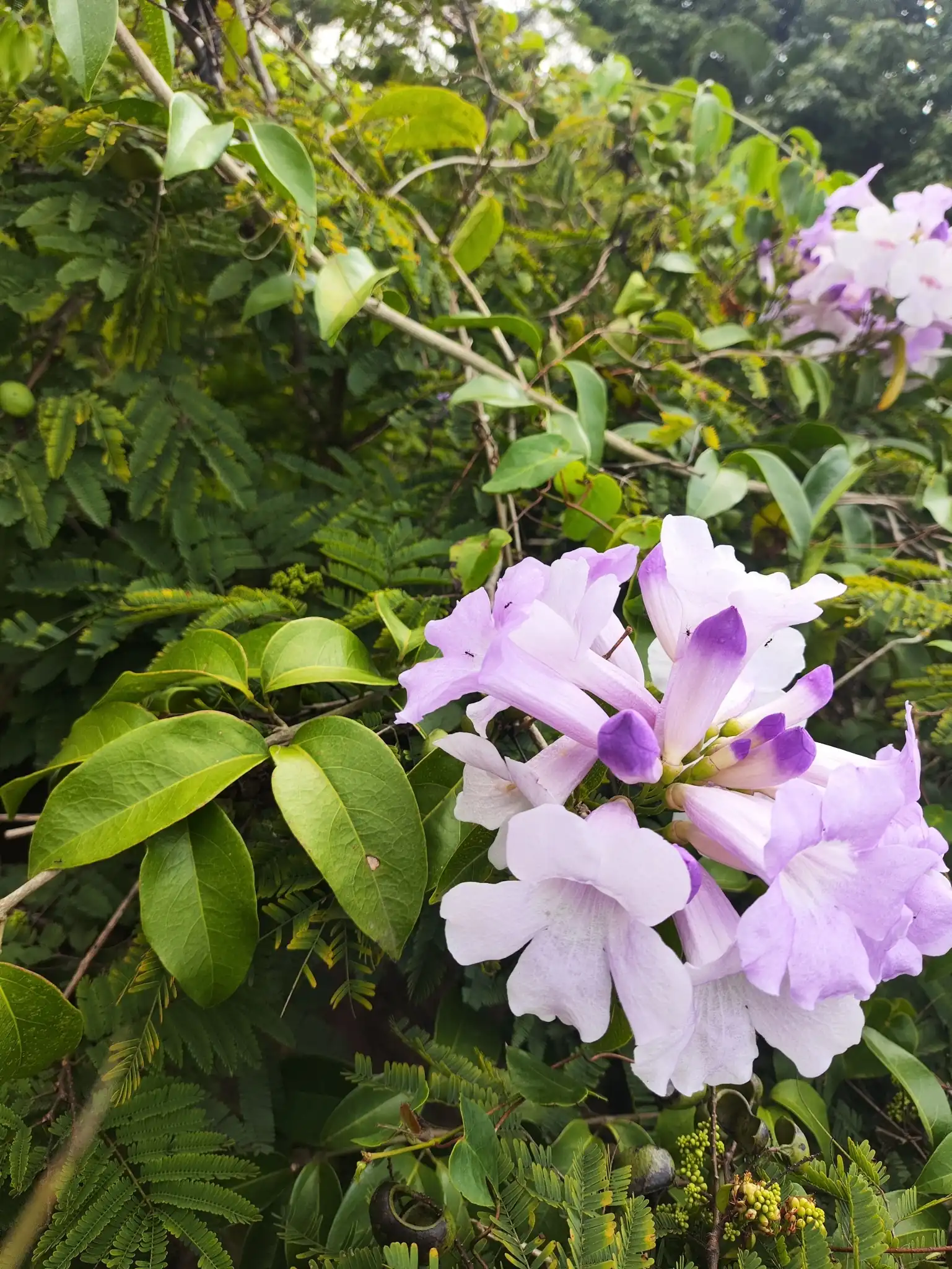
Flowers are borne in axillary and terminal panicles of funnel-shaped trumpets 2.5 to 3.5 inches long, opening deep lavender-purple with a white throat and fading through pink to near-white so three colors show together. True plants are separated from the look-alike sold as Cydista aequinoctialis because crushed leaves smell strongly of garlic while the flowers themselves are almost unscented except at close range.
Uses & Benefits:
Essentials
At a Glance
Plant Type
Vine
Height
120"
Width
180"
Light
Full Sun, Partial Sun
Zones
9, 10
Water
Moderate
Humidity
High
Lifespan
Long-lived evergreen vine
Native To
Tropical America
Toxicity
Unknown
Bloom period
Winter – Spring
In flower about 6 months of the year
Planting
How to Grow
- Plant out after last frost in full sun to light shade in well-drained organic-rich mix, giving a sturdy trellis or fence for support.
- Train new growth onto the support and keep container plants under 3 feet by light trimming; mature garden vines reach 8 to 10 feet and sprawl wider if unchecked.
- Water moderately through growth, letting the surface dry between waterings, then reduce water in winter; it tolerates short dry spells once established.
- Feed monthly from spring to early fall with balanced water-soluble fertilizer plus micronutrients at half label rate.
- Move pots indoors before freezing and hold above 57F at night in bright light; protect young outdoor plants from any freeze.
Pro Tip
Prune lightly right after each flush and train new shoots to the trellis; cutting hard into old wood removes buds set on new growth and leaves the vine flowerless.
Keep It Thriving
Care Guide
Do
- Grow in full sun for heaviest bloom
- Provide a trellis, fence or hoop and tie in new shoots
- Let the soil surface dry between waterings
- Feed monthly in the growing season at half rate
Don't
- Do not hard-prune or shear routinely; trim only after flowering
- Do not let pots sit waterlogged
- Do not leave young plants exposed below 30F
Seasonal Care Calendar
| Task | Jan | Feb | Mar | Apr | May | Jun | Jul | Aug | Sep | Oct | Nov | Dec |
|---|---|---|---|---|---|---|---|---|---|---|---|---|
| Fertilize | ||||||||||||
| Pest Check | ||||||||||||
| Plant | ||||||||||||
| Prune | ||||||||||||
| Winter Prep |
Watch Out For
Pests & Diseases
Common Pests
Common Diseases
In the Garden
Landscape Uses & Companions
Landscape Uses
Multiply
Propagation Methods
Good to Know
Common Questions
Garlic Vine questions
What zones can Garlic Vine grow in?
Garlic Vine is hardy in USDA Zones 9–10: in that range it survives winter in the ground. Colder than Zone 9, grow it in a container you can move to shelter for the winter, or as an annual.
When does Garlic Vine bloom?
Garlic Vine typically blooms from winter to spring. Exact timing shifts a week or two with your zone — Sow's bloom calendar maps it to your garden.
Does Garlic Vine need full sun?
Garlic Vine does best in full sun to part shade. In hot climates, afternoon shade keeps blooms fresher longer.
Is Garlic Vine drought tolerant?
Yes — once established (usually after the first full season), Garlic Vine handles dry spells with minimal watering. Water deeply its first year to build the root system that makes that possible.
Keep exploring
Explore the genus
Hardy in your zone?
Grow Garlic Vine with confidence
See it in a design of your actual yard, get zone-matched care reminders, and track it season by season in your garden journal.