The Story
Plant Bio
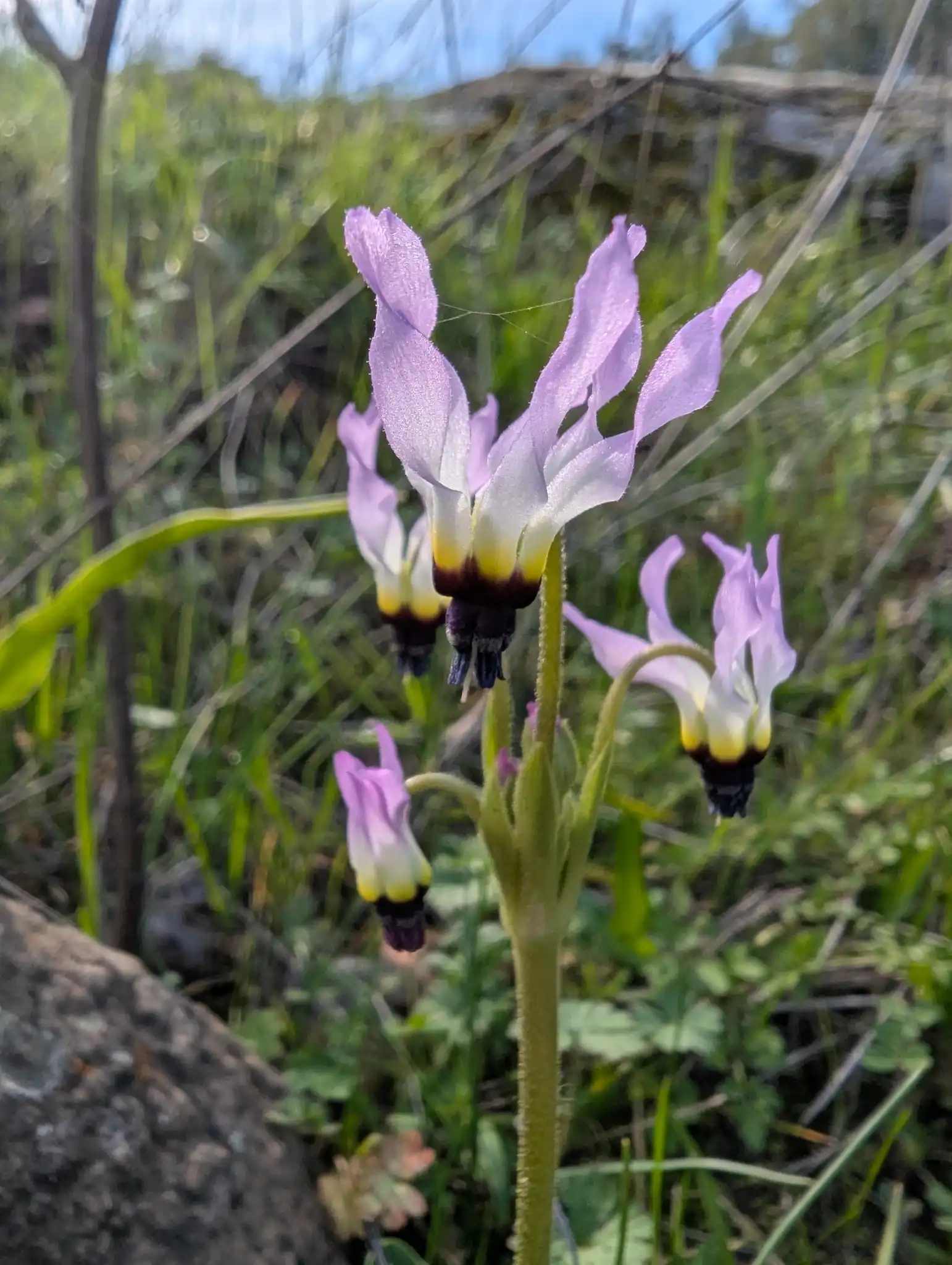
Primula clevelandii, still sold as Dodecatheon clevelandii, is a colony-forming spring-deciduous perennial that forms a basal rosette of broad light-green leaves and sends up leafless scapes to 16 inches tall. Plants emerge with fall rain, bloom in spring, then die back to the underground rootstock and remain dormant through summer.
This species bears an umbel of 2 to 16 nodding flowers with four to five swept-back petals about 1 inch long in magenta to deep lavender to white with a yellow tube and purple-spotted throat. The dark stamens join into a pointed beak in the flower center, and the clump stays about 6 inches wide.
Uses & Benefits:
Essentials
At a Glance
Plant Type
Perennial
Height
16"
Width
6"
Light
Full Sun, Partial Sun
Zones
6, 7, 8, 9
Water
Medium in growth, dry in summer
Humidity
Low
Lifespan
Perennial
Native To
California and Baja California
Toxicity
Possibly mildly toxic if ingested
Bloom period
Early spring – Late spring
In flower about 3 months of the year
Planting
How to Grow
- Plant dormant rootstock in fall about 1 inch deep in sandy, loam or clay soil that drains in winter.
- Give full sun near the coast and partial sun with afternoon shade inland.
- Water to keep soil evenly moist from emergence through bloom in spring.
- Withhold all water once foliage yellows and keep the patch dry all summer.
- Mark the spot so the dormant crown is not dug, divided or replanted in summer.
Pro Tip
Leave the dormant patch bone-dry and completely undisturbed through summer; watering, fertilizing or digging while the plant is invisible rots the crown.
Keep It Thriving
Care Guide
Do
- Keep soil moist from fall emergence through spring bloom
- Give afternoon shade in hot inland plantings
- Mark dormant crowns to prevent accidental digging
Don't
- Do not water during summer dormancy
- Do not dig, move or divide the crown while it is dormant in summer
- Do not plant where summer irrigation keeps soil wet
Seasonal Care Calendar
| Task | Jan | Feb | Mar | Apr | May | Jun | Jul | Aug | Sep | Oct | Nov | Dec |
|---|---|---|---|---|---|---|---|---|---|---|---|---|
| Divide | ||||||||||||
| Pest Check | ||||||||||||
| Plant | ||||||||||||
| Propagate |
Watch Out For
Pests & Diseases
Common Pests
Common Diseases
In the Garden
Landscape Uses & Companions
Landscape Uses
Multiply
Propagation Methods
Good to Know
Common Questions
Padre's Shooting Star questions
What zones can Padre's Shooting Star grow in?
Padre's Shooting Star is hardy in USDA Zones 6–9: in that range it survives winter in the ground. Colder than Zone 6, grow it in a container you can move to shelter for the winter, or as an annual. Warmer than Zone 9, winter isn't the problem: it prefers colder winters, and summer heat can shorten its life.
When does Padre's Shooting Star bloom?
Padre's Shooting Star typically blooms in spring. Exact timing shifts a week or two with your zone — Sow's bloom calendar maps it to your garden.
Does Padre's Shooting Star need full sun?
Padre's Shooting Star does best in full sun to part shade. In hot climates, afternoon shade keeps blooms fresher longer.
Is Padre's Shooting Star drought tolerant?
Yes — once established (usually after the first full season), Padre's Shooting Star handles dry spells with minimal watering. Water deeply its first year to build the root system that makes that possible.
More Dodecatheon to compare
Keep exploring
Explore the genus
Hardy in your zone?
Grow Padre's Shooting Star with confidence
See it in a design of your actual yard, get zone-matched care reminders, and track it season by season in your garden journal.