The Story
Plant Bio
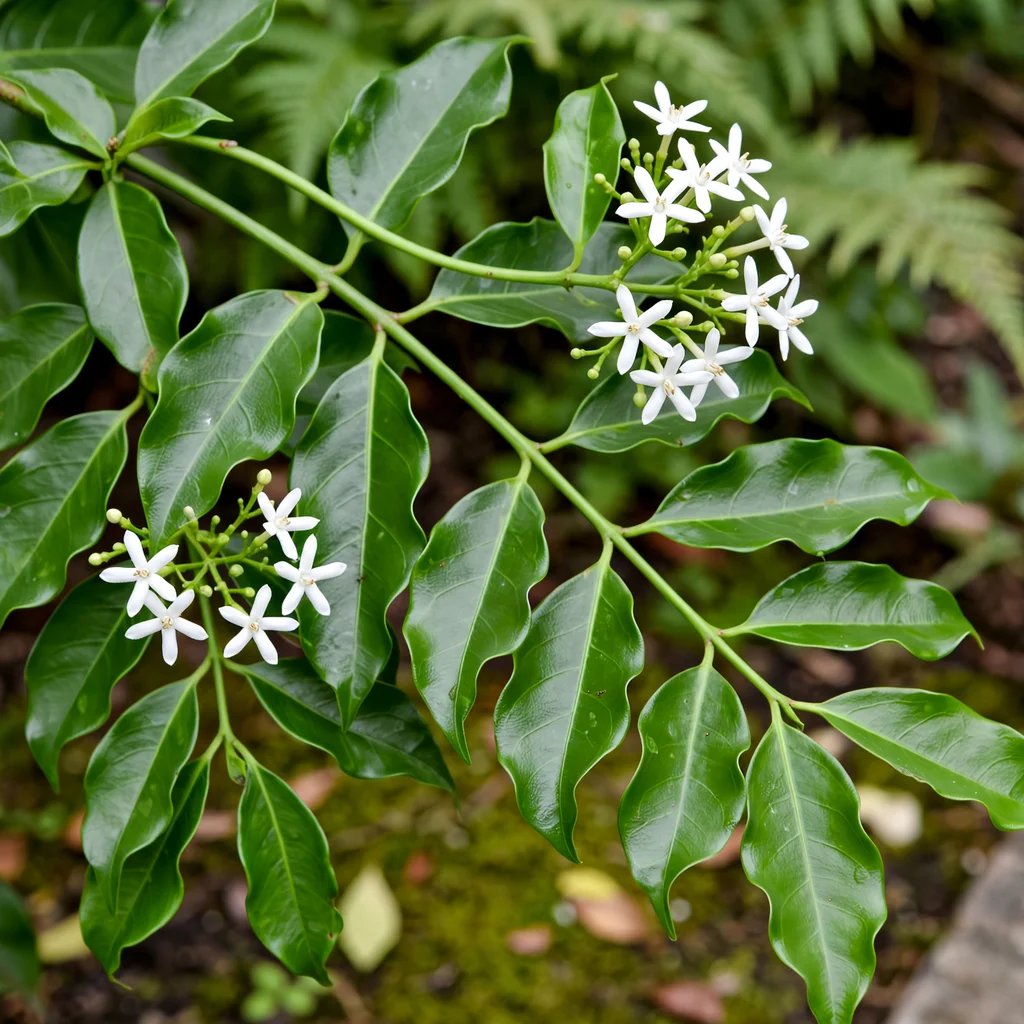
Vallaris glabra is an evergreen woody climber from lowland Indonesia that reaches 7 to 10 feet as a pruned garden plant and to 20 feet unpruned in the tropics, with opposite glossy green elliptic leaves with wavy margins. The white to creamy-white flowers are 1 to 1.5 cm cups of five pointed overlapping petals, borne in 3- to 6-flowered cymes near the branch tips.
It is grown for its strong pandan or cooked-rice scent, which opens in the morning and peaks in the evening and carries from small flowers that are easily missed at midday. Flowering depends on 4 to 6 hours of full sun; shaded plants grow but set few flowers, and all parts exude milky latex that irritates skin and is toxic if eaten.
Uses & Benefits:
Essentials
At a Glance
Plant Type
Vine
Height
120"
Width
120"
Light
Full Sun, Partial Sun
Zones
9, 10
Water
Moderate, evenly moist
Humidity
High, heat-loving
Lifespan
Long-lived woody vine
Native To
Indonesia - Sumatra, Java, Flores
Toxicity
Toxic if ingested, skin irritant
Bloom period
Summer – Autumn
In flower about 6 months of the year
Planting
How to Grow
- Plant in full sun in fertile, organic-rich, well-drained soil after all frost danger has passed.
- Provide a sturdy trellis, pergola or large container and tie young shoots until they twine and hold.
- Water regularly to keep soil evenly moist and mulch with compost; do not waterlog.
- Prune lightly after flowering to shape, or cut shrub forms back to 36 to 48 inches to force branching and flowers.
- Move potted plants indoors to a bright frost-free spot before first fall frost.
Pro Tip
Give it 4 to 6 hours of full sun or it will climb without flowering; smell the flowers in the evening when the pandan-rice scent peaks, and wear gloves when pruning for the milky sap.
Keep It Thriving
Care Guide
Do
- Do site in 4 to 6 hours of full sun for flowering.
- Do mulch with compost and keep soil moist but drained.
- Do train, tie and prune regularly while young.
- Do wear gloves when pruning because of milky sap.
Don't
- Do not grow in shade and expect flowers.
- Do not overwater or leave pots standing in saucers.
- Do not let pets or children chew leaves or stems.
Seasonal Care Calendar
| Task | Jan | Feb | Mar | Apr | May | Jun | Jul | Aug | Sep | Oct | Nov | Dec |
|---|---|---|---|---|---|---|---|---|---|---|---|---|
| Fertilize | ||||||||||||
| Pest Check | ||||||||||||
| Prune | ||||||||||||
| Stake | ||||||||||||
| Winter Prep |
Watch Out For
Pests & Diseases
Common Pests
Common Diseases
In the Garden
Landscape Uses & Companions
Landscape Uses
Multiply
Propagation Methods
Good to Know
Common Questions
Bread Flower questions
What zones can Bread Flower grow in?
Bread Flower is hardy in USDA Zones 9–10: in that range it survives winter in the ground. Colder than Zone 9, grow it in a container you can move to shelter for the winter, or as an annual.
When does Bread Flower bloom?
Bread Flower typically blooms from summer to fall. Exact timing shifts a week or two with your zone — Sow's bloom calendar maps it to your garden.
Does Bread Flower need full sun?
Bread Flower does best in full sun to part shade. In hot climates, afternoon shade keeps blooms fresher longer.
Keep exploring
Explore the genus
Hardy in your zone?
Grow Bread Flower with confidence
See it in a design of your actual yard, get zone-matched care reminders, and track it season by season in your garden journal.