The Story
Plant Bio
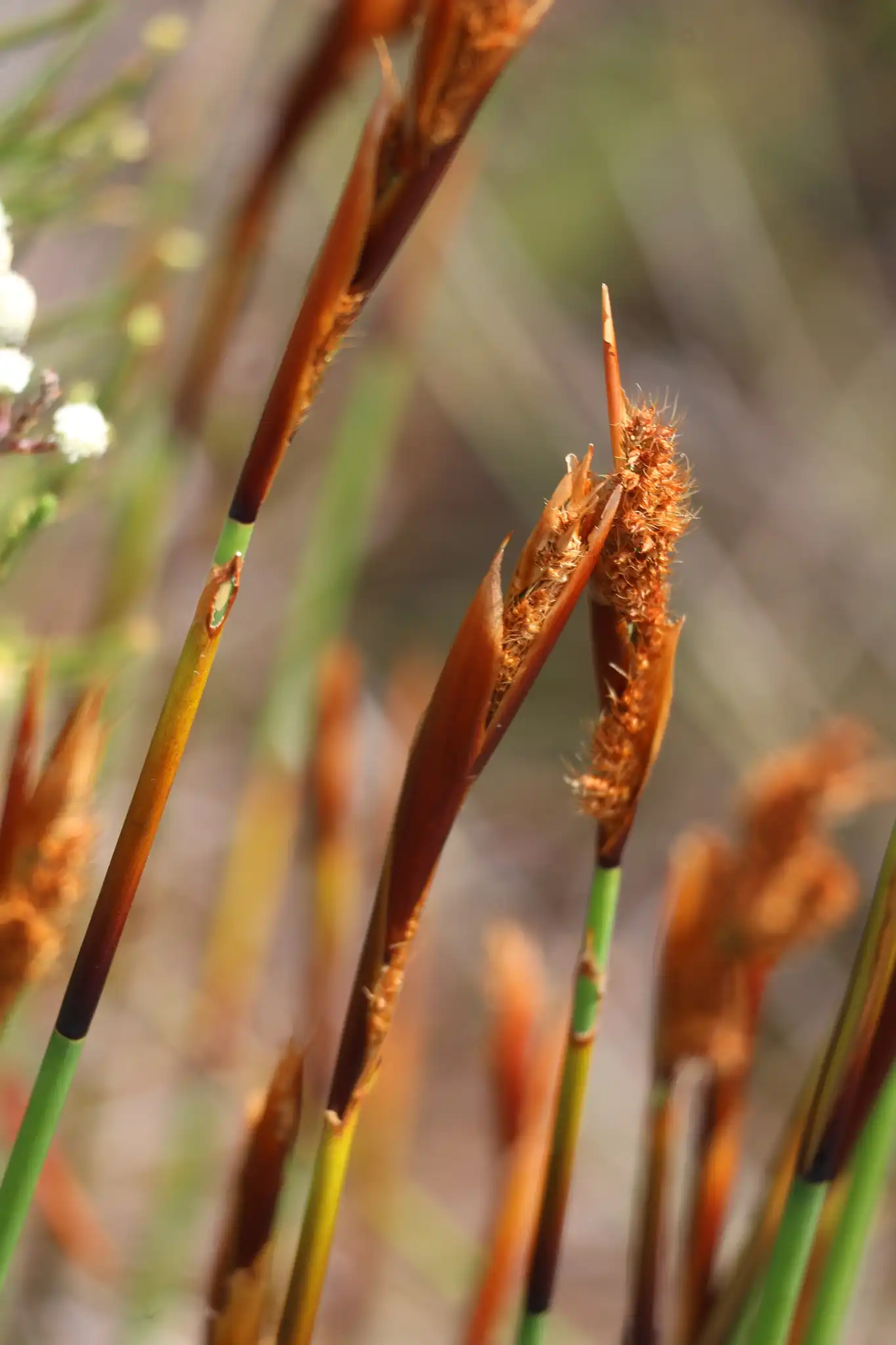
Elegia cuspidata is a dioecious, tufted restio forming a tight clump of sturdy, unbranched green culms to six feet in gardens. Dark green stems carry chestnut-brown sheaths at the nodes that splay and drop with age, leaving a clean abscission ring.
This species is distinguished by dense brush-like heads of dark brown to near-black bracts with long points, male plants shedding clouds of wind-borne pollen and female plants showing white fluffy styles. It stays neatly clumped without spreading rhizomes and tolerates winter flooding in acidic sand, then summer drought once established.
Uses & Benefits:
Essentials
At a Glance
Plant Type
Perennial
Height
79"
Width
79"
Light
Full Sun
Zones
8, 9, 10
Water
Moderate, tolerates winter wet
Humidity
Low to moderate with good air flow
Lifespan
Perennial, renew clump after ~5 years
Native To
Western Cape, South Africa
Toxicity
Unknown - no toxicity reported
Bloom period
Summer – Fall
In flower about 6 months of the year
Planting
How to Grow
- Plant divisions in spring in full sun in acidic sandy soil that drains freely but holds winter moisture.
- Water deeply through the first year to establish, then reduce; allow seasonal winter wet but no stagnant summer water.
- Feed sparingly with slow-release fertilizer at planting and a light organic top-dress each spring.
- Cut dead culms to the base in spring and leave all green culms untouched.
- Lift and replace crowded clumps after about five years when the center turns untidy.
Pro Tip
Give it full sun all day with open wind and air; cut only dead culms at the base in spring and never shorten green culms.
Keep It Thriving
Care Guide
Do
- Do plant in full sun with open wind and air circulation.
- Do water deeply the first year, then allow winter wet and summer drying.
- Do feed sparingly with low-dose slow-release fertilizer.
Don't
- Do not shade or crowd; weak yellow spindly growth follows.
- Do not cut green culms shorter; remove only dead stems at the base.
- Do not overfertilize or keep the crown wet through summer.
Seasonal Care Calendar
| Task | Jan | Feb | Mar | Apr | May | Jun | Jul | Aug | Sep | Oct | Nov | Dec |
|---|---|---|---|---|---|---|---|---|---|---|---|---|
| Fertilize | ||||||||||||
| Mulch | ||||||||||||
| Plant | ||||||||||||
| Propagate | ||||||||||||
| Prune |
Watch Out For
Pests & Diseases
Common Pests
Common Diseases
In the Garden
Landscape Uses & Companions
Landscape Uses
Companion Plants
Multiply
Propagation Methods
Good to Know
Common Questions
Horsetail Restio questions
What zones can Horsetail Restio grow in?
Horsetail Restio is hardy in USDA Zones 8–10: in that range it survives winter in the ground. Colder than Zone 8, grow it in a container you can move to shelter for the winter, or as an annual.
When does Horsetail Restio bloom?
Horsetail Restio typically blooms from summer to fall. Exact timing shifts a week or two with your zone — Sow's bloom calendar maps it to your garden.
Does Horsetail Restio need full sun?
Horsetail Restio does best in full sun (6+ hours).
Is Horsetail Restio drought tolerant?
Yes — once established (usually after the first full season), Horsetail Restio handles dry spells with minimal watering. Water deeply its first year to build the root system that makes that possible.
More Elegia to compare
Keep exploring
Explore the genus
Hardy in your zone?
Grow Horsetail Restio with confidence
See it in a design of your actual yard, get zone-matched care reminders, and track it season by season in your garden journal.