The Story
Plant Bio
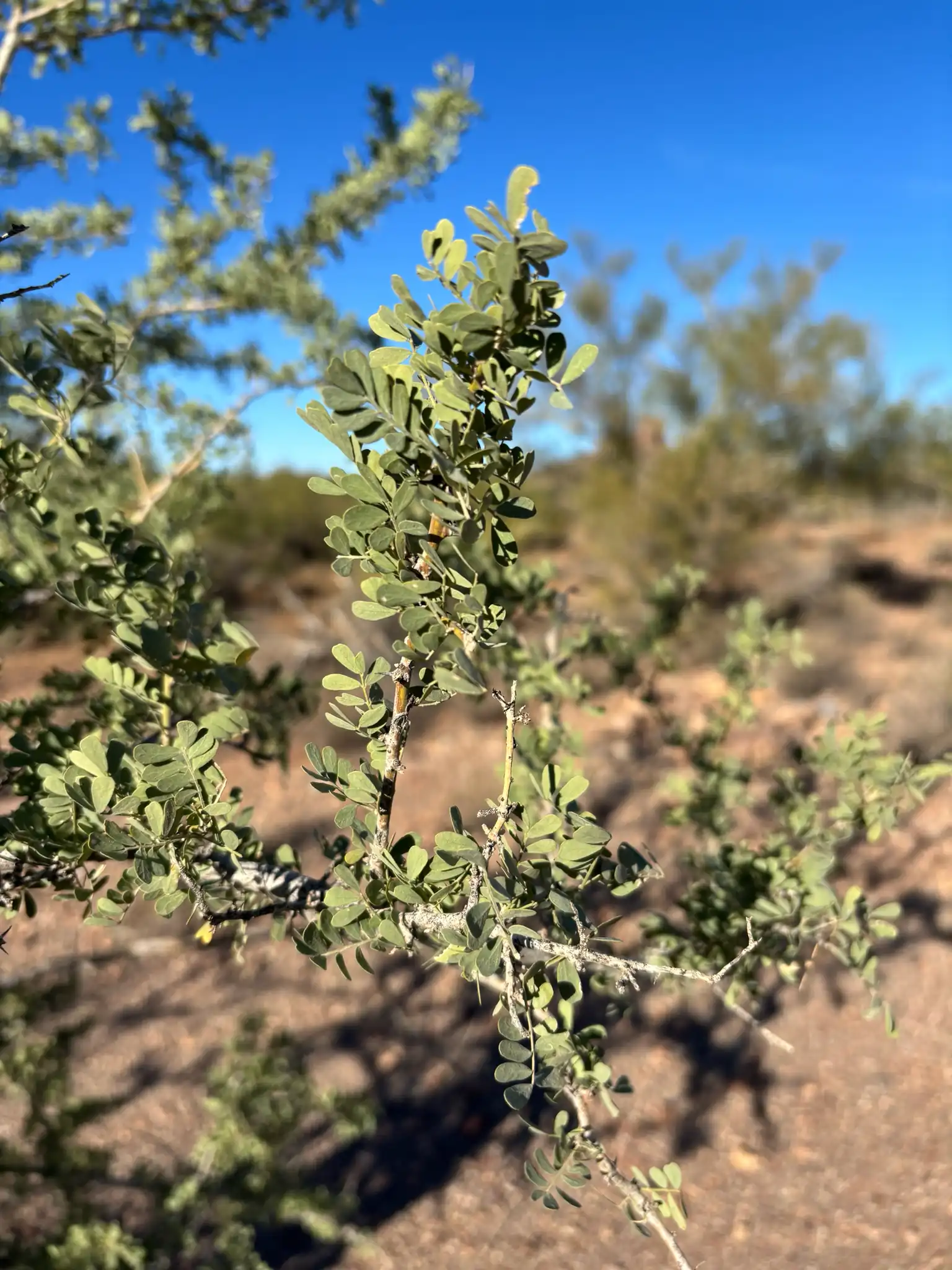
Olneya tesota is an evergreen to semi-deciduous desert tree native to southwestern North America, developing a broad, rounded canopy with sharp paired thorns along the branches. In late spring, pale purple to rose-purple pea-like flowers bloom in clusters alongside fine-haired, bluish-green foliage.
The dense canopy serves as an essential nurse plant in desert ecosystems, sheltering tender young flora and wildlife from extreme sun. As a nitrogen-fixing legume, it thrives in nutrient-poor mineral soils without supplementary feeding.
Uses & Benefits:
Essentials
At a Glance
Plant Type
Tree
Height
300"
Width
300"
Light
Full Sun
Zones
9, 10
Water
Low
Humidity
Low
Lifespan
Perennial
Native To
Southwestern North America
Toxicity
Non-toxic
Bloom period
Late spring – Early summer
In flower about 2 months of the year
Planting
How to Grow
- Select a planting site in full sun with sharp, fast-draining gravelly or sandy soil.
- Dig a hole twice as wide as the root ball but no deeper, keeping the root crown level with the surrounding soil.
- Backfill with unamended native soil to ensure uniform drainage around the root system.
- Water deeply at planting, then allow the soil to dry completely between initial waterings.
- Taper irrigation off once the tree is established, relying entirely on natural rainfall.
Pro Tip
Never prune hard into old, leafless wood, as mature branches lack latent buds and fail to resprout.
Keep It Thriving
Care Guide
Do
- Plant strictly in coarse, deep, unamended mineral soils.
- Provide intense full sun and ambient heat.
- Prune thorny lower growth carefully if near high-traffic paths.
Don't
- Do not amend the planting hole with rich organic compost or peat.
- Do not overwater or irrigate during warm summer months.
- Do not cut back into bare, mature wood when pruning.
Seasonal Care Calendar
| Task | Jan | Feb | Mar | Apr | May | Jun | Jul | Aug | Sep | Oct | Nov | Dec |
|---|---|---|---|---|---|---|---|---|---|---|---|---|
| Pest Check | ||||||||||||
| Propagate | ||||||||||||
| Prune | ||||||||||||
| Spring Cleanup |
Watch Out For
Pests & Diseases
Common Pests
Common Diseases
In the Garden
Landscape Uses & Companions
Landscape Uses
Multiply
Propagation Methods
Good to Know
Common Questions
Desert Ironwood questions
What zones can Desert Ironwood grow in?
Desert Ironwood is hardy in USDA Zones 9–10: in that range it survives winter in the ground. Colder than Zone 9, winters are too cold for it to survive outdoors.
When does Desert Ironwood bloom?
Desert Ironwood typically blooms from late spring to early summer. Exact timing shifts a week or two with your zone — Sow's bloom calendar maps it to your garden.
Does Desert Ironwood need full sun?
Desert Ironwood does best in full sun (6+ hours).
Is Desert Ironwood drought tolerant?
Yes — once established (usually after the first full season), Desert Ironwood handles dry spells with minimal watering. Water deeply its first year to build the root system that makes that possible.
Keep exploring
Explore the genus
Hardy in your zone?
Grow Desert Ironwood with confidence
See it in a design of your actual yard, get zone-matched care reminders, and track it season by season in your garden journal.