The Story
Plant Bio
Gustavia augusta is an evergreen understory tree of Neotropical rainforest, reaching twenty feet or more in cultivation with a straight, often unbranched trunk topped by a single crown. The leaves are large paddle-shaped blades to eighteen inches long, dark green and glossy with fine teeth, clustered at the branch ends with lime-green new growth.
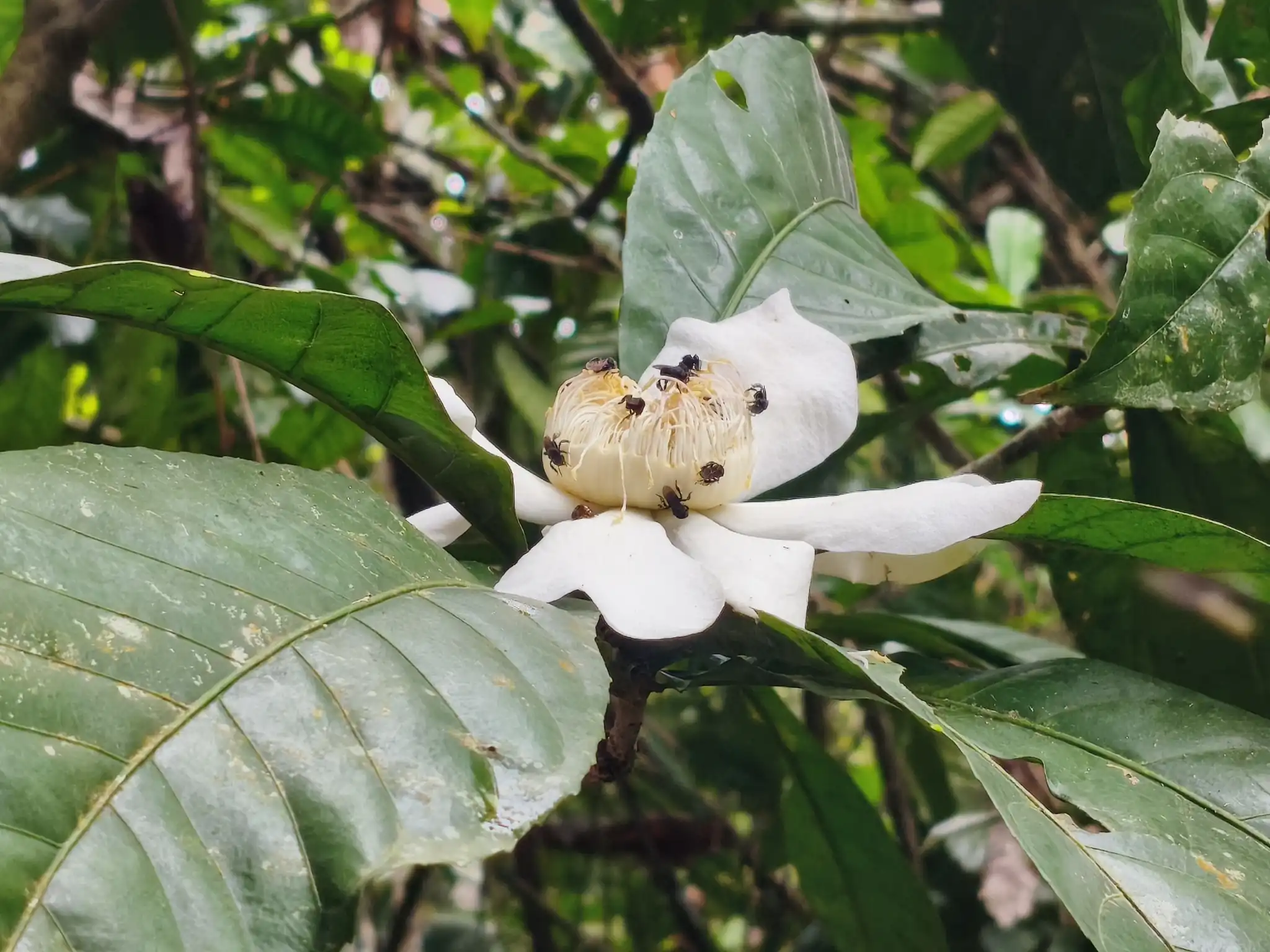
Flowers are carried in short racemes just above the leaves and directly on older wood, each fragrant bloom six to eight inches across with six to eight pale pink to white petals around a dense central ring of up to a thousand dark pink and yellow stamens. Plants bloom repeatedly through the year in warm humid air and set rounded fruits directly on the trunk.
Uses & Benefits:
Essentials
At a Glance
Plant Type
Tropical
Height
240"
Width
79"
Light
Full Sun, Partial Sun, Shade
Zones
9, 10
Water
Moderate - evenly moist
Humidity
High
Lifespan
Long-lived evergreen tree
Native To
Tropical Central and South America
Toxicity
No hazards reported - edibility uncertain
Bloom period
Year round
In flower about 12 months of the year
Planting
How to Grow
- Grow in a large container or in ground only in frost-free zone 9-11 where nights stay above 30F.
- Site in morning sun with midday shade and shelter from wind, mimicking rainforest understory.
- Plant in rich organic loam or sandy loam that holds moisture yet drains, keeping the rootball at the same depth.
- Water to keep soil consistently moist, never soggy and never fully dry.
- Hold indoors or in a heated greenhouse through winter with bright light and high humidity.
Pro Tip
Leave the single palm-like stem unpruned and keep young plants shaded, warm and evenly moist; cold or drying drops leaves that hard cutting does not replace.
Keep It Thriving
Care Guide
Do
- Keep soil evenly moist during active growth.
- Provide shade for young plants and morning sun for established plants.
- Protect from any frost; bring containers under cover before cold nights.
- Allow flowers and fruit forming on the trunk to develop undisturbed.
Don't
- Do not let the rootball dry out or sit waterlogged.
- Do not hard-prune the single trunk to force branching.
- Do not plant outdoors where winter falls below 30F.
- Do not eat fruit or foliage; edibility is conflicting and unconfirmed.
Seasonal Care Calendar
| Task | Jan | Feb | Mar | Apr | May | Jun | Jul | Aug | Sep | Oct | Nov | Dec |
|---|---|---|---|---|---|---|---|---|---|---|---|---|
| Fertilize | ||||||||||||
| Mulch | ||||||||||||
| Pest Check | ||||||||||||
| Plant | ||||||||||||
| Winter Prep |
Watch Out For
Pests & Diseases
Common Pests
Common Diseases
In the Garden
Landscape Uses & Companions
Landscape Uses
Multiply
Propagation Methods
Good to Know
Common Questions
Heaven Lotus questions
What zones can Heaven Lotus grow in?
Heaven Lotus is hardy in USDA Zones 9–10: in that range it survives winter in the ground. Colder than Zone 9, grow it in a container you can move to shelter for the winter, or as an annual.
When does Heaven Lotus bloom?
Heaven Lotus typically blooms year-round. Exact timing shifts a week or two with your zone — Sow's bloom calendar maps it to your garden.
Does Heaven Lotus need full sun?
Heaven Lotus does best in full sun to part shade. In hot climates, afternoon shade keeps blooms fresher longer.
Keep exploring
Explore the genus
Hardy in your zone?
Grow Heaven Lotus with confidence
See it in a design of your actual yard, get zone-matched care reminders, and track it season by season in your garden journal.