The Story
Plant Bio
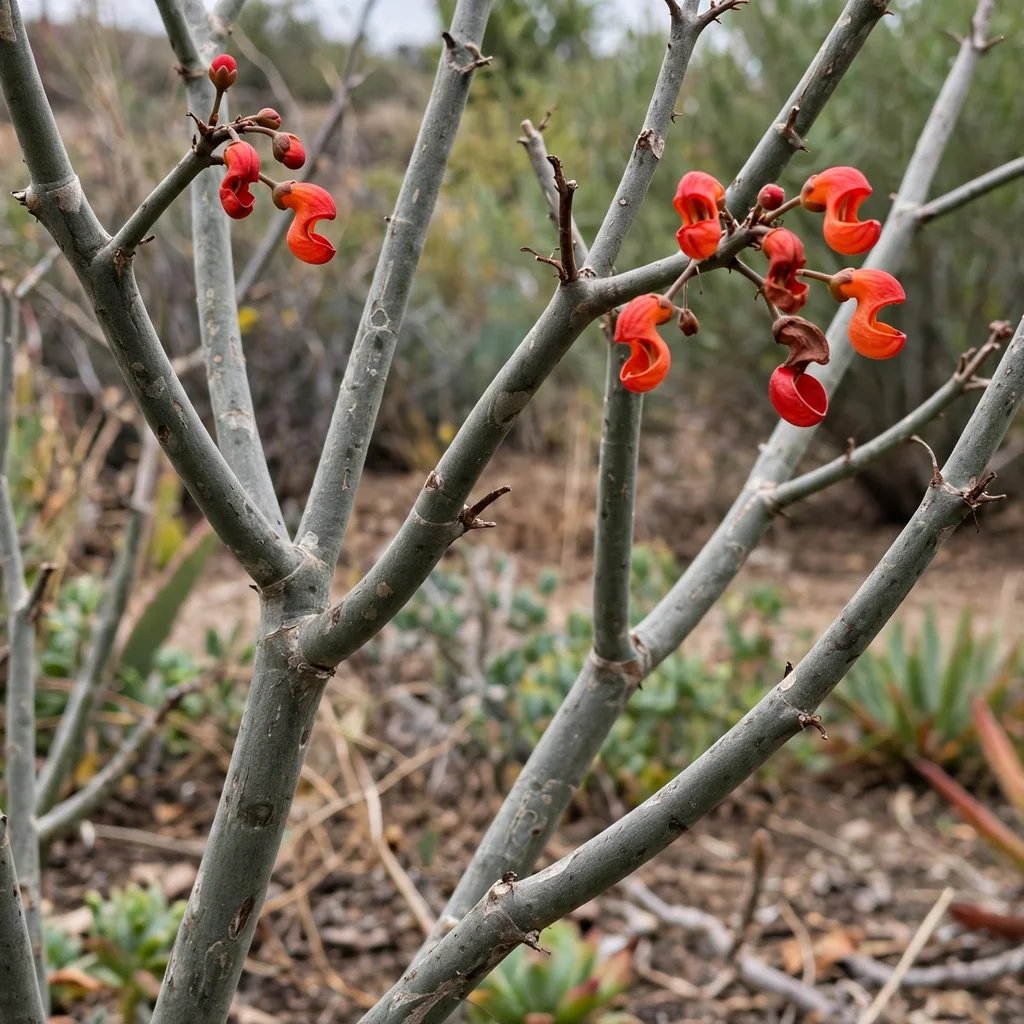
Euphorbia lomelii is a slow-growing succulent shrub from the Sonoran Desert that forms tight clumps of upright, arching lime-green stems. The stems are leafless and photosynthetic, about a third of an inch thick, branching from the base and spreading by underground stems to 3 to 5 feet tall and wide.
Sold as Pedilanthus macrocarpus, it carries slipper-shaped cyathia in orange-red along the stems in spring and fall, each bract folded like a tiny shoe around the true flowers. The nectar-rich cups are visited and pollinated by hummingbirds, and the clump holds its green stems year-round where drainage is sharp and frost is brief.
Uses & Benefits:
Essentials
At a Glance
Plant Type
Cactus Succulent
Height
60"
Width
48"
Light
Full Sun, Partial Sun
Zones
9, 10
Water
Low
Humidity
Low
Lifespan
Long-lived
Native To
Mexico - Sonora and Baja California
Toxicity
Toxic if ingested, skin irritant
Bloom period
Spring – Fall
In flower about 9 months of the year
Planting
How to Grow
- Plant in spring after frost in full sun to light shade in very porous sandy or rocky soil.
- Set the crown at or slightly above grade and backfill with coarse sand and gravel, never rich loam.
- Water in once, then water sparingly only when dry; established clumps need monthly water or less.
- Feed little or not at all; in pots use half-strength fertilizer monthly in the growing season if growth stalls.
- Leave the clump to form and prune only to remove damaged stems, wearing gloves and eye protection.
Pro Tip
Plant high in coarse sand and gravel and water only when the soil is dry through; cold plus wet rots the crown.
Keep It Thriving
Care Guide
Do
- Give full sun and reflected heat for the heaviest flowering.
- Provide excellent drainage with sand, gravel, and rock.
- Wear gloves and keep milky sap off skin and eyes.
Don't
- Do not overwater or plant in heavy clay that stays wet.
- Do not plant in deep shade, which suppresses flowers.
- Do not cut hard into old clumps annually; leave them to form.
Seasonal Care Calendar
| Task | Jan | Feb | Mar | Apr | May | Jun | Jul | Aug | Sep | Oct | Nov | Dec |
|---|---|---|---|---|---|---|---|---|---|---|---|---|
| Fertilize | ||||||||||||
| Pest Check | ||||||||||||
| Plant | ||||||||||||
| Propagate | ||||||||||||
| Prune |
Watch Out For
Pests & Diseases
Common Pests
Common Diseases
In the Garden
Landscape Uses & Companions
Landscape Uses
Multiply
Propagation Methods
Good to Know
Common Questions
Slipper Plant questions
What zones can Slipper Plant grow in?
Slipper Plant is hardy in USDA Zones 9–10: in that range it survives winter in the ground. Colder than Zone 9, grow it in a container you can move to shelter for the winter, or as an annual.
Is Slipper Plant deer resistant?
Yes — Slipper Plant is rated deer-resistant. Deer typically pass it over, though extreme hunger can override any plant's defenses.
When does Slipper Plant bloom?
Slipper Plant typically blooms from spring to fall. Exact timing shifts a week or two with your zone — Sow's bloom calendar maps it to your garden.
Does Slipper Plant need full sun?
Slipper Plant does best in full sun to part shade. In hot climates, afternoon shade keeps blooms fresher longer.
Is Slipper Plant drought tolerant?
Yes — once established (usually after the first full season), Slipper Plant handles dry spells with minimal watering. Water deeply its first year to build the root system that makes that possible.
More Pedilanthus to compare
Keep exploring
Explore the genus
Hardy in your zone?
Grow Slipper Plant with confidence
See it in a design of your actual yard, get zone-matched care reminders, and track it season by season in your garden journal.