The Story
Plant Bio
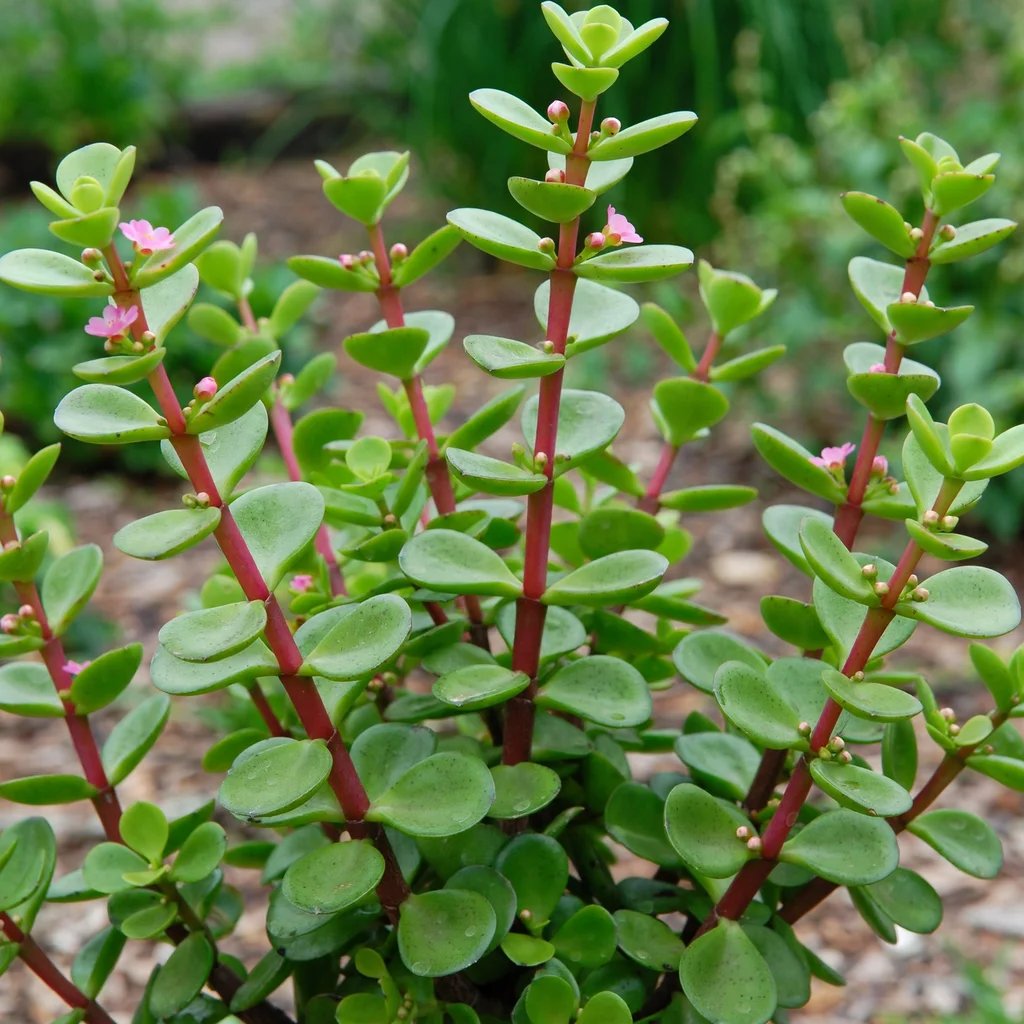
Portulacaria afra, the elephant bush, is an upright, heavily branched succulent shrub from southern Africa with thick reddish-brown stems that store water through long dry periods. It carries small round-oval emerald-green succulent leaves and builds a dense woody framework that holds as a 4 foot shrub in pots and reaches 8 to 12 feet upright outdoors where frost-free.
'Macrophylla' is the large-leaf form sold as Portulacaria macrophylla, distinguished by apple-green leaves to 1 inch long, about twice the half-inch length of the typical species. It keeps the same upright densely branched habit on red-purple stems and produces pale pink and white flowers only rarely in cultivation, flowering in early summer in its native range.
Uses & Benefits:
Essentials
At a Glance
Plant Type
Cactus Succulent
Height
144"
Width
72"
Light
Full Sun, Partial Sun
Zones
9, 10
Water
Low
Humidity
Low
Lifespan
Long-lived perennial
Native To
South Africa to Eswatini and Mozambique
Toxicity
Non-toxic
Bloom period
Early summer – Summer
In flower about 3 months of the year
Planting
How to Grow
- Set in full sun to light shade where winter stays above 25F, outdoors in zones 9-11 or in a bright pot indoors.
- Plant in very well-draining cactus or succulent mix with the stem base just above the soil line.
- Water deeply, then allow the mix to dry fully before watering again, keeping winter water sparing.
- Protect from frost and bring potted plants under cover before hard freezes.
Pro Tip
Let the soil dry completely between deep waterings; constant moisture rots the base faster than any drought harms the top.
Keep It Thriving
Care Guide
Do
- Give full coastal sun for compact growth and firm leaves.
- Use a gritty, fast-draining mix and a pot with drainage holes.
- Prune lightly to shape and root the trimmings as new plants.
Don't
- Do not overwater or leave the pot standing in a saucer of water.
- Do not cut back into old leafless wood expecting fast regrowth.
- Do not expect flowers in pots or indoors.
Seasonal Care Calendar
| Task | Jan | Feb | Mar | Apr | May | Jun | Jul | Aug | Sep | Oct | Nov | Dec |
|---|---|---|---|---|---|---|---|---|---|---|---|---|
| Pest Check | ||||||||||||
| Plant | ||||||||||||
| Propagate | ||||||||||||
| Prune | ||||||||||||
| Winter Prep |
Watch Out For
Pests & Diseases
Common Pests
Common Diseases
In the Garden
Landscape Uses & Companions
Landscape Uses
Multiply
Propagation Methods
Good to Know
Common Questions
Large Leaf Elephant Food questions
What zones can Large Leaf Elephant Food grow in?
Large Leaf Elephant Food is hardy in USDA Zones 9–10: in that range it survives winter in the ground. Colder than Zone 9, grow it in a container you can move to shelter for the winter, or as an annual.
When does Large Leaf Elephant Food bloom?
Large Leaf Elephant Food typically blooms in summer. Exact timing shifts a week or two with your zone — Sow's bloom calendar maps it to your garden.
Does Large Leaf Elephant Food need full sun?
Large Leaf Elephant Food does best in full sun to part shade. In hot climates, afternoon shade keeps blooms fresher longer.
Is Large Leaf Elephant Food drought tolerant?
Yes — once established (usually after the first full season), Large Leaf Elephant Food handles dry spells with minimal watering. Water deeply its first year to build the root system that makes that possible.
More Portulacaria to compare

Keep exploring
Explore the genus
Hardy in your zone?
Grow Large Leaf Elephant Food with confidence
See it in a design of your actual yard, get zone-matched care reminders, and track it season by season in your garden journal.