The Story
Plant Bio
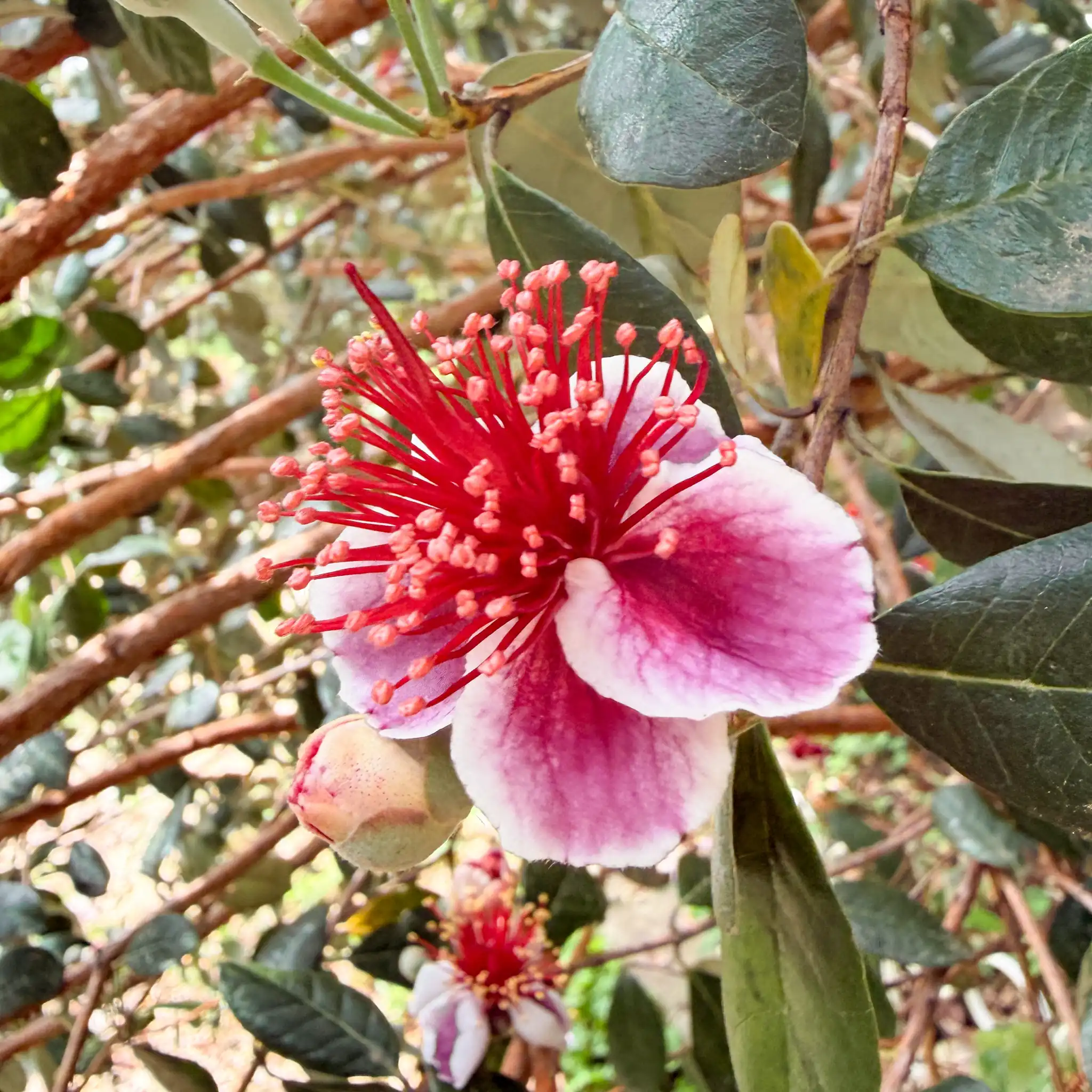
Feijoa sellowiana is a gray-green evergreen shrub to small tree from the highlands of southern Brazil, Uruguay and northeastern Argentina, reaching five to six feet in cooler gardens and ten to fifteen feet where winters stay mild. The leaves are leathery and silver-white beneath, and the spring flowers bear white petals around a central tuft of scarlet stamens.
The thick petals taste sweet like marshmallow and can be eaten straight from the flower, followed by egg-sized green fruit that ripens five to six months after bloom in late summer to fall. Fruiting is heaviest in full sun with deep watering and mulch, and plants left unpruned stay relatively open while clipped plants grow denser.
Uses & Benefits:
Essentials
At a Glance
Plant Type
Shrub
Height
144"
Width
144"
Light
Full Sun, Partial Sun
Zones
8, 9, 10
Water
Medium
Humidity
Average
Lifespan
Long-lived shrub
Native To
S. Brazil, Uruguay, NE Argentina
Toxicity
Non-toxic
Bloom period
Spring – Early summer
In flower about 4 months of the year
Planting
How to Grow
- Plant in full sun in moist, well-drained soil after the last hard frost.
- Dig the hole twice as wide as the pot, set at the same depth, then mulch 2-3 inches deep.
- Water deeply and regularly through the first two summers to establish the shallow roots.
- Prune lightly after bloom to shape as a hedge, specimen or small tree.
- Harvest fruit as it softens and drops in fall; flavor improves a few days off the plant.
Pro Tip
Plant two different cultivars or a self-fertile selection such as 'Coolidge' in full sun; lone self-sterile plants bloom without setting fruit.
Keep It Thriving
Care Guide
Do
- Water deeply during dry spells to size up fruit.
- Mulch to hold soil moisture.
- Prune to shape as a hedge, specimen or small tree.
Don't
- Do not let plants dry out while fruit is sizing.
- Do not plant in soggy ground with standing water.
- Do not rely on a single seedling for fruit without knowing it is self-fertile.
Seasonal Care Calendar
| Task | Jan | Feb | Mar | Apr | May | Jun | Jul | Aug | Sep | Oct | Nov | Dec |
|---|---|---|---|---|---|---|---|---|---|---|---|---|
| Fertilize | ||||||||||||
| Harvest | ||||||||||||
| Mulch | ||||||||||||
| Pest Check | ||||||||||||
| Prune |
Watch Out For
Pests & Diseases
Common Pests
In the Garden
Landscape Uses & Companions
Landscape Uses
Multiply
Propagation Methods
Good to Know
Common Questions
Pineapple Guava questions
What zones can Pineapple Guava grow in?
Pineapple Guava is hardy in USDA Zones 8–10: in that range it survives winter in the ground. Colder than Zone 8, grow it in a container you can move to shelter for the winter.
When does Pineapple Guava bloom?
Pineapple Guava typically blooms from early spring to early summer. Exact timing shifts a week or two with your zone — Sow's bloom calendar maps it to your garden.
Does Pineapple Guava need full sun?
Pineapple Guava does best in full sun to part shade. In hot climates, afternoon shade keeps blooms fresher longer.
Keep exploring
Explore the genus
Hardy in your zone?
Grow Pineapple Guava with confidence
See it in a design of your actual yard, get zone-matched care reminders, and track it season by season in your garden journal.