
The Story
Plant Bio
Equisetum hyemale is a spore-bearing evergreen perennial that grows as rigid, jointed stems rather than true leaves, spreading by deep creeping rhizomes to form dense colonies. The hollow stems contain silica in the epidermis and photosynthesize directly, with each node ringed by a fused sheath of reduced scale leaves.
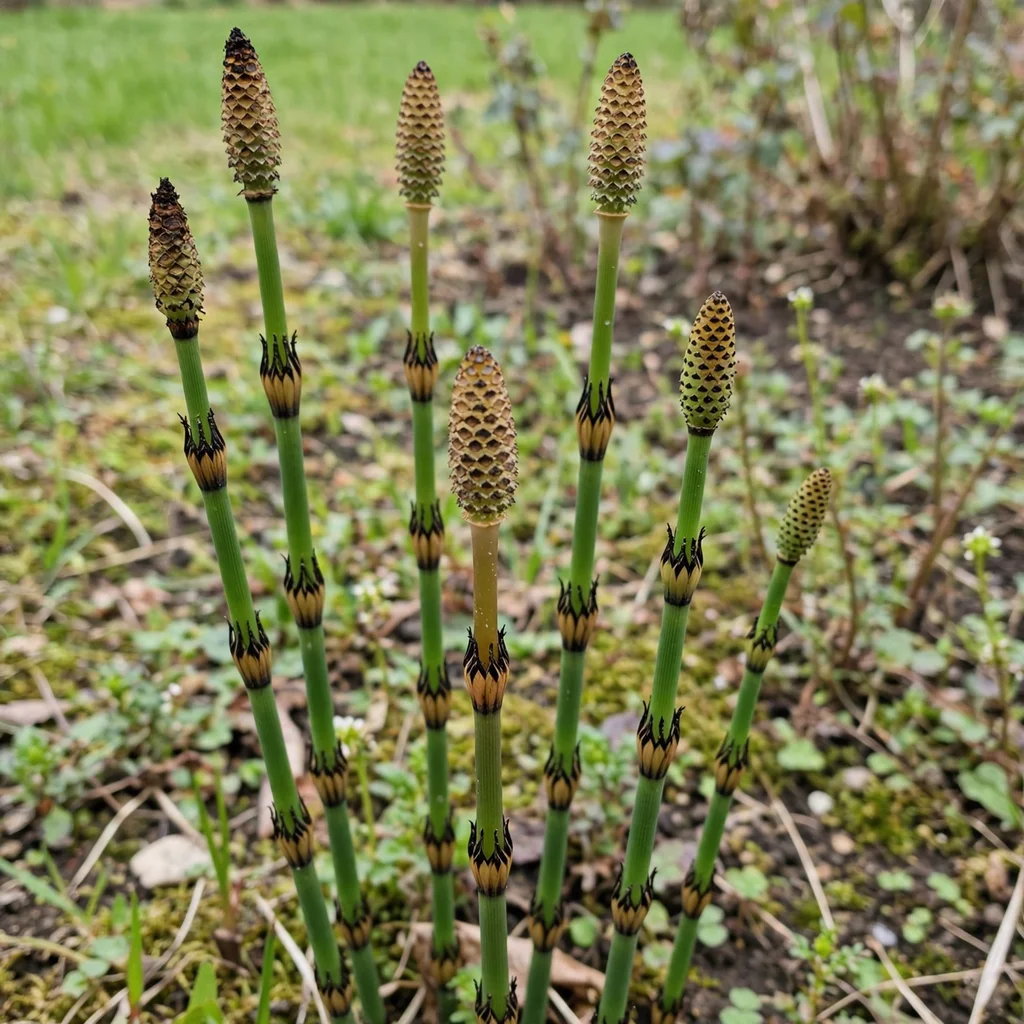
Sold as Equisetum falcatum, this is the scouring rush of the nursery trade, reaching two to four feet in pots with dark green stems to half an inch thick marked by fourteen to fifty silica ridges. Each joint carries an ash-gray sheath banded in black, tipped in season by a blunt pale-brown spore cone to an inch long rather than any flower.
Uses & Benefits:
Essentials
At a Glance
Plant Type
Fern
Height
48"
Width
72"
Light
Full Sun, Partial Sun, Shade
Zones
4, 5, 6, 7, 8, 9
Water
High - medium to wet
Humidity
Unknown
Lifespan
Perennial, evergreen clonal
Native To
North America, Eurasia
Toxicity
Toxic to livestock, large doses toxic to people
Planting
How to Grow
- Set a sealed tub, large pot without drainage holes, or rigid root barrier in full sun to part shade before any soil goes in.
- Plant rhizome sections 2 inches deep in loam, sand or clay kept medium to wet, with up to 4 inches of standing water over the crown.
- Water to keep the mix saturated at all times; do not let the container dry out in summer.
- Leave the evergreen stems standing through fall and winter for structure and cut only broken stems at the base in spring.
Pro Tip
Plant only in a sealed tub or pot sunk in the bog; any rhizome fragment left in open soil restarts the colony and digging will not remove it.
Keep It Thriving
Care Guide
Do
- Contain at planting in a sealed pot or barrier sunk in a bog or water garden
- Keep soil saturated to wet year-round
- Remove winter-damaged stems at the base in spring
- Inspect container edges for escaping rhizomes
Don't
- Never plant uncontained in damp soil or an open bog
- Never compost rhizomes or stems with rhizome attached
- Do not dig through an established colony - fragments resprout
- Do not feed; fertilizer is rarely needed in wet soil
Seasonal Care Calendar
| Task | Jan | Feb | Mar | Apr | May | Jun | Jul | Aug | Sep | Oct | Nov | Dec |
|---|---|---|---|---|---|---|---|---|---|---|---|---|
| Divide | ||||||||||||
| Pest Check | ||||||||||||
| Plant | ||||||||||||
| Spring Cleanup | ||||||||||||
| Winter Prep |
Watch Out For
Pests & Diseases
Common Pests
Common Diseases
In the Garden
Landscape Uses & Companions
Landscape Uses
Companion Plants
Multiply
Propagation Methods
Good to Know
Common Questions
Scouring Rush questions
What zones can Scouring Rush grow in?
Scouring Rush is hardy in USDA Zones 4–9: in that range it survives winter in the ground. Warmer than Zone 9, winter isn't the problem: it prefers colder winters, and summer heat can shorten its life.
Does Scouring Rush need full sun?
Scouring Rush does best in full sun to part shade. In hot climates, afternoon shade keeps blooms fresher longer.
More Equisetum to compare
Keep exploring
Explore the genus
Grow Scouring Rush with confidence
See it in a design of your actual yard, get zone-matched care reminders, and track it season by season in your garden journal.