The Story
Plant Bio
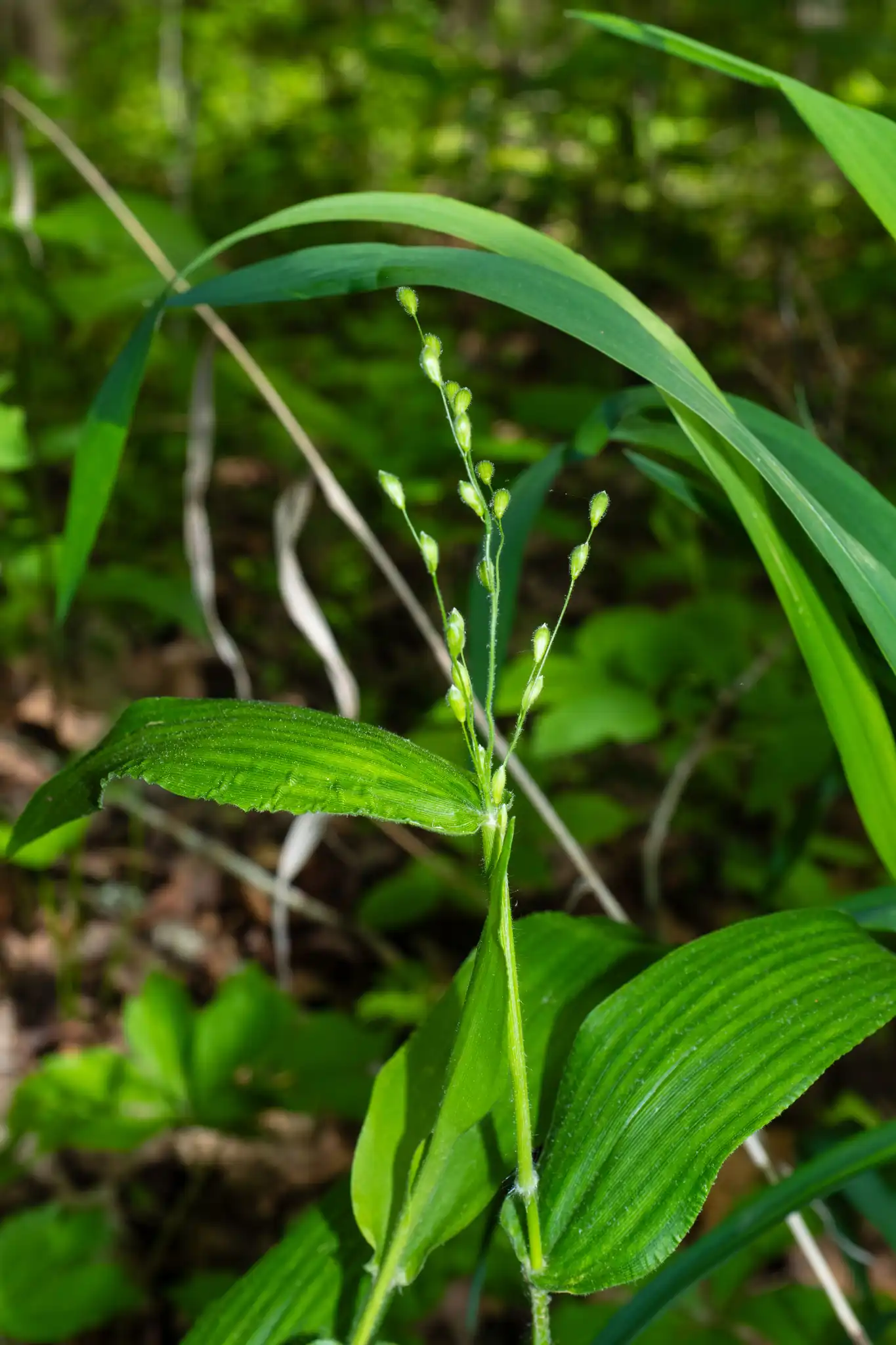
Dichanthelium boscii, Bosc's panicgrass, is a perennial woodland grass forming small clumps from knotty rhizomes, with slender culms eight to twenty-eight inches tall. The foliage is broad for the group, with rounded clasping leaf bases and softly downy upper surfaces, and the wind-pollinated spikelets are carried in open panicles with no showy petals.
This species carries the broadest leaves in its group, with retrorsely bearded nodes and ciliate leaf margins. It produces open spring panicles followed by small closed fall panicles that set seed without opening, a rosette-grass cycle valued for quail, turkey and sparrow forage rather than flower color.
Uses & Benefits:
Essentials
At a Glance
Plant Type
Grass
Height
28"
Width
12"
Light
Full Sun, Partial Sun, Shade
Water
Medium to dry
Humidity
Unknown
Lifespan
Perennial
Native To
Eastern and south-central USA
Toxicity
Unknown - no toxicity record
Bloom period
Spring – Summer
In flower about 6 months of the year
Planting
How to Grow
- Plant plugs in spring in dappled shade to full sun in loose loam, sand, or clay soil
- Water to settle the roots, then allow the soil to dry between waterings once established
- Leave spring and fall panicles intact to ripen seed for birds
- Cut back old culms in late winter before new spring growth resumes
Pro Tip
Site it in dappled shade to full sun in loose woodland soil and leave the fall panicles to ripen seed; it persists on dry soils once rooted.
Keep It Thriving
Care Guide
Do
- Plant in oak-hickory woodland conditions with sun to shade
- Allow fall seed to stand for quail, turkey, and sparrows
- Use division or seed to increase small clumps
Don't
- Do not expect showy flowers; this is a foliage and seed grass
- Do not cut the fall panicles before seed ripens
- Do not keep soils constantly saturated
Seasonal Care Calendar
| Task | Jan | Feb | Mar | Apr | May | Jun | Jul | Aug | Sep | Oct | Nov | Dec |
|---|---|---|---|---|---|---|---|---|---|---|---|---|
| Mulch | ||||||||||||
| Pest Check | ||||||||||||
| Plant | ||||||||||||
| Spring Cleanup |
Watch Out For
Pests & Diseases
Common Pests
In the Garden
Landscape Uses & Companions
Landscape Uses
Multiply
Propagation Methods
Good to Know
Common Questions
Bosc's Panicgrass questions
Is Bosc's Panicgrass deer resistant?
Not reliably. Deer may browse Bosc's Panicgrass, especially tender spring growth — plan on repellents or fencing where pressure is high.
When does Bosc's Panicgrass bloom?
Bosc's Panicgrass typically blooms from spring to summer. Exact timing shifts a week or two with your zone — Sow's bloom calendar maps it to your garden.
Does Bosc's Panicgrass need full sun?
Bosc's Panicgrass does best in full sun to part shade. In hot climates, afternoon shade keeps blooms fresher longer.
Is Bosc's Panicgrass drought tolerant?
Yes — once established (usually after the first full season), Bosc's Panicgrass handles dry spells with minimal watering. Water deeply its first year to build the root system that makes that possible.
Keep exploring
Explore the genus
Grow Bosc's Panicgrass with confidence
See it in a design of your actual yard, get zone-matched care reminders, and track it season by season in your garden journal.