The Story
Plant Bio
Napoleonaea imperialis is a slow-growing evergreen shrub or small multibranched understory tree from closed lowland rainforest in West and Central Africa, reaching about twenty feet in cultivation with branches held low on the trunk. It carries elliptic evergreen leaves to nine inches long and holds a dense low crown that needs constant warmth, humidity and evenly moist rich soil.
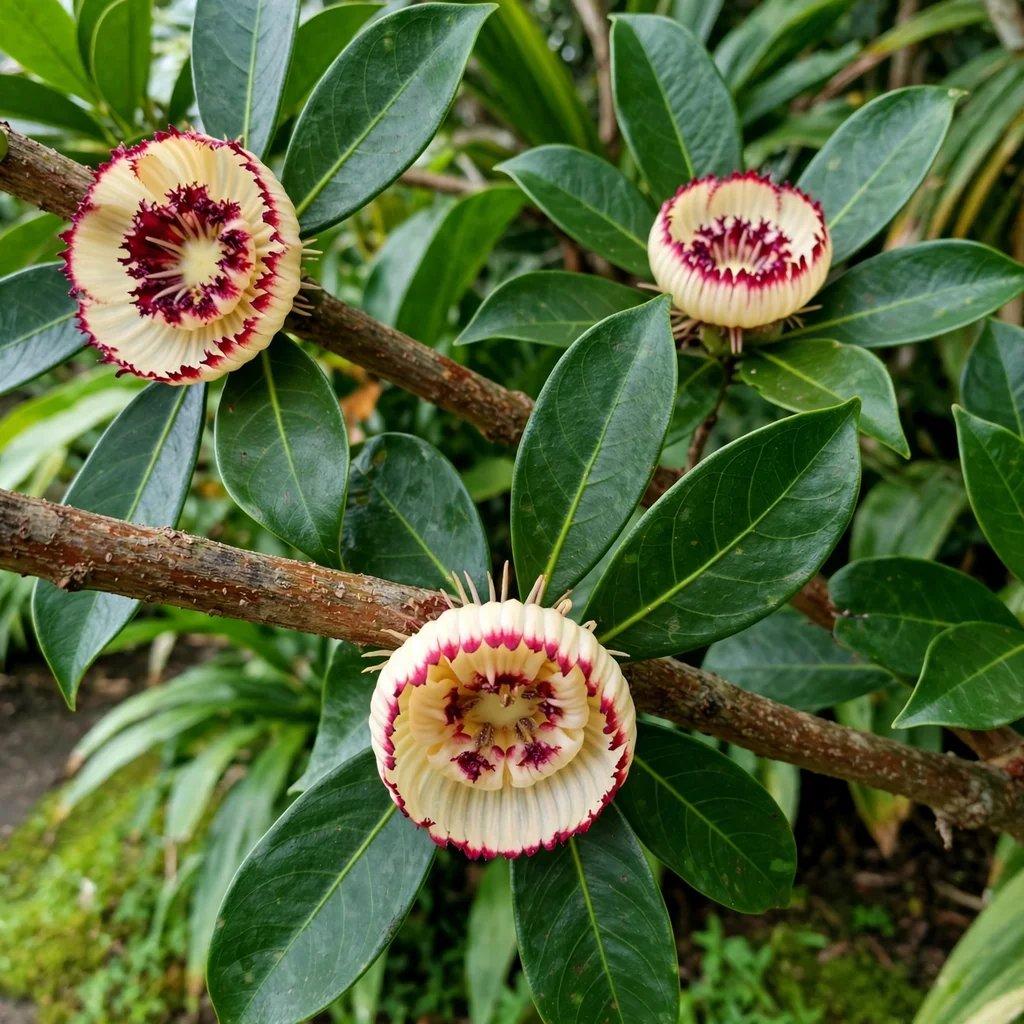
Flowers form singly or in twos and threes directly on old wood and in leaf axils, each two to three inch saucer with a cream to yellow outer ring and a frilly red to purple crown at the center. They open opportunistically through the year with a sweet butterscotch scent and separate this species from similar Napoleonaea whitfieldii and vogelii sold under the same common name.
Uses & Benefits:
Essentials
At a Glance
Plant Type
Tropical
Height
240"
Width
120"
Light
Partial Sun, Shade
Zones
9, 10
Water
High
Humidity
High
Lifespan
Long-lived
Native To
West and Central Africa
Toxicity
Unknown
Bloom period
Year round
In flower about 12 months of the year
Planting
How to Grow
- Grow in a large pot or greenhouse bed in zones 10 to 11, moving pots indoors before nights fall below 60F.
- Give bright indirect light or dappled shade with shelter from midday sun and drying wind.
- Plant in rich moisture-retentive but well-drained acid mix and water regularly to keep it evenly moist.
- Hold high humidity and temperatures from 64 to 80F with good air movement.
- Feed lightly through the growing season and prune only after flowering to shape.
Pro Tip
Keep it above 60F in humid partial shade and prune only lightly after flowering to contain size; cutting into old leafless wood resprouts poorly and full dry sun scorches it.
Keep It Thriving
Care Guide
Do
- Keep the root zone evenly moist and never let the pot dry out completely.
- Provide dappled shade, high humidity and free air movement.
- Repot young plants as needed into fresh rich mix to sustain steady growth.
Don't
- Do not plant outdoors where frost occurs or winter nights fall below 50F.
- Do not cut back into old leafless wood to reduce size.
- Do not grow in full dry sun or in alkaline, drought-prone soil.
Seasonal Care Calendar
| Task | Jan | Feb | Mar | Apr | May | Jun | Jul | Aug | Sep | Oct | Nov | Dec |
|---|---|---|---|---|---|---|---|---|---|---|---|---|
| Fertilize | ||||||||||||
| Pest Check | ||||||||||||
| Prune | ||||||||||||
| Winter Prep |
Watch Out For
Pests & Diseases
Common Pests
Common Diseases
In the Garden
Landscape Uses & Companions
Landscape Uses
Companion Plants
Multiply
Propagation Methods
Good to Know
Common Questions
Napoleon's Hat questions
What zones can Napoleon's Hat grow in?
Napoleon's Hat is hardy in USDA Zones 9–10: in that range it survives winter in the ground. Colder than Zone 9, grow it in a container you can move to shelter for the winter, or as an annual.
When does Napoleon's Hat bloom?
Napoleon's Hat typically blooms year-round. Exact timing shifts a week or two with your zone — Sow's bloom calendar maps it to your garden.
Does Napoleon's Hat need full sun?
Napoleon's Hat does best in part shade.
Keep exploring
Explore the genus
Hardy in your zone?
Grow Napoleon's Hat with confidence
See it in a design of your actual yard, get zone-matched care reminders, and track it season by season in your garden journal.