The Story
Plant Bio
Gmelina philippensis is a scandent, spiny shrub from thickets and secondary forest in Southeast Asia that builds open, arching stems to ten to twenty feet, scrambling without regular pruning. The leaves are opposite, rhomboid-elliptic and dark green with a pale glandular underside, carried on lenticellate stems armed with sharp spines.
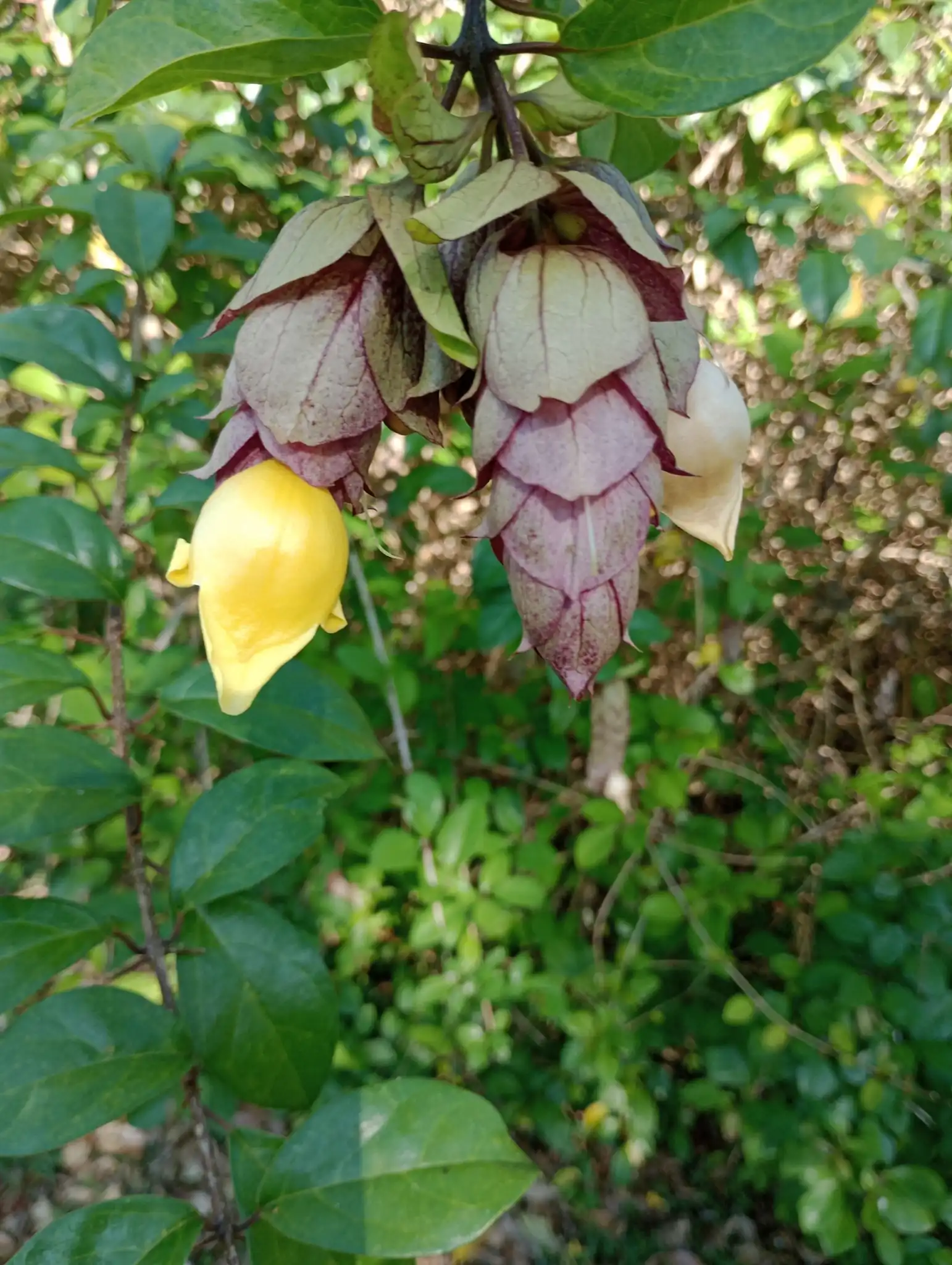
The ornamental effect comes from pendant chains of overlapping, broadly ovate bracts that open green and mature toward purple. From each bract emerges a tubular yellow to orange-yellow flower shaped like a parrot's beak, borne summer to fall.
Uses & Benefits:
Essentials
At a Glance
Plant Type
Shrub
Height
180"
Width
120"
Light
Full Sun, Partial Sun
Zones
9, 10
Water
Moderate
Humidity
Unknown
Lifespan
Long-lived tender shrub
Native To
India to Philippines
Toxicity
Unknown
Bloom period
Summer – Autumn
In flower about 6 months of the year
Planting
How to Grow
- Set out in full sun to partial shade after all frost danger, in fertile, well-drained mix.
- Plant at the same depth as in the nursery pot and water in deeply.
- Water freely during active growth, letting the top inch dry between waterings.
- Feed with balanced 10-10-10 every 4 to 6 weeks in season or a slow-release bloom formula in spring.
- Move pots indoors before nights drop below 40F and overwinter bright and frost-free.
Pro Tip
Prune after flowering to shape and pinch young shoots to branch; shearing midseason removes the terminal bract chains and stops bloom, and plants kept as bonsai rarely flower.
Keep It Thriving
Care Guide
Do
- Give full sun to partial shade and fertile, well-drained soil.
- Prune after flowering to keep the arching frame compact.
- Wear gloves when handling the spiny stems.
Don't
- Do not shear during growth; it cuts off the bract chains that carry the flowers.
- Do not leave containers out below 40F.
- Do not cut back hard for bushiness if you want bloom the same season.
Seasonal Care Calendar
| Task | Jan | Feb | Mar | Apr | May | Jun | Jul | Aug | Sep | Oct | Nov | Dec |
|---|---|---|---|---|---|---|---|---|---|---|---|---|
| Fertilize | ||||||||||||
| Pest Check | ||||||||||||
| Plant | ||||||||||||
| Prune | ||||||||||||
| Winter Prep |
Watch Out For
Pests & Diseases
Common Pests
Common Diseases
In the Garden
Landscape Uses & Companions
Landscape Uses
Good to Know
Common Questions
Parrot's Beak questions
What zones can Parrot's Beak grow in?
Parrot's Beak is hardy in USDA Zones 9–10: in that range it survives winter in the ground. Colder than Zone 9, grow it in a container you can move to shelter for the winter.
When does Parrot's Beak bloom?
Parrot's Beak typically blooms from summer to fall. Exact timing shifts a week or two with your zone — Sow's bloom calendar maps it to your garden.
Does Parrot's Beak need full sun?
Parrot's Beak does best in full sun to part shade. In hot climates, afternoon shade keeps blooms fresher longer.
More Gmelina to compare
Keep exploring
Explore the genus
Hardy in your zone?
Grow Parrot's Beak with confidence
See it in a design of your actual yard, get zone-matched care reminders, and track it season by season in your garden journal.