The Story
Plant Bio
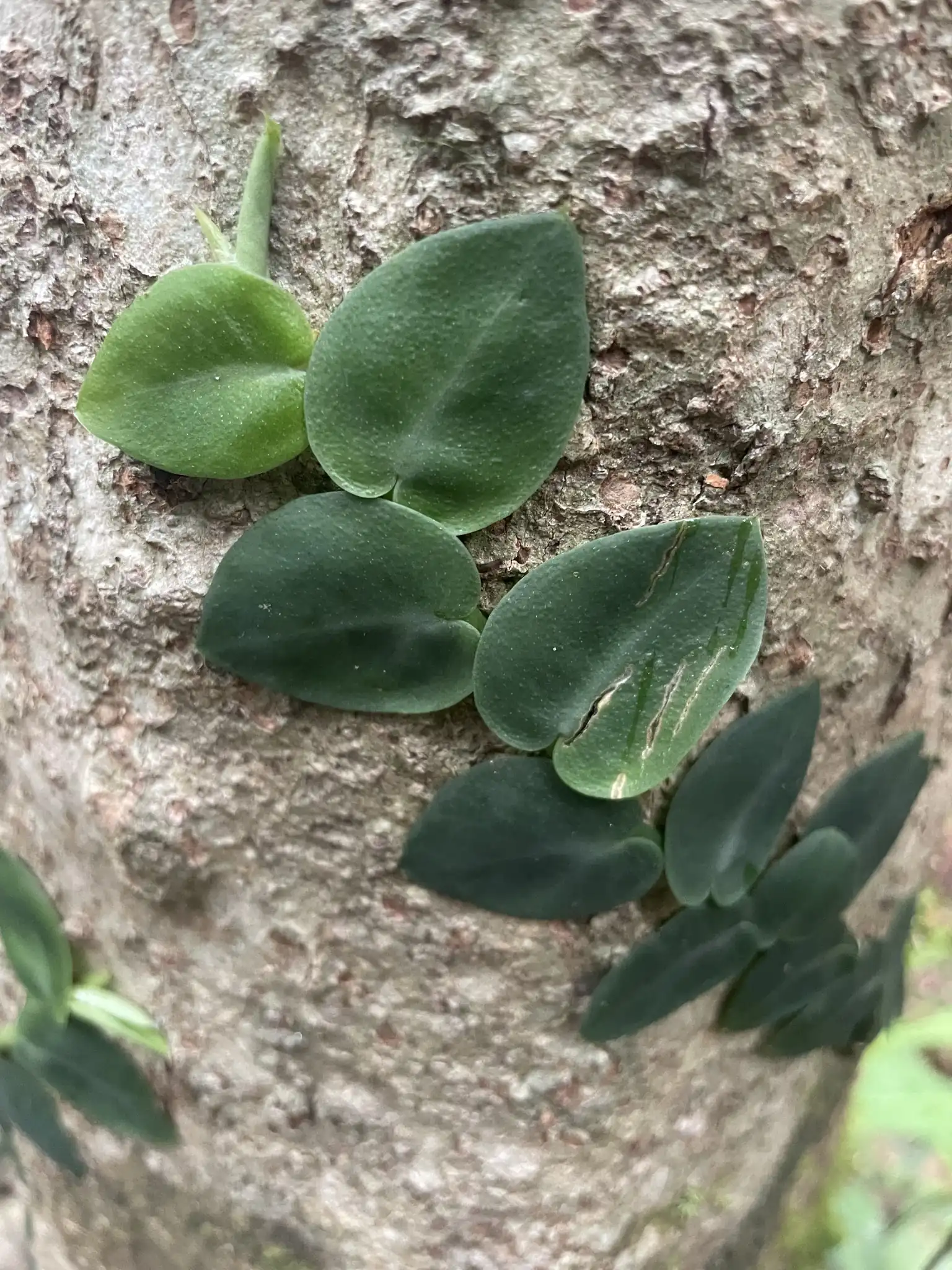
Rhaphidophora hayi is a slow-growing evergreen hemiepiphyte that climbs by aerial roots pressed to bark or rock, reaching about 5 feet as a houseplant and 30 feet or more in wet lowland forest. The juvenile leaves are oval, leathery and dark green, held flat against the support in a shingling habit, while mature foliage grows larger and more spaced once established high on a tree.
Unlike trailing aroids, it stays tightly appressed, with each leaf overlapping the last like shingles to shade the stem and the aerial roots beneath. It rarely flowers indoors, where the interest is foliage, but in spring and summer mature plants can produce a solitary canoe-shaped yellow spathe flushed orange-apricot inside around a stout yellow to creamy-white cigar-shaped spadix.
Uses & Benefits:
Essentials
At a Glance
Plant Type
Vine
Height
60"
Width
12"
Light
Partial Sun, Shade
Zones
10
Water
Evenly moist
Humidity
High, 60-70%+
Lifespan
Long-lived perennial vine
Native To
New Guinea, Solomon Islands, northeastern Queensland
Toxicity
Toxic to humans, dogs and cats
Bloom period
Spring – Summer
In flower about 6 months of the year
Planting
How to Grow
- Grow indoors in bright indirect or medium light; keep out of harsh direct sun and outdoors only in Zones 10-12.
- Pot in a chunky, fast-draining aroid mix that stays evenly moist but never waterlogged.
- Fix a vertical board or moss pole in the pot at planting and tie the stem flat so aerial roots can grip.
- Water when the top 1 to 2 inches dries, about 3 times per week in summer and once per week in winter, with humidity at 60 to 70 percent if possible.
Pro Tip
Mount it on a board or moss pole from the start and hold humidity above 60 percent; without a flat surface to root into, the leaves lift off the support and never shingle.
Keep It Thriving
Care Guide
Do
- Do provide a flat board or moss pole from the start.
- Do keep humidity high and watering consistent.
- Do let the top 1 to 2 inches dry between waterings.
Don't
- Don't grow it as a trailer without support.
- Don't overwater or leave the pot sitting wet.
- Don't cut back into leafless old wood.
Seasonal Care Calendar
| Task | Jan | Feb | Mar | Apr | May | Jun | Jul | Aug | Sep | Oct | Nov | Dec |
|---|---|---|---|---|---|---|---|---|---|---|---|---|
| Pest Check | ||||||||||||
| Propagate | ||||||||||||
| Prune | ||||||||||||
| Stake | ||||||||||||
| Winter Prep |
Watch Out For
Pests & Diseases
Common Pests
Common Diseases
In the Garden
Landscape Uses & Companions
Landscape Uses
Companion Plants
Multiply
Propagation Methods
Good to Know
Common Questions
Shingle Plant questions
What zones can Shingle Plant grow in?
Shingle Plant is hardy in USDA Zone 10: in that range it survives winter in the ground. Colder than Zone 10, grow it in a container you can move to shelter for the winter, or as an annual.
When does Shingle Plant bloom?
Shingle Plant typically blooms from spring to summer. Exact timing shifts a week or two with your zone — Sow's bloom calendar maps it to your garden.
Does Shingle Plant need full sun?
Shingle Plant does best in part shade.
More Rhaphidophora to compare
Keep exploring
Explore the genus
Hardy in your zone?
Grow Shingle Plant with confidence
See it in a design of your actual yard, get zone-matched care reminders, and track it season by season in your garden journal.