The Story
Plant Bio
Scindapsus pictus is a slow-growing evergreen climber from wet tropical Asia, climbing by short aerial rootlets or trailing when it has nothing to grip. Juvenile stems bear entire ovate leaves indoors, while high-climbing outdoor stems develop larger pinnately lobed leaves.
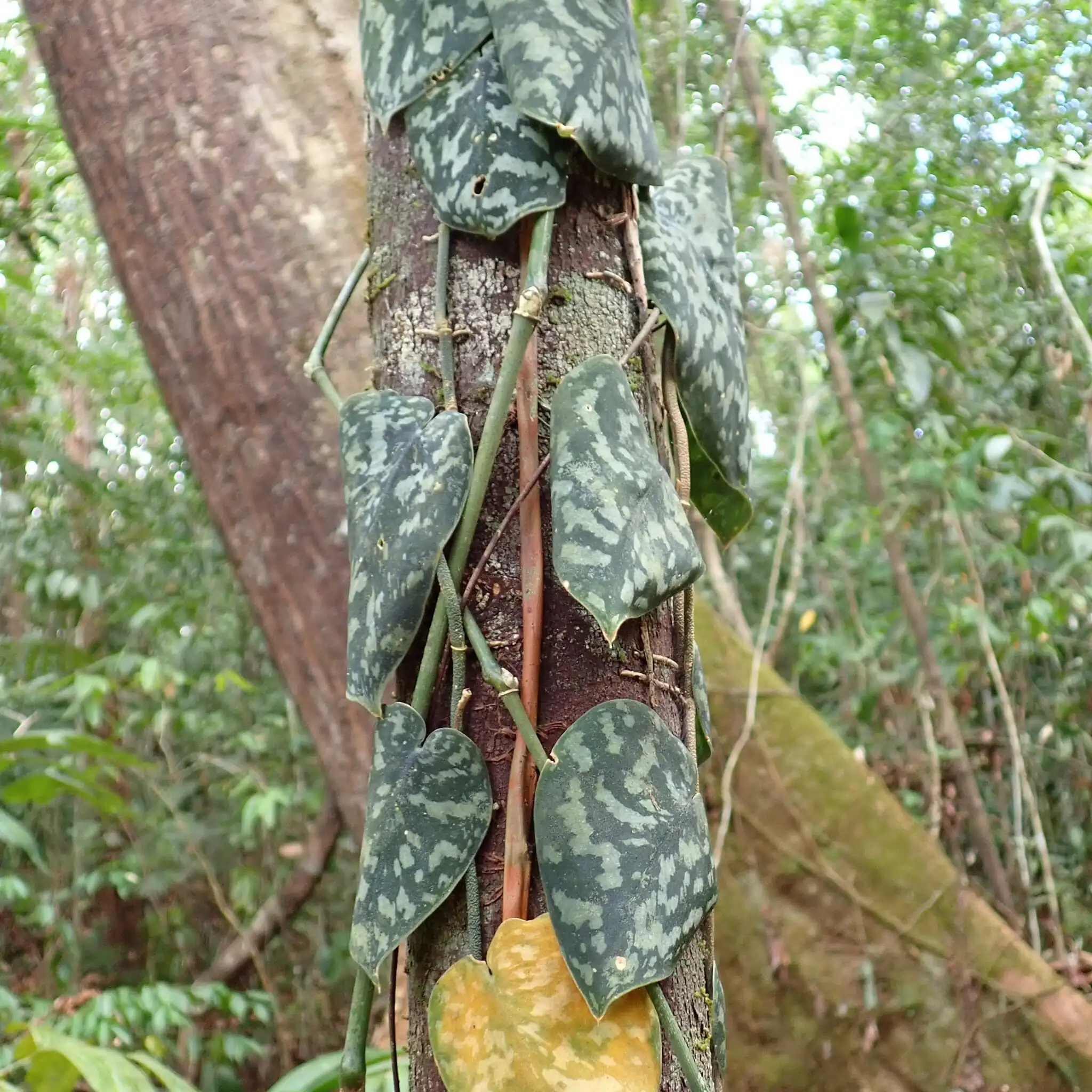
Leaves are three to four inches long with a heart-shaped base, matte deep green with irregular silver-gray blotches above and paler green beneath. Outdoor plants produce tiny apetalous flowers packed on a spadix enclosed by a spathe in summer, followed by small berries, but indoor plants rarely flower.
Uses & Benefits:
Essentials
At a Glance
Plant Type
Vine
Height
36"
Width
48"
Light
Partial Sun, Shade
Water
Medium, consistently moist
Humidity
High
Lifespan
Perennial evergreen vine
Native To
Southeast Bangladesh to western and central Malesia
Toxicity
Toxic to people, dogs, cats and horses
Bloom period
Summer
In flower about 3 months of the year
Planting
How to Grow
- Set in bright indirect light with no direct sun, 65-85F and high humidity; keep above 60F.
- Pot in fertile, peaty, acidic mix that drains freely and never stays waterlogged.
- Water to keep mix consistently moist in growth, letting the top dry slightly; reduce in winter.
- Train up a moss stick or let trail, pinching stem tips to shape.
Pro Tip
It is not golden pothos despite the satin pothos name, and nursery stock is juvenile foliage; cold below 60F, direct sun, and soggy mix cause more damage than pests.
Keep It Thriving
Care Guide
Do
- Provide bright indirect light and high humidity.
- Use a peaty acidic mix with sharp drainage.
- Feed monthly with dilute fertilizer in the growing season.
Don't
- Do not overwater or leave pots sitting in water.
- Do not expose to frost, cold below 60F, or direct sun.
- Do not ingest any part; keep away from dogs, cats, and horses.
Seasonal Care Calendar
| Task | Jan | Feb | Mar | Apr | May | Jun | Jul | Aug | Sep | Oct | Nov | Dec |
|---|---|---|---|---|---|---|---|---|---|---|---|---|
| Fertilize | ||||||||||||
| Pest Check | ||||||||||||
| Pinch | ||||||||||||
| Propagate | ||||||||||||
| Prune |
Watch Out For
Pests & Diseases
Common Pests
Common Diseases
In the Garden
Landscape Uses & Companions
Landscape Uses
Multiply
Propagation Methods
Good to Know
Common Questions
Satin Pothos questions
When does Satin Pothos bloom?
Satin Pothos typically blooms in summer. Exact timing shifts a week or two with your zone — Sow's bloom calendar maps it to your garden.
Does Satin Pothos need full sun?
Satin Pothos does best in part shade.
Keep exploring
Explore the genus
Grow Satin Pothos with confidence
See it in a design of your actual yard, get zone-matched care reminders, and track it season by season in your garden journal.