The Story
Plant Bio
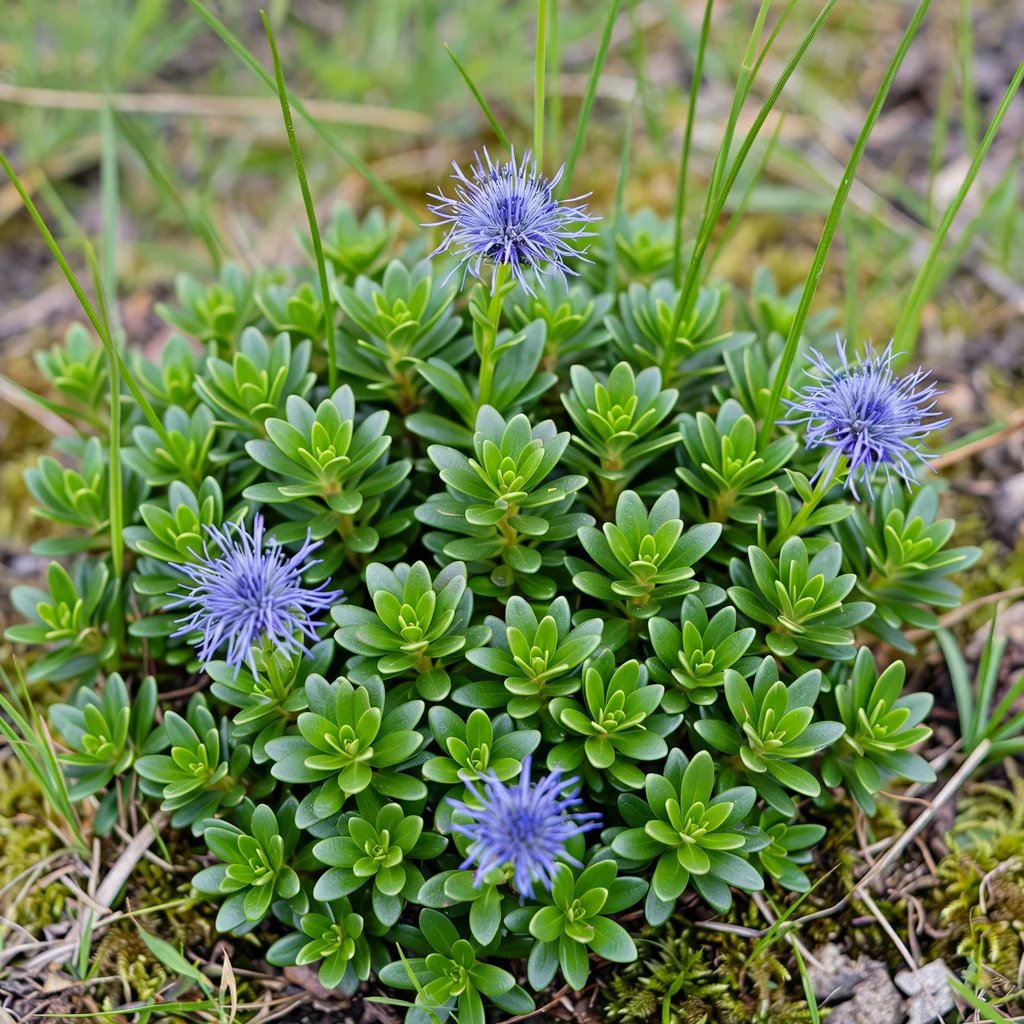
Globularia trichosantha is a mat-forming evergreen perennial from rocky steppes, limestone slopes and rock crevices of eastern Mediterranean to southwest Asia. It builds low tight mats of small oval glossy green leaves in basal rosettes, with upright leafless stalks topped by dense spherical heads of blue flowers.
Unlike Globularia vulgaris, which lacks stolons, this species spreads by short stolons to form a tight evergreen groundcover. Its heads carry hairy bracts and a calyx with teeth three to four times the length of the tube, opening rich blue to violet-blue with a fuzzy texture.
Uses & Benefits:
Essentials
At a Glance
Plant Type
Groundcover
Height
8"
Width
12"
Light
Full Sun, Partial Sun
Zones
5, 6, 7, 8, 9
Water
Moderate
Humidity
Unknown
Lifespan
Perennial
Native To
E Mediterranean to SW Asia
Toxicity
Unknown
Bloom period
Late spring – Summer
In flower about 4 months of the year
Planting
How to Grow
- Plant in full sun in rich yet gritty well-drained soil in a rockery, wall crevice or edging.
- Set plants 12 inches apart with the crown level with the surface, firming gravel around the rosette.
- Water to settle, then water moderately and let the top inch dry between waterings.
- Clip spent flower stalks to the base after bloom and clear fall leaves off the mat before winter.
Pro Tip
Set the crown at soil level in gritty fast-draining soil and keep fallen leaves off the mat; winter wet rots the center faster than cold kills it.
Keep It Thriving
Care Guide
Do
- Give full sun with sharp drainage in rockery or gravel soil
- Space to allow 12-inch mats to knit without crowding
- Remove spent globe stalks to keep mats tight
Don't
- Do not bury the crown under mulch or soil
- Do not keep soil soggy through winter
- Do not cut back into old woody centers expecting regrowth
Seasonal Care Calendar
| Task | Jan | Feb | Mar | Apr | May | Jun | Jul | Aug | Sep | Oct | Nov | Dec |
|---|---|---|---|---|---|---|---|---|---|---|---|---|
| Deadhead | ||||||||||||
| Plant | ||||||||||||
| Propagate | ||||||||||||
| Spring Cleanup | ||||||||||||
| Winter Prep |
Watch Out For
Pests & Diseases
Common Pests
Common Diseases
In the Garden
Landscape Uses & Companions
Landscape Uses
Multiply
Propagation Methods
Good to Know
Common Questions
Blue Globe Daisy questions
What zones can Blue Globe Daisy grow in?
Blue Globe Daisy is hardy in USDA Zones 5–9: in that range it survives winter in the ground. Colder than Zone 5, grow it in a container you can move to shelter for the winter, or as an annual. Warmer than Zone 9, winter isn't the problem: it prefers colder winters, and summer heat can shorten its life.
When does Blue Globe Daisy bloom?
Blue Globe Daisy typically blooms from late spring to late summer. Exact timing shifts a week or two with your zone — Sow's bloom calendar maps it to your garden.
Does Blue Globe Daisy need full sun?
Blue Globe Daisy does best in full sun to part shade. In hot climates, afternoon shade keeps blooms fresher longer.
More Globularia to compare
Keep exploring
Explore the genus
Hardy in your zone?
Grow Blue Globe Daisy with confidence
See it in a design of your actual yard, get zone-matched care reminders, and track it season by season in your garden journal.