The Story
Plant Bio
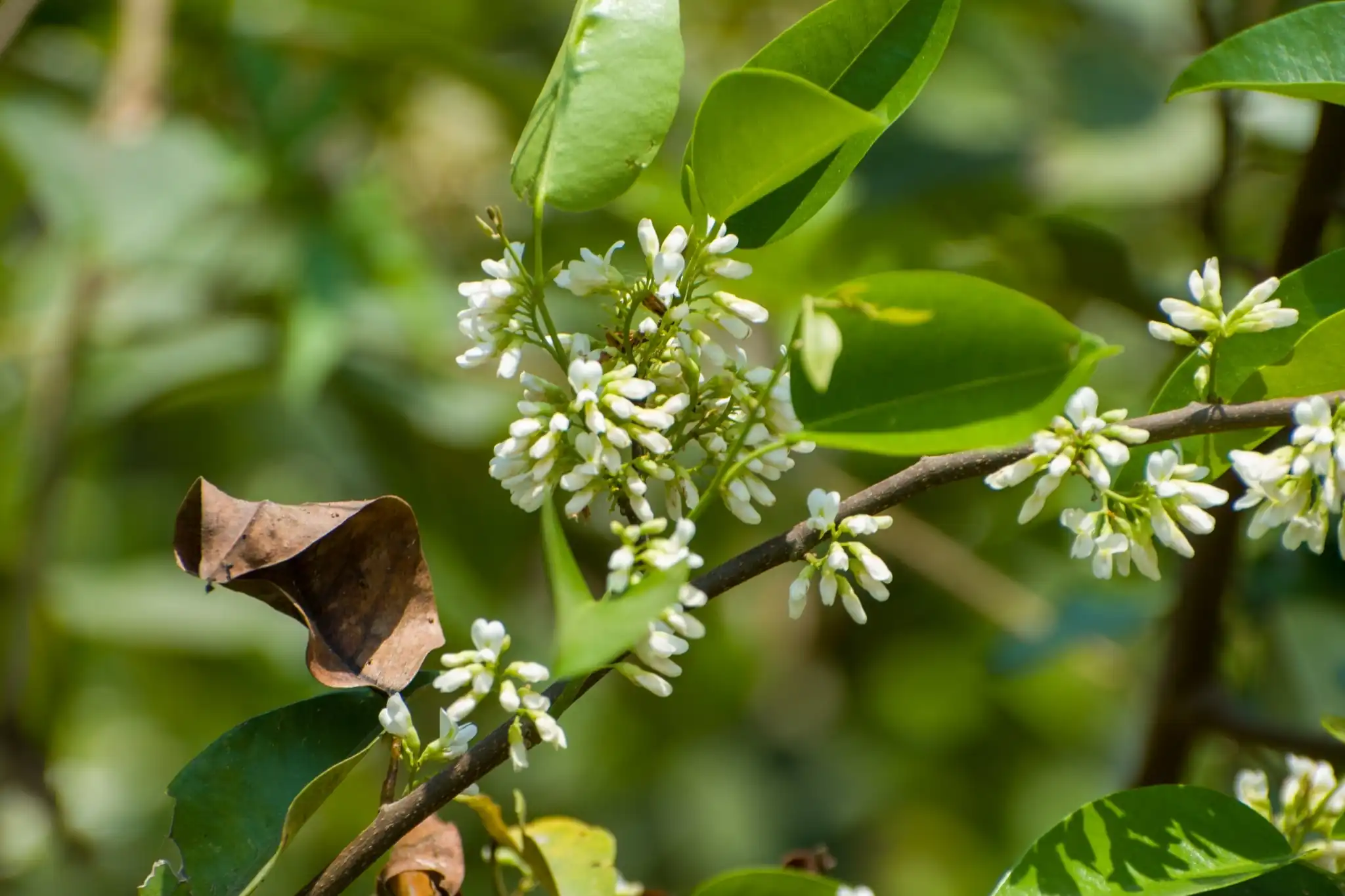
Dalbergia brownei is a neotropical legume that grows as a scrambling shrub or small tree, often climbing by long trailing stems. The leaves are unifoliolate with a single lustrous ovate leaflet 2 to 3 inches long on a jointed stalk, with young stems coated in reddish hairs.
It is separated from Coinvine relatives by that single heart-based leaflet with a pointed tip rather than several leaflets. In spring it carries corymbose panicles of small fragrant white pea flowers about one-third inch across on hairy axes.
Uses & Benefits:
Essentials
At a Glance
Plant Type
Vine
Height
394"
Width
144"
Light
Full Sun, Partial Sun
Zones
10
Water
Moist
Humidity
High
Lifespan
Woody perennial vine
Native To
South Florida, Mexico, Central America, Caribbean and northern South America
Toxicity
Unknown
Bloom period
Spring
In flower about 3 months of the year
Planting
How to Grow
- Plant nursery-propagated stock in spring in moist hammock soil at the base of a strong trellis or tree.
- Water to establish and keep the root zone moist; this is a wetland-margin plant for frost-free ground near lagoons and hammocks.
- Train the long stems onto support and allow room to climb to 20 to 30 feet.
- Leave established plants undisturbed and never collect from the wild.
Pro Tip
Set nursery-propagated stock at the foot of a stout support in frost-free, moist hammock ground and let it climb without cutting back into old bare wood.
Keep It Thriving
Care Guide
Do
- Do source only nursery-propagated plants with documented provenance.
- Do provide a sturdy support and room to scramble.
- Do keep soil moist in a frost-free, low-elevation position.
Don't
- Don't plant outdoors where frost occurs; it is a tropical lowland plant.
- Don't cut hard into old leafless stems.
- Don't wild-collect or confuse it with Dalbergia ecastaphyllum.
Seasonal Care Calendar
| Task | Jan | Feb | Mar | Apr | May | Jun | Jul | Aug | Sep | Oct | Nov | Dec |
|---|---|---|---|---|---|---|---|---|---|---|---|---|
| Mulch | ||||||||||||
| Pest Check | ||||||||||||
| Plant | ||||||||||||
| Prune |
Watch Out For
Pests & Diseases
Common Pests
In the Garden
Landscape Uses & Companions
Landscape Uses
Companion Plants
Multiply
Propagation Methods
Good to Know
Common Questions
Brown's Indian Rosewood questions
What zones can Brown's Indian Rosewood grow in?
Brown's Indian Rosewood is hardy in USDA Zone 10: in that range it survives winter in the ground. Colder than Zone 10, grow it in a container you can move to shelter for the winter, or as an annual.
When does Brown's Indian Rosewood bloom?
Brown's Indian Rosewood typically blooms in spring. Exact timing shifts a week or two with your zone — Sow's bloom calendar maps it to your garden.
Does Brown's Indian Rosewood need full sun?
Brown's Indian Rosewood does best in full sun to part shade. In hot climates, afternoon shade keeps blooms fresher longer.
More Dalbergia to compare
Keep exploring
Explore the genus
Hardy in your zone?
Grow Brown's Indian Rosewood with confidence
See it in a design of your actual yard, get zone-matched care reminders, and track it season by season in your garden journal.