The Story
Plant Bio
Oplopanax horridus, known as devil's club, is an erect, thicket-forming deciduous shrub native to moist understories and riparian corridors of northwestern North America. It forms spreading stands of thick stems clad in large, umbrella-shaped palmately lobed leaves that measure up to 16 inches across.
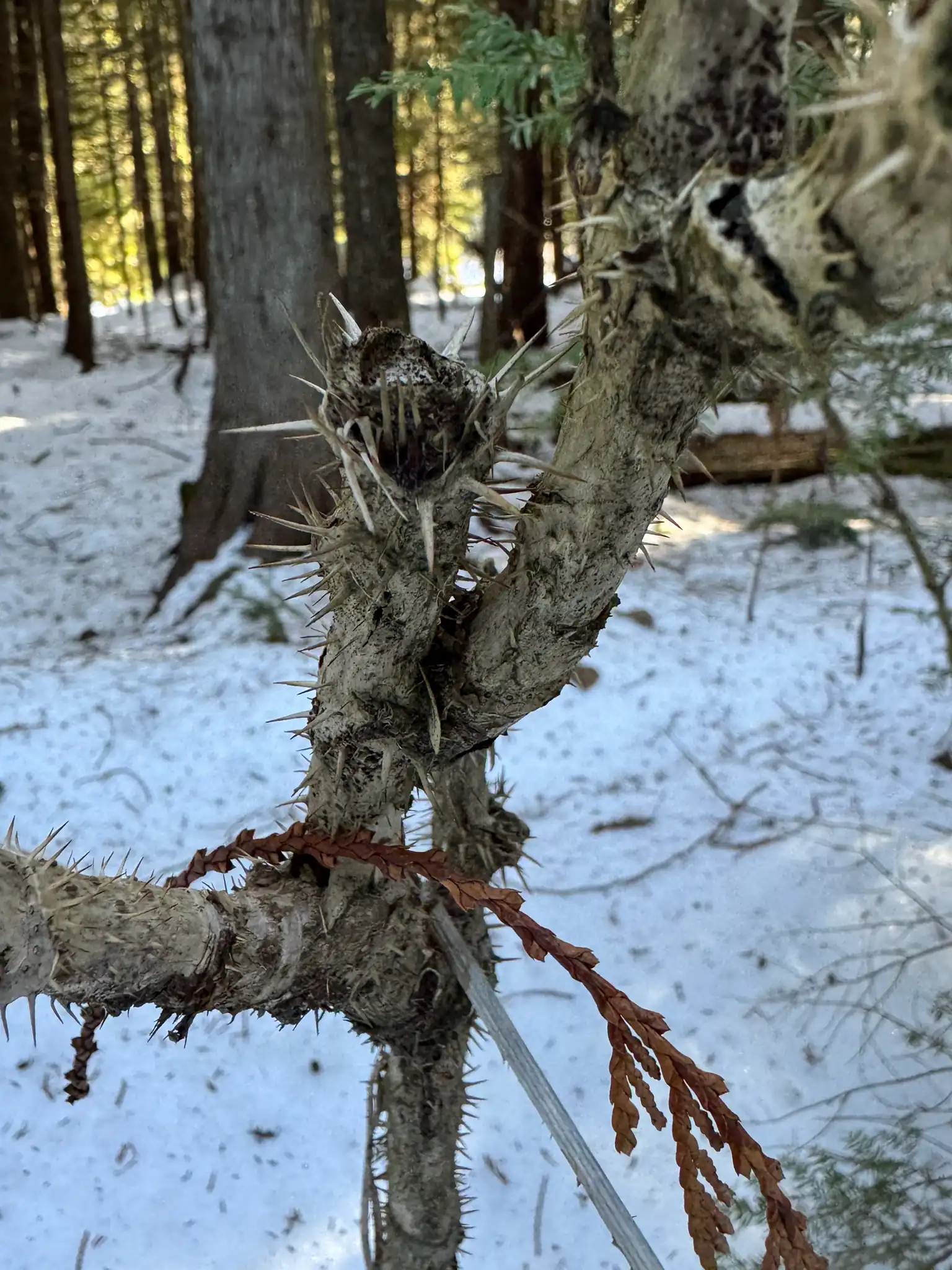
Every stem, leaf petiole, and primary vein carries a dense armor of sharp, brittle yellowish spines. Late spring brings terminal pyramidal spikes of greenish-white flowers that mature into dense clusters of scarlet berries by midsummer.
Uses & Benefits:
Essentials
At a Glance
Plant Type
Shrub
Height
144"
Width
118"
Light
Partial Sun, Shade
Zones
4, 5, 6, 7, 8, 9
Water
High
Humidity
High
Lifespan
Perennial
Native To
North America
Toxicity
Toxic if ingested; physical skin irritant
Bloom period
Spring – Summer
In flower about 6 months of the year
Planting
How to Grow
- Select a site with partial to full shade, sheltered from strong winds and harsh afternoon sun.
- Prepare rich, acidic to neutral soil heavily amended with compost or organic leaf mold.
- Plant at original container depth and water thoroughly to settle roots.
- Maintain high soil moisture constantly, never allowing the root zone to dry out.
Pro Tip
Never prune into old leafless wood, as stems regenerate poorly; handle canes strictly with heavy forestry or welder's gloves to prevent brittle spines from embedding under skin.
Keep It Thriving
Care Guide
Do
- Maintain a thick layer of organic leaf mold to retain consistent moisture.
- Wear heavy leather gloves whenever handling or pruning stems.
- Plant in deep shade or damp, sheltered woodland microclimates.
Don't
- Do not allow the soil to dry out during dry summer spells.
- Do not prune hard into old, leafless wood.
- Do not plant near high-traffic garden pathways due to physical spine hazards.
Seasonal Care Calendar
| Task | Jan | Feb | Mar | Apr | May | Jun | Jul | Aug | Sep | Oct | Nov | Dec |
|---|---|---|---|---|---|---|---|---|---|---|---|---|
| Mulch | ||||||||||||
| Pest Check | ||||||||||||
| Prune | ||||||||||||
| Spring Cleanup |
Watch Out For
Pests & Diseases
Common Pests
Common Diseases
In the Garden
Landscape Uses & Companions
Landscape Uses
Companion Plants
Multiply
Propagation Methods
Good to Know
Common Questions
Devil's Club questions
What zones can Devil's Club grow in?
Devil's Club is hardy in USDA Zones 4–9: in that range it survives winter in the ground. Warmer than Zone 9, winter isn't the problem: it prefers colder winters, and summer heat can shorten its life.
Is Devil's Club deer resistant?
Not reliably. Deer may browse Devil's Club, especially tender spring growth — plan on repellents or fencing where pressure is high.
When does Devil's Club bloom?
Devil's Club typically blooms from spring to summer. Exact timing shifts a week or two with your zone — Sow's bloom calendar maps it to your garden.
Does Devil's Club need full sun?
Devil's Club does best in part shade.
Keep exploring
Explore the genus
Grow Devil's Club with confidence
See it in a design of your actual yard, get zone-matched care reminders, and track it season by season in your garden journal.