The Story
Plant Bio
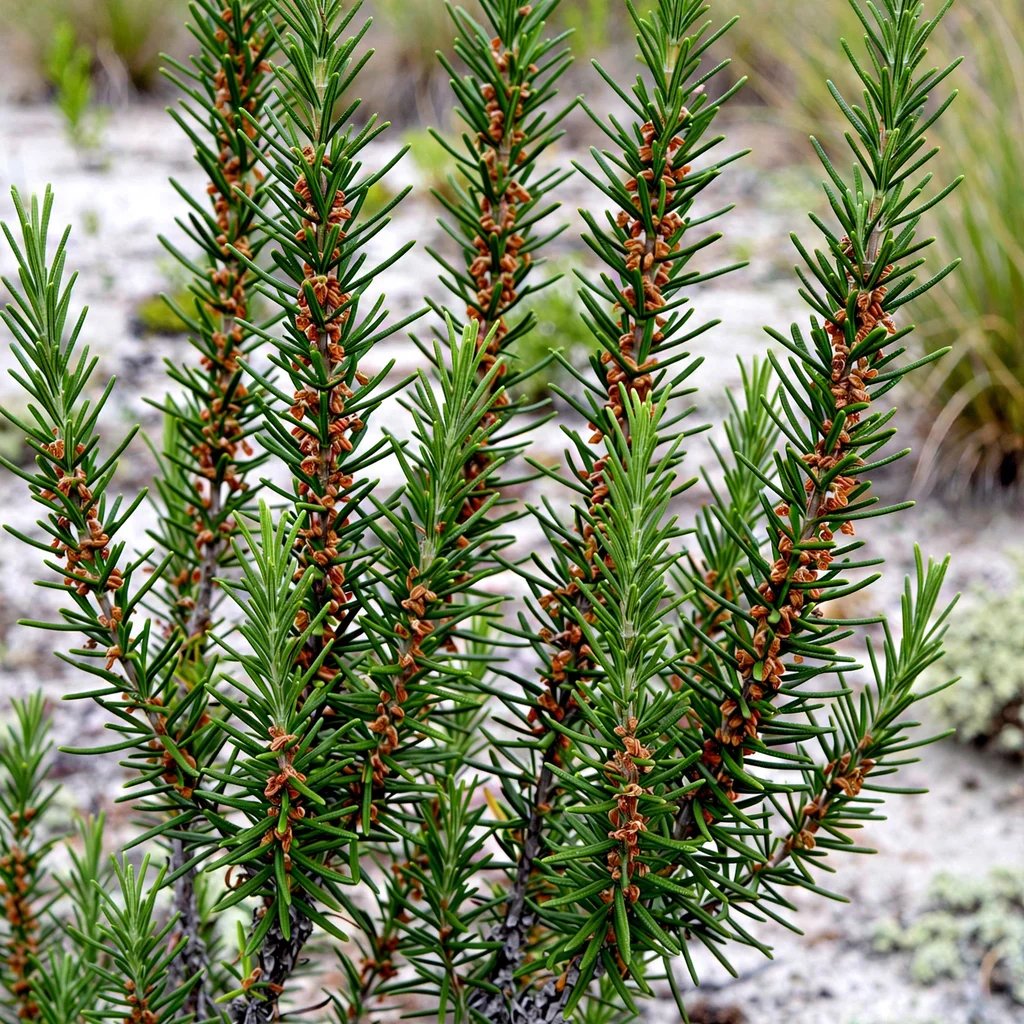
Ceratiola ericoides, the Florida rosemary, is an evergreen shrub reaching four to eight feet tall and wide, with many erect stems clothed in dark green needle-like leaves 8 to 15 mm long that smell of rosemary and honey in warm weather. Male and female flowers grow on separate plants as small papery yellow to bronze clusters tucked in the leaf axils from early spring to early summer.
Older stems develop gray shredding bark on a dense rounded frame, and the foliage releases allelopathic ceratiolin that suppresses competing seedlings in the surrounding sand. Seed carries deep fire-linked dormancy, so plants establish only in deep acidic silica sand with exceptional drainage and fail quickly in rich loam or irrigated soil.
Uses & Benefits:
Essentials
At a Glance
Plant Type
Shrub
Height
96"
Width
96"
Light
Full Sun
Zones
8, 9, 10
Water
Low
Humidity
Tolerant of coastal humidity if drainage is sharp
Lifespan
Long-lived woody shrub
Native To
Southeastern U.S. coastal plain
Toxicity
Non-toxic
Bloom period
Early spring – Early summer
In flower about 4 months of the year
Planting
How to Grow
- Plant in fall into deep, coarse, acidic sand in full sun, setting the rootball at the same depth it grew in the container.
- Disturb roots as little as possible and water in once to settle the sand around them.
- Withhold fertilizer entirely and withhold routine irrigation once established.
- Keep heavy mulch, loam, and competing groundcovers away from the crown to maintain sharp drainage.
- Leave established plants undisturbed; do not move or root-prune mature shrubs.
Pro Tip
Set it in deep dry sand in full sun and leave the roots alone; never cut back into old leafless wood because those stems do not resprout.
Keep It Thriving
Care Guide
Do
- Plant in excessively drained silica sand with full sun exposure.
- Allow soils to stay dry between rains and favor fall planting for root establishment.
- Source seed-grown or cutting-grown container stock from native nurseries.
- Leave leaf litter sparse to preserve the open sand surface it requires.
Don't
- Do not plant in clay, loam, or standard potting mix with regular irrigation.
- Do not fertilize or enrich the sand with compost or manure.
- Do not prune hard into old leafless stems.
- Do not dig, divide, or transplant established plants.
Seasonal Care Calendar
| Task | Jan | Feb | Mar | Apr | May | Jun | Jul | Aug | Sep | Oct | Nov | Dec |
|---|---|---|---|---|---|---|---|---|---|---|---|---|
| Pest Check | ||||||||||||
| Plant | ||||||||||||
| Propagate | ||||||||||||
| Prune |
Watch Out For
Pests & Diseases
Common Pests
Common Diseases
In the Garden
Landscape Uses & Companions
Landscape Uses
Companion Plants
Multiply
Propagation Methods
Good to Know
Common Questions
Florida Rosemary questions
What zones can Florida Rosemary grow in?
Florida Rosemary is hardy in USDA Zones 8–10: in that range it survives winter in the ground. Colder than Zone 8, grow it in a container you can move to shelter for the winter.
When does Florida Rosemary bloom?
Florida Rosemary typically blooms from early spring to early summer. Exact timing shifts a week or two with your zone — Sow's bloom calendar maps it to your garden.
Does Florida Rosemary need full sun?
Florida Rosemary does best in full sun (6+ hours).
Is Florida Rosemary drought tolerant?
Yes — once established (usually after the first full season), Florida Rosemary handles dry spells with minimal watering. Water deeply its first year to build the root system that makes that possible.
Keep exploring
Explore the genus
Hardy in your zone?
Grow Florida Rosemary with confidence
See it in a design of your actual yard, get zone-matched care reminders, and track it season by season in your garden journal.