The Story
Plant Bio
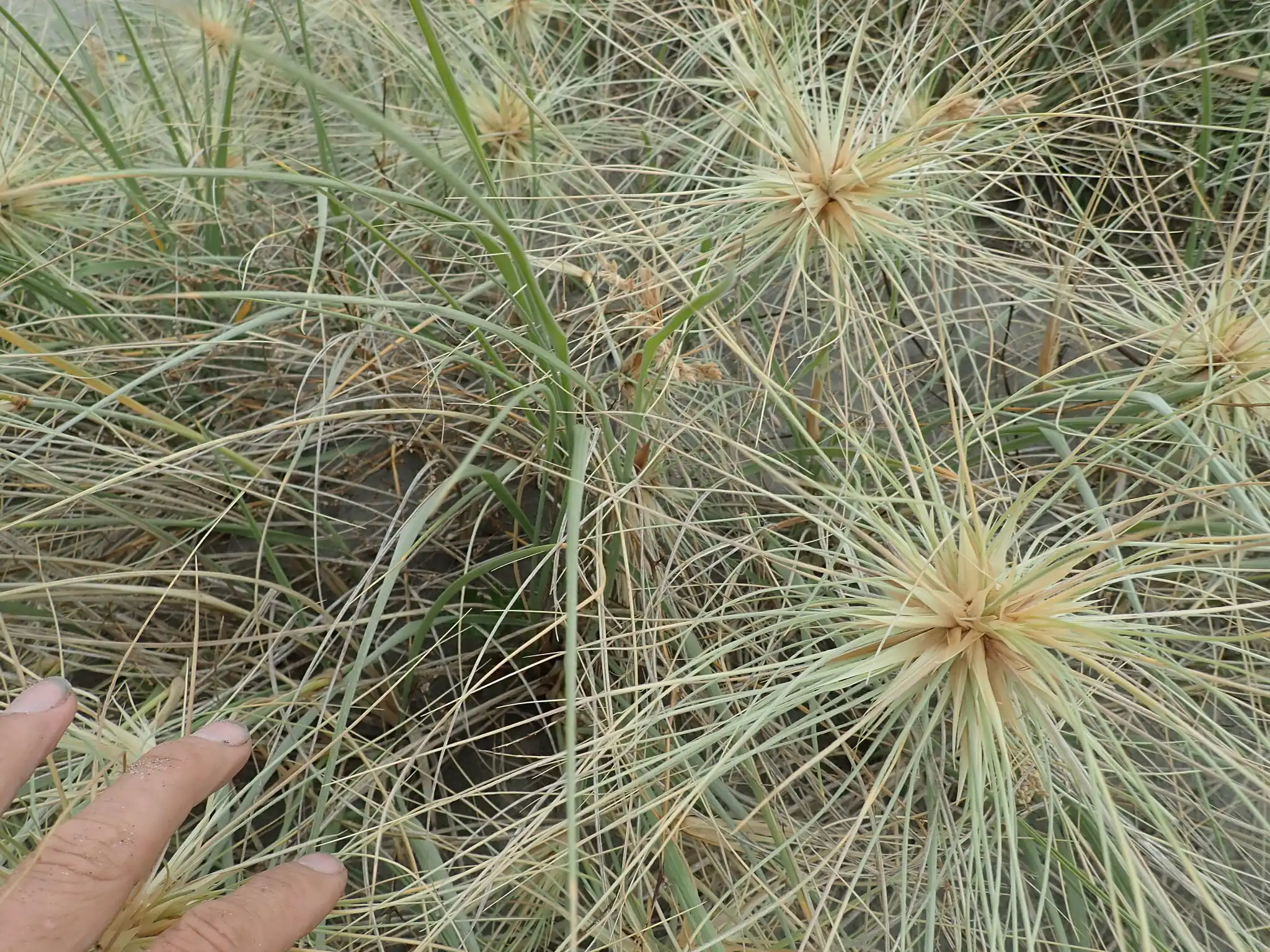
Spinifex sericeus is a stout, creeping perennial dune grass native to Oceania, spreading via branched rhizomes and runners to bind coastal sands. The rigid linear leaves are covered in dense silky hairs that give the plant a silvery-grey appearance while deflecting high heat and reducing water loss.
This species is dioecious, producing male and female flowers on separate plants during summer. Female inflorescences form large spherical heads up to eight inches across that detach at maturity and tumble across dunes to disperse seeds.
Uses & Benefits:
Essentials
At a Glance
Plant Type
Grass
Height
35"
Width
197"
Light
Full Sun
Zones
9, 10
Water
Low
Humidity
Moderate to High
Lifespan
Perennial
Native To
Oceania
Toxicity
Non-toxic (sharp spiny foliage)
Bloom period
Summer
In flower about 3 months of the year
Planting
How to Grow
- Select a planting site receiving full sun with pure sand or exceptionally fast-draining substrate.
- Set plugs or potted plants into the sand at the same depth as their nursery containers.
- Water lightly at planting to settle sand closely around the root mass.
- Withhold all nitrogen and phosphorus fertilizers to avoid burning sensitive roots.
- Allow natural rainfall to sustain established plants without supplemental irrigation.
Pro Tip
Grow exclusively in pure, unamended sand with full sun exposure; fertilizer applications and moisture-retentive soils cause immediate root rot.
Keep It Thriving
Care Guide
Do
- Plant in full sun and pure sandy substrate
- Ensure exceptionally sharp drainage around root zones
- Allow space for sprawling runners to creep across sand
Don't
- Do not apply nitrogen or phosphorus fertilizers
- Do not plant in heavy loam or clay soils
- Do not cut back into old leafless stolons
- Do not overwater established plantings
Seasonal Care Calendar
| Task | Jan | Feb | Mar | Apr | May | Jun | Jul | Aug | Sep | Oct | Nov | Dec |
|---|---|---|---|---|---|---|---|---|---|---|---|---|
| Pest Check | ||||||||||||
| Prune | ||||||||||||
| Spring Cleanup | ||||||||||||
| Winter Prep |
Watch Out For
Pests & Diseases
Common Pests
Common Diseases
In the Garden
Landscape Uses & Companions
Landscape Uses
Companion Plants
Multiply
Propagation Methods
Good to Know
Common Questions
Hairy Spinifex questions
What zones can Hairy Spinifex grow in?
Hairy Spinifex is hardy in USDA Zones 9–10: in that range it survives winter in the ground. Colder than Zone 9, grow it in a container you can move to shelter for the winter, or as an annual.
When does Hairy Spinifex bloom?
Hairy Spinifex typically blooms in summer. Exact timing shifts a week or two with your zone — Sow's bloom calendar maps it to your garden.
Does Hairy Spinifex need full sun?
Hairy Spinifex does best in full sun (6+ hours).
Is Hairy Spinifex drought tolerant?
Yes — once established (usually after the first full season), Hairy Spinifex handles dry spells with minimal watering. Water deeply its first year to build the root system that makes that possible.
Keep exploring
Explore the genus
Hardy in your zone?
Grow Hairy Spinifex with confidence
See it in a design of your actual yard, get zone-matched care reminders, and track it season by season in your garden journal.