Quick answer
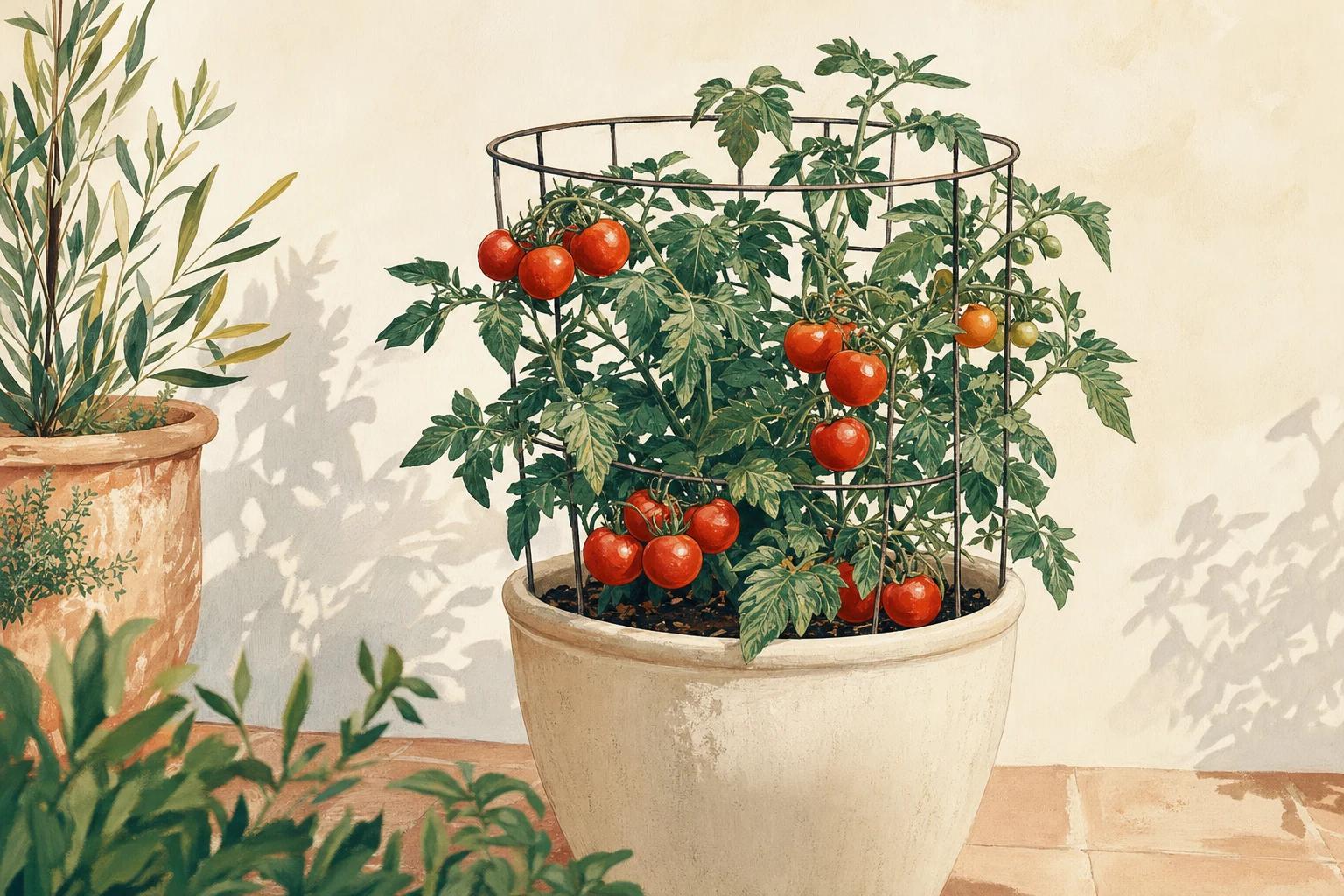
Grow one compact determinate or dwarf tomato per container of at least 5 gallons (19 L) with drainage holes, filled with fresh soilless potting mix, never garden soil. Set it out after frost once the mix holds at least 60°F (16°C), in 6 to 8 hours of sun, with a cage installed at planting. Water whenever the top 2 inches (5 cm) dry out and feed about weekly.
Key facts
- Pot size
- 5 gal (19 L) for full-size plants; 2–5 gal (7.6–19 L) for patio cherries; bigger than 5 gal for vining types
- Plants per pot
- One
- Growing medium
- Fresh soilless potting mix; never garden soil or topsoil
- Plant out
- After the last frost, once the mix is at least 60°F (16°C); roots do best at 65°F (18°C) or warmer
- Sun
- 6 hours minimum, 8 hours better; shade pots through the hottest part of summer days
- Water
- When the top 2 in (5 cm) is dry: daily, or twice a day in summer heat
- Feed
- About weekly once the starter fertilizer is spent; potassium at least equal to nitrogen
- Pets
- Leaves and stems are toxic to dogs, cats and horses; ripe fruit is not
A tomato crops well in a pot when three things line up: a variety sized for the container, a container big enough to buffer water and heat, and a daily check of the mix in summer. Five gallons (19 L) is the practical floor for one full-size plant. Patio cherries manage with less, and true vining types need more room and a tall cage.
The most common fruit problems in pots, blossom end rot and split fruit, trace back to water rather than soil or fertilizer. A few gallons of potting mix can swing from soaked to dry in a single hot day, and those swings are what cause both. Leave about 1 inch (2.5 cm) of space below the rim when you fill the pot, so each watering has room to pool and soak down through the mix.
Choose a tomato sized for the pot
Pick a determinate, patio or dwarf variety for any pot of 5 gallons (19 L) or less, and save full vining types for the largest containers you own.
Growth habit decides how a tomato behaves in a pot. Determinate varieties stop growing at a set height, anywhere from 6 inches (15 cm) to about 4 feet (1.2 m) depending on the cultivar, and set most of their crop over a few weeks. Indeterminate varieties keep lengthening and setting fruit until frost, which makes them hard to keep in proportion with a container. Not every determinate is small, so read the mature height on the label rather than trusting the word.
| Variety | Type | Plant size | Days to harvest | Why it suits a pot |
|---|---|---|---|---|
| 'Red Robin' | Micro dwarf cherry (determinate) | 8–12 in (20–30 cm) tall | 55 | Fits a pot as small as 8 in (20 cm) across |
| 'Patio Choice Yellow' | Determinate cherry | About 18 in (45 cm) tall | — | Yellow cherries of about 1/2 oz (14 g) on a short plant |
| 'Little Napoli' | Determinate paste | Compact bush (height not listed) | — | A sauce tomato on a plant sized for containers |
| 'Bush Early Girl' | Determinate slicer | About 18 in (45 cm) tall, 36 in (90 cm) wide | 65 | 6 oz (170 g) fruit on a self-supporting plant |
| 'Tidy Treats' | Dwarf indeterminate cherry | Compact vine (height not listed) | 60 | About 1/4 oz (6–8 g) cherries; sold for containers only; a standard cage holds it |
| 'Sun Gold' | Indeterminate cherry | Full-size vine | 57 | Only in an extra-large pot with tall support and pruning |
Days are seed-company figures, counted from transplanting where the company states a basis; a dash means no seed-company figure was found. Cool summers stretch them.
'Celebrity', a determinate red slicer, also suits a 5-gallon pot with a cage set at planting, and it is among the varieties less prone to blossom end rot. Paste and roma types such as 'Little Napoli' are the opposite: their long fruit gets blossom end rot more readily than small round ones, so they reward the steadiest watering you can manage.
'Better Boy', 'Early Girl', 'Rutgers', 'Brandywine' and 'Cherokee Purple' are all indeterminate and make poor choices for ordinary containers. If you want a vining tomato anyway, a cherry type in a big pot with a large cage and regular sucker removal is the workable compromise. 'Sun Gold' fits that role, though its fruit splits readily.
Varieties for hot and cool summers
Where summers run hot, as across the South, choose heat-set varieties, which keep setting fruit when other tomatoes drop their flowers. Good ones include 'Solar Fire', 'Bella Rosa', 'Phoenix', 'Red Bounty' and 'Tribute'. Heirloom varieties are more sensitive to heat than modern hybrids, so plant them soon after the last frost to get fruit set before midsummer.
Where summers are short or cool, as in the mountain West or the Pacific Northwest, choose early determinates such as 'Gold Nugget' (cherry) and 'Cordova' (paste). 'Santiam' and 'Siletz' are mid-season determinate slicers bred in Oregon that set seedless fruit without pollination, so they still crop when nights are too cold for pollen to form. In the coldest areas pick the fewest days to maturity you can find, and add at least 10 days to 2 weeks to the packet figure in high, cool valleys such as central Oregon.
Container size, material and drainage
Use a container of at least 5 gallons (19 L) with drainage holes for any full-size tomato, and go bigger whenever you have the choice.
A larger volume of mix holds more water and more nutrients, so it stretches the time between waterings and evens out the swings that damage fruit. Small pots heat up and dry out fastest. Very large pots warm, cool and dry slowly, but they can stay soggy in the bottom, which is why the mix should get coarser as the pot gets bigger.
| Tomato type | Examples | Minimum container | Support |
|---|---|---|---|
| Micro dwarf cherry (determinate) | 'Red Robin' | Pot 8 in (20 cm) across | Usually none |
| Patio or determinate cherry | 'Patio Choice Yellow' | 2–5 gal (7.6–19 L), 12–18 in (30–45 cm) deep | Small cage, or none |
| Determinate slicer or paste | 'Bush Early Girl', 'Little Napoli', 'Celebrity' | 5 gal (19 L); 14–20 in (35–50 cm) across | Cage set at planting |
| Dwarf indeterminate cherry | 'Tidy Treats' | 5 gal (19 L) | Standard cage |
| Full indeterminate | 'Sun Gold', 'Better Boy' | Larger than a 5-gal bucket; never a 12-in (30 cm) pot | Cage at least 24 in (60 cm) across, or a stake |
Minimums for one plant per pot. Every step up in size buys more time between waterings.
Grow one plant per container. Crowding does not raise the harvest, and it increases leaf disease. At the very smallest, a cherry tomato can get by in 2 gallons (7.6 L, about 10 inches or 25 cm across) and a standard one in 4 gallons (15 L, about 12–14 inches or 30–35 cm across), but pots that small need watering even more often.
Material and color
Container material sets how fast the mix dries, and so how often you will water.
| Material | How fast it dries | Watch for |
|---|---|---|
| Terra cotta (unglazed clay) | Fastest | Avoid small sizes, which dry out too fast |
| Concrete or hypertufa | Fairly fast | Higher cost |
| Wood | Slower than clay, faster than plastic | Red cedar or redwood; skip treated lumber for planters |
| Glazed ceramic | Slower than terra cotta | Higher cost |
| Plastic | Slowest | Light enough to tip once the plant is tall |
Choose a slower-drying material if you cannot check pots every day.
For how long cedar and redwood last outdoors, see cedar raised garden beds.
Fabric grow bags are porous, like pressed-fiber pots, so they dry faster than plastic; check them every day in summer. Color matters as much as material. Dark pots warm up usefully in spring and fall, but in summer sun they get hot enough to slow root growth or damage roots. Choose light-colored plastic, or shade the sides of a dark pot through the hottest part of the day. Setting the pot on the ground rather than on a stand also keeps the mix cooler.
Weight is the other practical limit, especially on a deck or balcony. A large container of moist mix is far too heavy to carry, so set a big pot on a wheeled caddy before you fill it rather than trying to lift it later.
Drainage and reused containers
Every container needs drainage holes. A 5-gallon bucket works well once you drill several holes in it; holes in the side a few inches above the base leave a shallow reservoir of water the roots can draw on between waterings. Skip the layer of gravel in the bottom: water collects in the mix just above it instead of draining away, so fill the whole pot with mix.
Never grow food in a bucket or tub that once held chemicals or other toxic materials. Scrub any used pot and soak it in a 10 percent bleach solution, one part household bleach to nine parts water, to kill disease spores left from last year.
Potting mix, never garden soil
Fill the pot with fresh soilless potting mix: garden soil and topsoil pack down in a container and starve the roots of air.
A good container mix combines an organic base such as peat moss, composted pine bark or coir with perlite, vermiculite or sand for drainage. Well-made, herbicide-free compost is a useful addition. Avoid mixes that are mostly peat, because peat compresses over a summer and shrinks the space the roots have to grow. For a large pot, pick a coarser blend with less peat and more composted pine bark so the bottom does not stay waterlogged.
Mixes rich in compost carry their own food: a large container whose mix is more than 25 percent compost may need little or no added fertilizer. To supply calcium, a common practice is to blend about 1 cup (240 mL) of garden lime into each 5 gallons (19 L) of mix. It helps a little against blossom end rot, but steady watering matters far more.
Start each season with new mix if last year's plants had leaf spots or blight, because the spores survive on old leaves and roots. If you do reuse clean mix, pick out every scrap of old plant material first. For more on choosing mixes and pots for the rest of the patio, see container gardening for beginners.
When and how to plant
Plant after your last frost once the mix stays at 60°F (16°C) or warmer, setting the stem deeper than it grew in the nursery pot and installing the cage the same day.
Timing
Tomatoes grow and fruit best with a root zone of 65°F (18°C) or more and air temperatures of 60°F (16°C) or higher. They need nights above 32°F (0°C) to survive, and a week of days below 55°F (13°C) stunts the plants and cuts the eventual harvest, so never plant into a cold spell. For plants in the ground the rule is two to three weeks after the average last frost date, which you can look up in Sow's garden calendar. A pot can go out a little sooner because its mix warms faster than garden soil, as long as you can bring it in on cold nights.
In practice the window runs from mid-April to early May in Tennessee, May 1–10 in western Oregon and late May on the Colorado Front Range; the guide to when to plant tomatoes gives dates by city.
Harden off plants raised indoors by giving them a few more hours outside each day for several days, so they adjust to cooler air, lower humidity and brighter light. The ideal transplant is dark green, 6–8 inches (15–20 cm) tall, with a stem about as thick as a pencil and no pinched or cut tips.
How to plant a tomato in a container
- Put the pot in its sunny spot. Set the empty container where it will get at least 6 hours of direct sun before you fill it, because a pot of wet mix is hard to move.
- Fill with mix and starter fertilizer. Blend controlled-release fertilizer into the mix unless the bag already lists a starter charge, and add lime at this stage if you use it.
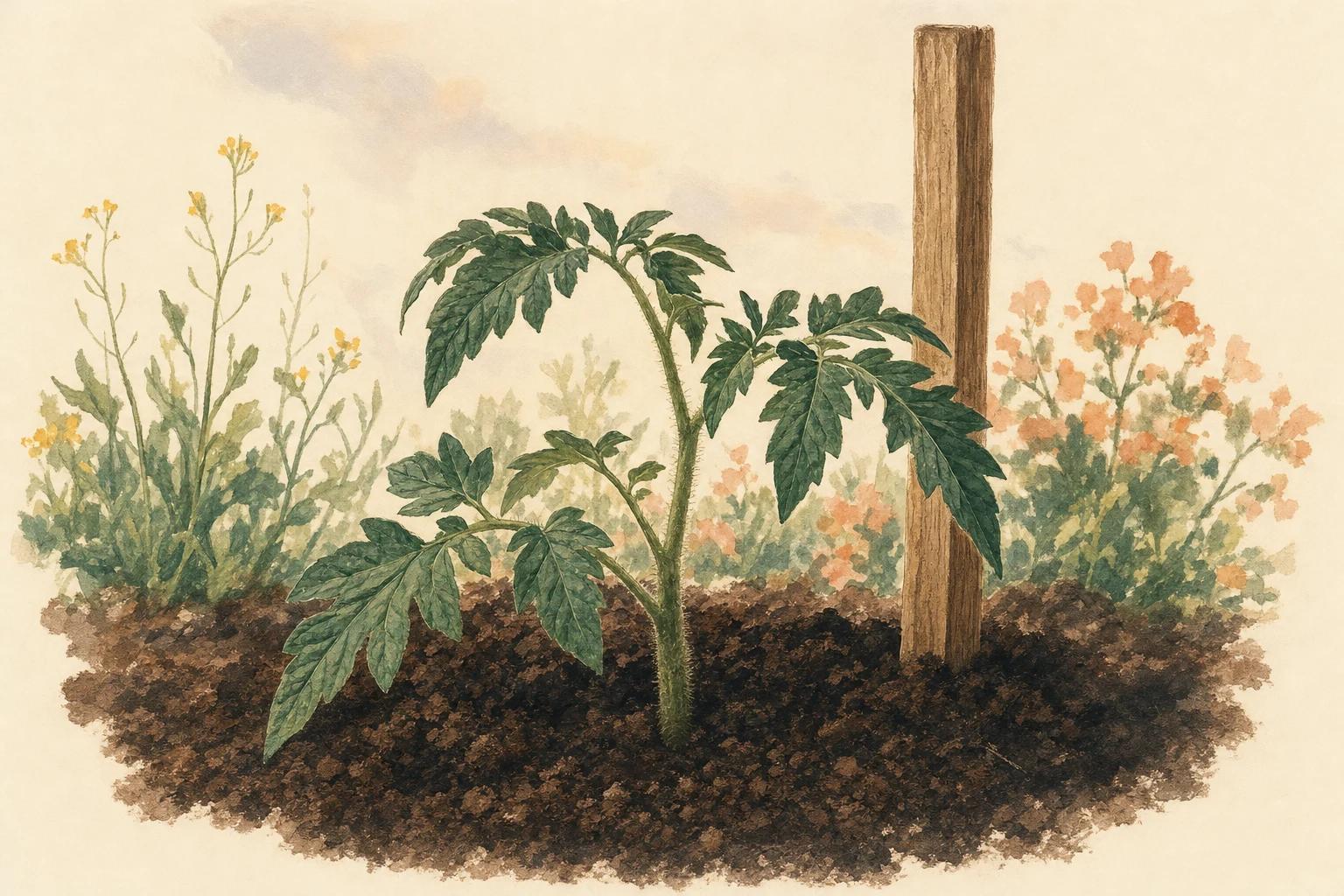
- Set the plant deeper than it grew. A stocky transplant goes in slightly deeper than it sat in its nursery pot. Bury a leggy one at an angle so only the top two or three sets of leaves show. Strip the leaves from the part that goes underground, and keep the graft union of a grafted plant above the mix.
- Loosen roots and firm gently. Tease apart roots circling the root ball and press the mix lightly around them, stopping short of packing it so water can still flow through.
- Install the cage or stake now. Pushing a support in later stabs through roots that have already spread. Most store-bought cages are too small for full-size varieties, so use one at least 24 inches (60 cm) across with 4-inch (10 cm) mesh for anything larger than a patio type.
- Water until it drains. Soak the pot until water runs from the holes, then top up any mix that settles so about 1 inch (2.5 cm) of space remains below the rim to hold each watering.
- Mulch the surface once the mix is warm. In a cool spring, wait until the weather settles; then a layer of straw or compost slows evaporation and keeps mix from splashing onto the lowest leaves.
On staked plants, train the vine to one or two main stems by removing suckers, the shoots that form where a leaf meets the stem; at a minimum, take off every sucker below the first flower cluster.
Tomato leaves and stems contain solanine and are toxic to dogs, cats and horses. A pet that chews the foliage can drool, refuse food, vomit or have diarrhea, and become weak or lethargic with dilated pupils and a slow heart rate. Ripe fruit is not considered toxic. Keep pots on decks and balconies out of reach of animals that chew plants, and call your veterinarian if one eats the leaves.
Sun, heat and flower drop
Give a container tomato at least 6 hours of direct sun, and 8 if you can; in the hottest weeks of summer, shade the pot through the hottest part of the day.
Flowers often abort when days climb past 85°F (29°C) while nights stay above 72°F (22°C), and some varieties drop them on warm nights alone, even when days stay cooler. Blossoms that open on a morning that reaches 90°F (32°C) by 10 a.m. usually fall. Heat-set varieties keep setting fruit longest.
A hot spell of a week or less does little lasting harm, and fruit set resumes once temperatures ease. Keep pots away from brick or concrete paving that holds heat and reflects it onto them, or move them to a cooler spot for the afternoon.
Cold nights cause the same symptom for a different reason. Below 55°F (13°C), pollen fails to develop and the flowers that open the next morning will not set. On the Colorado Front Range even July and August nights have only about even odds of staying above 55°F (13°C), and central Oregon sees the same problem; it is one more reason not to rush planting. If flowers fall in mild weather, look at your feeding instead (see below).
Watering container tomatoes
Water until it runs from the drainage holes, then water again as soon as the top 2 inches (5 cm) of mix feel dry; in summer that can mean twice a day.
Push a finger into the mix to the second knuckle every day. Small pots in hot sun can need water once or more a day, and even deep containers need a daily check in summer. How regularly you water matters as much as how much: a plant that wilts between waterings, then gets flooded, is the classic setup for blossom end rot and cracked fruit.
Water the mix at the base of the plant rather than the leaves, and do it in the morning so any splashed foliage dries before night; wet leaves late in the day invite leaf-spot disease. Let roughly 10 percent of what you pour run out the bottom each time. That flush carries away the fertilizer salts that build up in a pot and otherwise burn leaf edges, stunt growth and cut flowering.
If you cannot water daily, or twice a day in a heat wave, grow in a self-watering container with a built-in reservoir. Drip lines on a timer help during a vacation but do not replace looking at the plants, and a mulch of straw or compost on the surface noticeably slows drying.
Water that has passed through a water softener carries sodium in place of calcium and magnesium, which harms container plants. Use water from a tap that bypasses the softener.
Feeding schedule
Once the starter fertilizer in the mix is spent, feed a water-soluble fertilizer about weekly, switching to one with at least as much potassium as nitrogen when the first fruits reach cherry size.
Potting mix holds little food and loses some with every watering. A plain starter charge can be gone within a couple of weeks, while a mix with controlled-release fertilizer lasts about 8–10 weeks; check the bag, then start liquid feeding.
| Stage | What to feed | How often |
|---|---|---|
| At planting | Controlled-release granules mixed in, or a mix with a starter charge | Once |
| Before flowering | Balanced water-soluble fertilizer (1-1-1 ratio, such as 20-20-20) | Weekly |
| Fruits at cherry size onward | Potassium-rich formula, third number at least equal to the first | Weekly |
| Simpler alternative | 15-30-15 or 20-20-20 water-soluble | Every 1–2 weeks |
Mix at the label rate. Small pots and hot weather call for the shorter interval.
Potassium matters because excess nitrogen builds leaves at the expense of fruit. Too much nitrogen can also make flowers drop, and so can the salts from heavy feeding. Yellowing lower leaves in midsummer are the opposite signal: the plant has run short of nitrogen, which also lets early blight spread up the plant, so resume or increase feeding.
Blossom end rot, cracking and other problems
Most fruit problems in pots come from uneven watering, and steady moisture prevents blossom end rot and cracking better than any additive.
Blossom end rot
Blossom end rot is a sunken patch that turns brown to black on the end of the fruit opposite the stem. It is a disorder, not an infection: it happens when too little calcium reaches the developing fruit, often even when the mix holds enough. Dry spells, alternating wet and dry mix, cold or waterlogged roots and heavy nitrogen feeding all bring it on, which is why container tomatoes get it so often.
Damaged fruit cannot recover, so pick it off. If the skin over the patch is unbroken, the rest of the fruit is still edible. Calcium sprays on the leaves are not very effective. The real fix is the watering routine described above, a reservoir container if you are often away, mulch on the surface, and lime in next year's mix. Cherry tomatoes and varieties such as 'Celebrity' and 'Mountain Pride' are less susceptible.
Cracked and split fruit
Cracking follows the same uneven moisture that drives blossom end rot: a dry spell, then a flood of water. Steady watering and prompt picking prevent most of it. Cherry types such as 'Sun Gold' can split soon after ripening, so pick them slightly before full color.
Leaf diseases
Early blight starts as small dark spots on the lowest leaves that enlarge into rings like a target, and Septoria leaf spot shows as many small round brown spots. Both survive the winter on old tomato, pepper, potato and eggplant debris and splash up onto the lower leaves. Remove spotted leaves promptly, clip off the lowest leaves so none touch the mix, keep foliage dry, and choose resistant varieties next year. Avoid handling plants while they are wet, and wash your hands after touching diseased leaves. If you use a fungicide, follow its label exactly.
Pests
The tomato hornworm is a large green caterpillar with a black horn at its tail and eight white V-shaped marks on each side; it strips leaves fast and chews into fruit. Picking it off by hand is the most effective control. The biological insecticide Bt (kurstaki strain) works best on very young caterpillars. Leave any hornworm carrying white, rice-like cocoons, because those are parasitic wasps that will attack the next generation. Deer browse potted tomatoes, chipmunks take ripe fruit, and slugs and earwigs climb into containers, so check under the rim and leaves.
Harvest and the end of the season
Pick tomatoes once they show 60 to 80 percent of their final color and let them finish indoors; store ripe fruit at room temperature, because chilling dulls its flavor, and refrigerate only fruit you cannot use within a few days.
Fruit left to ripen fully on the vine has the best flavor, but picking a little early protects cherries and large slicers from cracking and from chipmunks. Before a hard frost, pick every green fruit that has reached about three-quarters of its full size. Brought indoors, it ripens in about two weeks at 65–70°F (18–21°C); keep it above 50°F (10°C), because colder storage leaves it bland.
When the plant is finished, cut it out, bag the stems and leaves, and keep them out of the compost unless your pile reliably heats to 145°F (63°C), since the leaf-spot fungi survive on that debris. Empty the old mix, scrub the pot and store it dry. Before next spring, plan where each pot will catch 6 to 8 hours of sun with Sow's garden design studio, and if you are ready to move tomatoes into the ground, see how to build a raised garden bed.
Frequently asked questions
How many tomato plants per 10 gallon container?
One. A 10-gallon (38 L) pot is not two 5-gallon spaces; it is one plant with more water and nutrients in reserve, so it needs watering less often and suffers fewer moisture swings. Two plants in one pot compete for the same water and shade each other, and crowding raises disease without raising the harvest. Use the extra volume for a larger variety or a vigorous cherry vine.
Where should I put a tomato pot on a hot patio?
Somewhere it gets 6 to 8 hours of direct sun, with shade for the pot through the hottest part of the day at the peak of summer. Keep it away from brick or concrete paving that holds heat and reflects it onto the pot. Choose a light-colored pot or shade the sides of a dark one, and set it on the ground rather than on a stand so the mix stays cooler.
What do coffee grounds do for tomato plants?
Very little that you can count on. Used grounds are not reliably acidic, with measured pH anywhere from 4.6 to 8.4, and their effect on plant growth as they break down is unpredictable. Pure grounds spread as mulch pack into a crust that blocks water and air. If you use them, keep them to about 20 percent of a compost pile; in a pot, the potting mix and fertilizer drive the result.
What is the best way to plant tomato plants?
Choose a stocky, dark green transplant about 6 to 8 inches (15 to 20 cm) tall with a stem as thick as a pencil, and harden it off outdoors for several days first. Plant it after frost into fresh mix, slightly deeper than it grew in the nursery pot, and push the cage in the same day. A leggy plant can go in at an angle with most of its stem buried.
What are 9 common mistakes to avoid when growing tomatoes?
In containers the usual nine are: a pot that is too small, garden soil instead of potting mix, watering that swings between soaked and dry, a dark pot baking in full sun, too much nitrogen, staking after the roots have spread, softened tap water, planting out while nights are still cold, and reusing last year's diseased mix. Most of them show up as blossom end rot, dropped flowers or split fruit.
What is the best tomato for a 5-gallon bucket?
A compact determinate or dwarf variety. 'Bush Early Girl' gives 6-ounce (170 g) slicers on a self-supporting plant about 18 inches (45 cm) tall, 'Little Napoli' is a determinate paste type sized for containers, and 'Tidy Treats' is a dwarf cherry vine that a standard cage holds. Drill several drainage holes in the bucket, use a light-colored one or shade its sides, and cage anything taller than 2 feet (60 cm) at planting.
Can you grow indeterminate tomatoes in pots?
Yes, but it takes more work than a determinate. A vining variety keeps growing all season, so it needs a container larger than a 5-gallon bucket, a cage at least 24 inches (60 cm) across or a sturdy stake, and regular removal of suckers. Cherry types such as 'Sun Gold' handle this better than large heirloom slicers, which are poor choices for containers.
Can I reuse potting mix from last year's tomatoes?
Only if last year's plants stayed free of disease; mix that grew blighted or spotted plants should go. To refresh clean mix, tip it out of the pot, break up the clumps and pull out the old roots, then blend in some new potting mix, compost and fertilizer before refilling. Reblending this way also stops the old mix from compacting into a dense, airless mass.
Are tomato plants poisonous to dogs and cats?
The leaves and stems are, but ripe fruit is not considered toxic. The risk is the green parts of the plant, so set pots where a dog or cat cannot reach the foliage, and pick up the suckers and lower leaves you prune off rather than leaving them on the patio. If a pet eats the foliage, call your veterinarian promptly.
Why should you sprinkle baking soda around your tomato plants?
There is no good reason to. Baking soda does not kill fungi; it only stops spores from sprouting while a surface stays alkaline, and the next rain rinses it away. Garden trials gave inconsistent disease control, and a spray as weak as 1 percent can scorch leaves. In a pot, the sodium also builds up in the mix and harms the roots.
References
- University of Tennessee Institute of Agriculture Extension. Container Tomatoes for the Tennessee Gardener (D 142). Accessed October 16, 2026.
- Clemson Cooperative Extension Home & Garden Information Center. Tomatoes in Containers. Accessed October 16, 2026.
- University of Wisconsin-Madison Extension. Growing a Tomato Plant in a Container. Accessed October 16, 2026.
- North Carolina A&T State University Cooperative Extension. Growing Fruiting Vegetables in Containers: Tomato, Pepper and Eggplant. Accessed October 16, 2026.
- Iowa State University Extension and Outreach. Growing Tomatoes in Containers. Accessed October 16, 2026.
- Alabama Cooperative Extension System. Blossom Drop in Tomato (ANR-2717). Accessed October 16, 2026.
- University of Illinois Extension. Tomato gardeners beware; blossom end rot can be prevented. Accessed October 16, 2026.
- Colorado State University Extension. CMG GardenNotes 717: Growing Tomatoes. Accessed October 16, 2026.
- Colorado State University Extension. Container Gardens. Accessed October 16, 2026.
- Oregon State University Extension Service. Grow your own tomatoes and tomatillos (EC 1333). Accessed October 16, 2026.
- NC State Extension. Extension Gardener Handbook, Chapter 18: Plants Grown in Containers. Accessed October 16, 2026.
- University of Missouri Extension. Growing Home Garden Tomatoes (G6461). Accessed October 16, 2026.
- University of Minnesota Extension. Tomato hornworms in home gardens. Accessed October 16, 2026.
- ASPCA Animal Poison Control. Tomato Plant (Toxic and Non-Toxic Plants). Accessed October 16, 2026.
- Washington State University Extension. Coffee grounds: will they perk up plants?. Accessed October 16, 2026.
- Territorial Seed Company. Red Robin Tomato Seed. Accessed October 16, 2026.
- Washington State University Extension. Baking soda: will fungi fail and roses rejoice?. Accessed October 16, 2026.
- Johnny's Selected Seeds. Tidy Treats (F1) Tomato Seed. Accessed October 16, 2026.
- Johnny's Selected Seeds. Sun Gold (F1) Tomato Seed. Accessed October 16, 2026.
- Burpee. Bush Early Girl Tomato. Accessed October 16, 2026.
Sow Editorial
Written by the Sow team from university extension services, botanical gardens, USDA and NOAA data and plant breeders. Every source is listed under References.
The plants Sow gardeners save most