Quick answer
Transplant tomatoes once the chance of a later frost is down to about 1 in 10, usually two to three weeks after your average last frost, and only when the soil is at least 60°F (16°C) and nights stay above 50°F (10°C). Start seeds indoors 6 to 8 weeks earlier. South Florida plants August through February; Phoenix plants mid-February to mid-March and again mid-July.
Key facts
- Transplant outdoors
- From the 1-in-10 last-frost date, once soil reaches 60°F (16°C)
- Minimum soil temperature
- 60°F (16°C)
- Night air temperature
- Above 50°F (10°C); growth slows at 45°F (7°C)
- Start seeds indoors
- 6–8 weeks before your transplant date
- Days to maturity (from transplant)
- Early 50–65, midseason 65–80, late 80 or more
- Frost tolerance
- None: 32°F (0°C) injures plants
- Fall crop (South, Gulf, low desert)
- Midsummer, July to September by region
Set tomatoes out once frost is behind you and the ground has warmed. In most of the country the risk of a later frost drops to about 1 in 10 two to three weeks after the median last frost. The soil must also read at least 60°F (16°C), and nights must hold above 50°F (10°C). Start seeds indoors six to eight weeks ahead of that transplant date, not ahead of the frost date.
Two kinds of climate break the pattern. Where springs stay cool, as in the Pacific Northwest and the coastal Northeast, soil and night temperatures set the date long after frost has ended. Where summers are brutal, from the Gulf Coast to the low desert, heat ends fruit set by midsummer, so tomatoes go in as early as frost allows and again for a fall crop.
Tomato planting dates by city
The frost-safe window below opens on the date when the chance of a later frost falls to about 1 in 10 and closes three weeks after that. It is the earliest safe span, not a guarantee, so check the soil thermometer before you plant.
| City (USDA zone) | Median last frost | Median first frost | Frost-safe window |
|---|---|---|---|
| Fargo, ND (4a) | May 10 | Sep 30 | May 23 – Jun 13 |
| Minneapolis, MN (5a) | Apr 23 | Oct 18 | May 7 – May 28 |
| Chicago, IL (5b) | Apr 16 | Oct 28 | May 1 – May 22 |
| Denver, CO (6a) | May 5 | Oct 9 | May 19 – Jun 9 |
| Detroit, MI (6b) | Apr 20 | Oct 27 | May 8 – May 29 |
| Kansas City, MO (6b) | Apr 13 | Oct 24 | Apr 29 – May 20 |
| Boston, MA (7a) | Apr 4 | Nov 9 | Apr 17 – May 8 |
| Salt Lake City, UT (7b) | Apr 8 | Oct 31 | Apr 30 – May 21 |
| New York, NY (7b) | Mar 30 | Nov 20 | Apr 9 – Apr 30 |
| Nashville, TN (7b) | Mar 31 | Nov 3 | Apr 16 – May 7 |
| Raleigh, NC (8a) | Mar 31 | Nov 4 | Apr 16 – May 7 |
| Atlanta, GA (8a) | Mar 15 | Nov 20 | Apr 4 – Apr 25 |
| Dallas-Fort Worth, TX (8b) | Mar 8 | Nov 24 | Mar 26 – Apr 16 |
| Seattle, WA (9a) | Mar 2 | Nov 23 | Mar 23 – Apr 13 |
| Sacramento, CA (9b) | Feb 2 | Dec 2 | Mar 5 – Mar 26 |
| Houston, TX (9b) | Feb 13 | Dec 9 | Mar 12 – Apr 2 |
Frost dates are medians from NOAA 1991–2020 climate normals for each city's main weather station, so in half of years the last frost falls later; USDA zone (2023 map) is for that station.
To use the rule where you live, look up your 1-in-10 last-frost date, the date after which a spring frost comes only 1 year in 10. Plant during the three weeks that follow, on the first days your soil reaches 60°F (16°C). If you can only find the median date, add two to three weeks to it before you start counting. The median first frost is your deadline for picking the last fruit and for timing any fall crop.
Four cities need a later date than the frost-safe window, because frost ends there well before the soil and nights warm. In New York, wait until nights stay in the 60s°F (16 to 21°C); the city's last frost can still arrive any time from April 8 to May 1. In Boston, hold off until the soil and daytime air reach 60 to 65°F (16 to 18°C). Around Seattle and the rest of Puget Sound, plant around mid-May. In Sacramento, set transplants out from mid-April into June; the March window is too early there.
Why tomatoes wait for warm soil and warm nights
Tomatoes have no frost tolerance at all. A light frost kills them, 32°F (0°C) injures the leaves and stems, and growth slows to a crawl at 45°F (7°C). They grow best with days of 70 to 80°F (21 to 27°C) and nights of 60 to 70°F (16 to 21°C).
The damage from cold starts well above freezing. Below 50°F (10°C) growth is impaired, and a plant exposed to a run of cold nights can take up to two weeks to start growing normally again. Nights of 50 to 60°F (10 to 16°C) right after transplanting make catfacing more likely: puckered, scarred fruit with deep seams at the blossom end. Nights below 55°F (13°C) also spoil pollen, so the first flowers fall off without setting fruit.
That is why the 60°F (16°C) soil figure matters more than the calendar. On the Colorado Front Range, 55°F (13°C) soil is the accepted floor, and tomatoes prefer 65°F (18°C) or warmer, but 60°F (16°C) is the safe general minimum. Night air should stay above 50°F (10°C), and ideally above 52°F (11°C) with days over 60°F (16°C).
How to tell the soil is ready
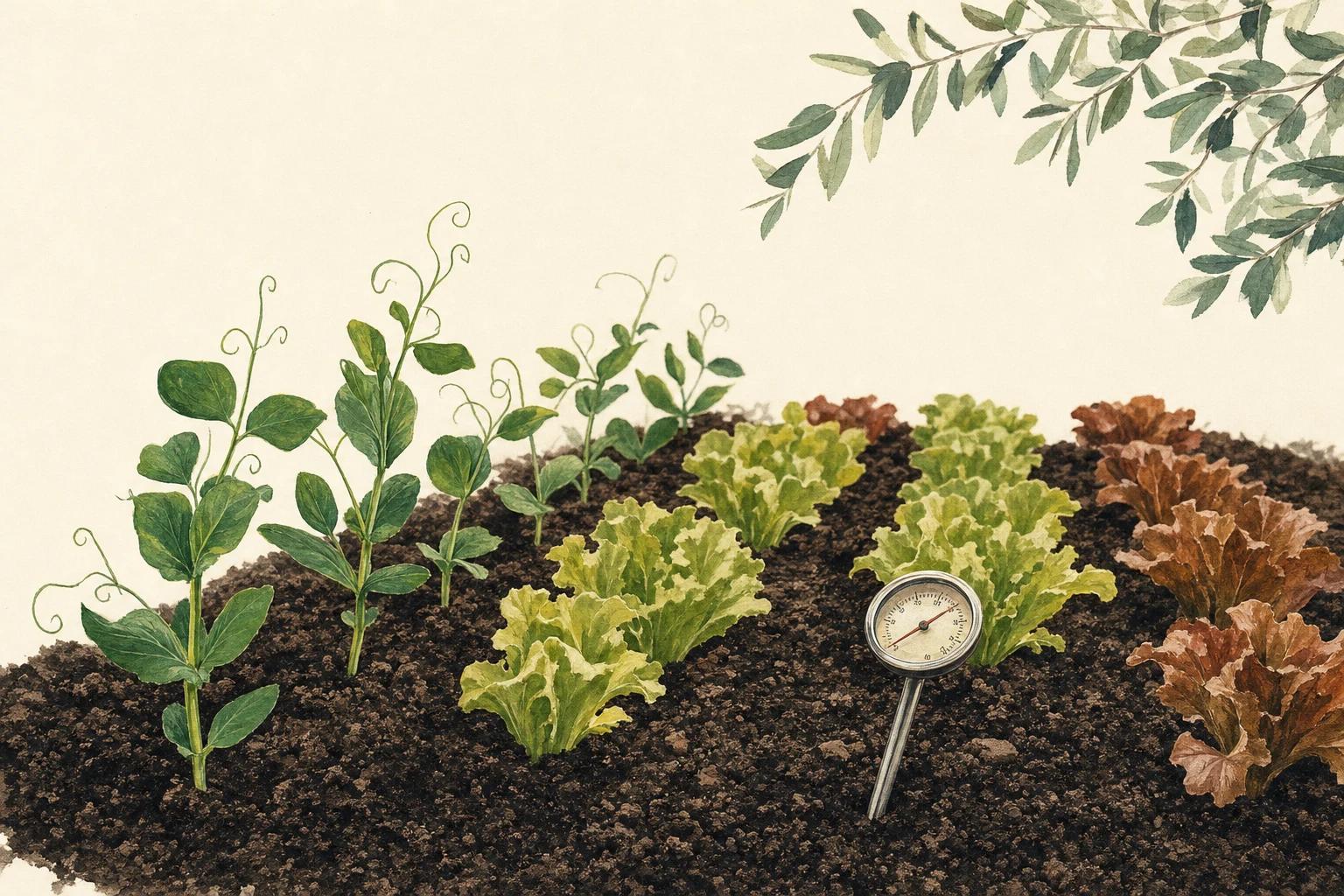
Use a soil thermometer rather than the air forecast. Push it in to the depth the root ball will sit and wait for a steady 60°F (16°C) reading on several days in a row. The bed should also be workable: moist soil that crumbles in your hand, not mud that smears. The same thermometer test applies if you grow tomatoes in raised beds; for pots, the guide to tomatoes in containers covers when potting mix is warm enough to plant.
When to start tomato seeds indoors
Sow seeds indoors six to eight weeks before your planned transplant date. In Chicago, for example, a May 1 transplant means sowing between March 6 and March 20. Since most cities' frost-safe windows open 13 to 22 days past the median frost, sowing usually falls three to six weeks before that median date.
A shorter lead time of four to six weeks still gives a good plant. A longer one does not help: seedlings started too early grow leggy and root-bound, are awkward to handle, and do not ripen fruit any sooner.
Sow seed 1/4 to 1/2 inch (6 to 13 mm) deep and keep it at 75 to 85°F (24 to 29°C), on a heat mat if your house runs cool. At 75°F (24°C), seedlings come up in about a week. Once they emerge, grow them on at about 70°F (21°C) under strong light, or they stretch toward the window.
If you buy transplants instead, look for stocky plants 6 to 10 inches (15 to 25 cm) tall with no open flowers. A plant that is already flowering in its pot is under stress before it reaches the garden.
Tomato planting windows by region
The frost rule works across most of the country, but local calendars refine it where cool springs or hot summers change the picture.
| Region | Spring planting | Fall planting |
|---|---|---|
| Minnesota | Late May | — |
| Missouri | Apr 20–May 15 south; May 5–20 central; May 10–20 north | — |
| Colorado Front Range | Late May | — |
| Western Oregon | May 1–10 | — |
| Puget Sound (western Washington) | Around mid-May | — |
| Central Oregon | Second week of June, with protection | — |
| Middle Georgia | Late March to early April | By July 20 |
| South Carolina coastal plain | Mar 1–Apr 30 | Jul 1–15 |
| Houston area | March to mid-April | Late July to early August |
| North Florida | Late March–April | August |
| Central Florida | January–February | August–September |
| South Florida | August–February, one long season | Same season |
| Phoenix area | Feb 15–Mar 15 | Jul 15–Aug 1 |
| Sacramento area | Mid-April to June | — |
| California interior valleys | March–May | — |
| California south coast | April to mid-July | — |
| California north coast | May | — |
| California desert valleys | December–March | Same season |
Local planting windows where cool springs or summer heat shift the dates; a dash means no separate fall window is listed.
North and Upper Midwest (Zones 3 to 5). Plants go out in late May or early June, from seed sown around mid-April. Fargo and Denver have the latest windows in the city table, and both run into June.
Northeast. Wait at least a week or two after the last frost, until nights hold consistently above 45°F (7°C) as a bare minimum. In Massachusetts, the soil and daytime air should reach 60 to 65°F (16 to 18°C) first, and in New York City, nights in the 60s°F (16 to 21°C) are the signal. Tomatoes set out later catch up quickly, so waiting costs little.
Rocky Mountains and the Intermountain West. Late May is normal on the Colorado Front Range, once soil passes 55 to 60°F (13 to 16°C) and nights hold above 52°F (11°C).
Pacific Northwest. Frosts end early, but soil and nights stay cool into May. Plant May 1 to 10 in most of western Oregon and around mid-May in the Puget Sound area of western Washington. In central Oregon, wait until the second week of June and add 10 to 14 days to the maturity time on the seed packet.
California. The interior valleys plant from March to May overall, but around Sacramento transplants go out from mid-April into June. The south coast plants from April to mid-July.
Southeast. In Georgia, spring planting moves up to two to three weeks earlier in the south of the state and one to three weeks later in the north and mountains. Plant as early in the window as you safely can, because fruit set stops once summer nights stay warm.
Texas and the Gulf Coast. Around Houston, the ideal spring planting time runs from March 1 to mid-April, in step with the city table, and the fall crop goes in from late July to early August. Plant at the front of the spring window so most fruit sets before nights stay above about 75°F (24°C).
Frost-free areas and the low desert. In South Florida and California's Imperial and Coachella valleys, summer nights stay too warm for fruit set, so tomatoes are a fall-to-spring crop. South Florida plants from August through February and the desert valleys from December through March. Around Phoenix, plant in late winter, from mid-February to mid-March, and again from mid-July to August 1 for a fall crop.
Fall tomatoes in the South and low desert
Where the first fall frost comes late, a second crop planted in midsummer ripens in the cooler weeks of autumn. The deadline is set by maturity time: the variety needs its full days to maturity, counted from transplanting, plus time for the last fruit to ripen before the first fall frost. Fruit takes 25 to 35 days from flower to ripe, depending on temperature and variety.
The regional table gives the fall dates for each area. Georgia's July 20 deadline for the middle of the state shifts about two weeks later in south Georgia and two weeks earlier in the north.
Heat is the main obstacle for both the late spring crop and the young fall crop. Blossoms drop when nights stay above 70 to 75°F (21 to 24°C) or days pass 90 to 95°F (32 to 35°C), and no flowers set at 100°F (38°C). If it is already 90°F (32°C) by 10 a.m., the blossoms that open that day abort. Heat-set varieties such as 'Sun Leaper' and 'Solar Set' are bred to keep setting fruit through that heat, which helps both crops.
Varieties that change the timing
Days to maturity, counted from transplanting, decide whether a variety fits your season. Add about 25 days if you sow seed directly in the garden, which is rarely worth doing.
| Group | Days from transplant | Varieties (days) | Best for |
|---|---|---|---|
| Early | 50–65 | Sun Gold 57; Early Girl 52–60; Matt's Wild Cherry 60 | Zones 3–5, mountains, Pacific Northwest |
| Midseason | 65–80 | Supersweet 100 65–70; Celebrity 70–72; Cherokee Purple 72; Big Beef 72; Better Boy 75; Brandywine 78 | Most slicers and heirlooms |
| Late | 80 or more | Roma 80; San Marzano 80 | Long, warm seasons |
Days to maturity count from transplanting; a range means the figure varies from garden to garden.
In short-season gardens, early varieties are the difference between a harvest and a vine full of green fruit at the first frost. In the mountains, choose Early Girl or another variety that matures in 50 to 60 days. Around Puget Sound, pick varieties that mature in 75 days or less; Sun Gold and Stupice are proven there. 'Gold Nugget', 'Sweet Mojo', 'Cordova' and 'Roprechto Paste' are reliable early choices for western Oregon. In the cooler parts of New York, only early varieties may mature at all.
Long-season heirlooms such as Brandywine need a warm summer of 78 days or more after planting. Paste tomatoes such as San Marzano take about 80 days, so plant them at the start of your window. Cherokee Purple is a good compromise: an heirloom slicer that ripens in 72 days.
How to plant tomatoes outdoors
Planting itself goes quickly once the soil is warm and the plants are tough enough for full sun and wind.
- Harden the plants off. Over one to two weeks, move seedlings to a sheltered outdoor spot for a couple of hours of sun a day, lengthening the time as they toughen. Bring them in on any night that threatens to approach freezing.
- Warm the bed. Where springs are cool, cover the bed with black plastic before planting. It raises soil temperature by 5 to 6°F (about 3°C) and can bring the first harvest two to three weeks sooner. Clear plastic warms soil more, by 8 to 14°F (4 to 8°C).
- Check the soil temperature. Plant only when the thermometer reads 60°F (16°C) at root-ball depth and the forecast shows nights above 50°F (10°C).
- Plant on a cloudy, calm day or in the evening. Cooler, still air cuts water loss from the leaves while the roots settle, so plants wilt less.
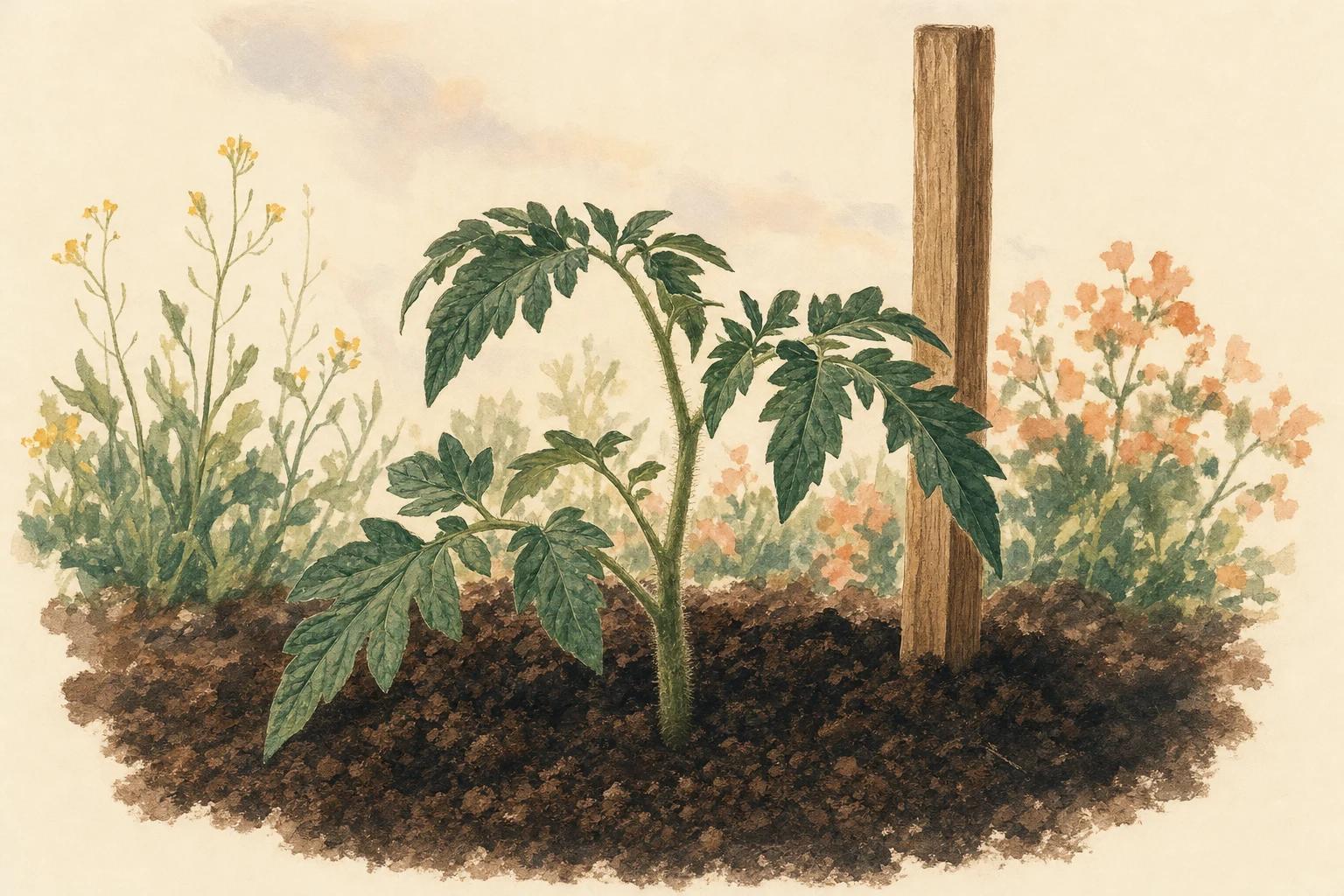
- Bury the stem. Set each plant so only the top two or three sets of leaves stay above ground. Lay leggy plants on their side in a trench 2 to 4 inches (5 to 10 cm) deep, or at a 30-degree slant with the top 5 to 6 inches (13 to 15 cm) showing. Roots grow along the buried stem, and a shallow trench keeps them out of soil below 6 to 7 inches (15 to 18 cm), which stays too cool for good root growth.
- Space and support. Allow about 24 inches (60 cm) between plants. Compact determinate types can go 12 to 24 inches (30 to 60 cm) apart, staked indeterminates 14 to 20 inches (35 to 50 cm), and unstaked vines 24 to 36 inches (60 to 90 cm). Very vigorous indeterminates can need 4 feet (1.2 m). Put stakes or cages in now so you do not tear roots later. The plant spacing calculator works out how many fit in a bed.
- Hold off on organic mulch. Leave straw or compost off until the soil passes 75°F (24°C), because a mulch layer keeps cool soil cool.
After planting, keep the soil evenly moist with 1 to 2 inches (2.5 to 5 cm) of water a week. Drought stress causes poor fruit set just as heat and cold do.
What happens if you plant too early or too late
Planting right at the median last frost is a common mistake, and it gains less than it seems. Half of years bring a later frost that can kill unprotected plants outright. Even without frost, cold soil and nights below 50°F (10°C) stall growth, and plants set out a couple of weeks later into warm soil often catch up.
Planting too late costs you in different ways depending on where you live. In the North, a long-season variety put in late may still be covered in green fruit when the first fall frost arrives. In the South and low desert, late spring plantings flower into summer heat and drop their blossoms. Fall crops planted after the deadline for your area may not ripen before frost.
Tomatoes cannot survive a frost. If the forecast drops to 32°F (0°C) after planting, cover every plant that evening, or the whole bed can be lost in one night.
Protecting tomatoes from a late frost or cold snap
When frost or a run of nights below 45 to 50°F (7 to 10°C) is forecast after planting, cover the plants before dark. Floating row cover, upturned buckets, plastic milk jugs and hot caps all hold in the day's warmth from the soil. Leave plants uncovered only once nights stay consistently above 45°F (7°C).
Walls of water, rings of water-filled plastic tubes, protect against a mild frost, which makes them useful for planting ahead of the window in the mountains and the Pacific Northwest. Plants under clear plastic row covers gain two to three times more heat than uncovered plants, which speeds growth in cool springs.
Vent or remove every cover as soon as the air passes 85°F (29°C). A sealed cover on a sunny spring afternoon can cook the plants it was meant to protect.
The tomato plant contains solanine, which is toxic to dogs, cats and horses; ripe fruit is not. Keep pets from chewing the leaves and vines, and clear prunings off the ground.
Once nights stay warm, the covers come off for good. From then on, green fruit keeps ripening on the vine as long as temperatures stay above 50°F (10°C) most of the time. Pick everything before the first fall frost, ripe or not. For the rest of the warm-season garden, see when to plant pumpkins and the full vegetable planting calendar, then map where each crop goes with Sow's garden planner.
Frequently asked questions
What month should I plant tomatoes?
It depends on your frost date and how fast your soil warms. Fargo plants from late May into mid-June, Chicago in May, Atlanta in April and Houston from March to mid-April. Where springs stay cool, warm soil sets the date: the Puget Sound area plants around mid-May, western Oregon May 1 to 10 and Sacramento from mid-April into June. New York and Boston also wait past their frost-safe dates for warm soil and nights. South Florida plants from August through February.
Can I plant tomatoes before the last frost?
Not unprotected. Tomatoes have no frost tolerance, and 32°F (0°C) injures them. With row covers or walls of water you can set plants out up to a week ahead of your planting window, but that window itself falls after the last frost. Without cover, an early start often gains nothing, because plants chilled below 50°F (10°C) can stall for up to two weeks.
What month do you plant cherry tomatoes?
Cherry tomatoes follow the same frost and soil rule as slicers, so the month is set by your climate: late May in Minnesota, late March to early April in middle Georgia, mid-April to June around Sacramento and August to February in South Florida. Their speed helps in short seasons: Sun Gold ripens 57 days after transplanting, one to three weeks ahead of most midseason slicers.
How do you plant a cherry tomato plant?
Plant it deep, with soil up to the top two or three sets of leaves, after frost danger has passed and the soil reaches 60°F (16°C). Like most garden tomatoes, many cherry types are indeterminate vines that keep growing until frost, so space unstaked plants 24 to 36 inches (60 to 90 cm) apart and put a tall stake, cage or trellis in at planting time.
How much sun do tomatoes need daily?
At least 6 hours of direct sun a day, and 8 hours or more where you can give it. Seedlings indoors need strong light too, or they grow tall and spindly before they reach the garden. In cool-summer areas such as Puget Sound, a raised bed or a bed against a south-facing wall gives plants extra warmth as well as sun.
What should never be planted near tomatoes?
Black walnut is the main one to avoid: plants growing near these trees can wilt and die, so keep tomatoes at least 50 feet (15 m) away and out of reach of walnut roots. Also skip beds where tomatoes, potatoes, peppers, eggplant or tomatillos grew in the past three or four years, because these related crops share soil-borne diseases such as early blight and Fusarium and Verticillium wilts.
Is it too late to plant tomatoes in June or July?
In the coldest areas June is on schedule: Fargo's window runs to mid-June and central Oregon plants in the second week of June. Elsewhere in the North, a late planting needs an early variety of 50 to 65 days. In the South and low desert, July starts the fall crop: July 1 to 15 on the South Carolina coastal plain, by July 20 in middle Georgia, July 15 to August 1 around Phoenix and late July to early August around Houston.
How long do tomatoes take to grow from seed?
Add 6 to 8 weeks of indoor growing to the variety's days to maturity, which are counted from transplanting. A 72-day variety such as Cherokee Purple therefore needs about four months from sowing to first ripe fruit. Seed sown directly in the garden takes about 25 days longer than a transplant, and in Florida seeded tomatoes take 90 to 110 days.
What temperature is too cold for tomato plants?
Frost at 32°F (0°C) injures or kills them, growth slows at 45°F (7°C), and nights below 50°F (10°C) set plants back for up to two weeks. Nights below 55°F (13°C) also interfere with pollen, so early flowers drop. Even nights of 50 to 60°F (10 to 16°C) in the first weeks after transplanting raise the odds of catfaced fruit.
References
- University of Minnesota Extension. Growing tomatoes in home gardens. Accessed October 16, 2026.
- Cornell Garden-Based Learning (Cornell University). Tomato growing guide. Accessed October 16, 2026.
- Clemson Cooperative Extension Home & Garden Information Center. Tomato (HGIC 1323). Accessed October 16, 2026.
- University of Missouri Extension. Growing Home Garden Tomatoes (G6461). Accessed October 16, 2026.
- University of Illinois Extension. Tomato | Home Vegetable Gardening. Accessed October 16, 2026.
- UMass Amherst Center for Agriculture, Food, and the Environment. Planting a Vegetable Garden. Accessed October 16, 2026.
- New York Botanical Garden, Mertz Library. When can I plant tomatoes outdoors in the Northeast?. Accessed October 16, 2026.
- University of Georgia Cooperative Extension. Vegetable Garden Calendar (Circular 943). Accessed October 16, 2026.
- NC State Extension. Extension Gardener Handbook, Chapter 16: Vegetable Gardening. Accessed October 16, 2026.
- UF/IFAS Extension. Florida Vegetable Gardening Guide (SP 103/VH021). Accessed October 16, 2026.
- Texas A&M AgriLife Extension, Harris County. Vegetable Garden Planting Dates for Harris County. Accessed October 16, 2026.
- UC Statewide IPM Program (UC Agriculture and Natural Resources). Cultural Tips for Growing Tomato. Accessed October 16, 2026.
- UCCE Sacramento County Master Gardeners (UC Agriculture and Natural Resources). Sacramento Vegetable Planting Schedule (EHN 11). Accessed October 16, 2026.
- Colorado State University Extension. Growing Tomatoes. Accessed October 16, 2026.
- Oregon State University Extension Service. Grow your own tomatoes and tomatillos (EC 1333). Accessed October 16, 2026.
- WSU Extension Master Gardener Program, King County. Puget Sound Gardening Tip Sheet #7: Tomatoes. Accessed October 16, 2026.
- University of Arizona Cooperative Extension. Vegetable Planting Calendar for Maricopa County. Accessed October 16, 2026.
- NOAA National Centers for Environmental Information. U.S. Climate Normals 1991–2020: Annual/Seasonal freeze data. Accessed October 16, 2026.
- USDA Agricultural Research Service. USDA Plant Hardiness Zone Map (2023). Accessed October 16, 2026.
- ASPCA Animal Poison Control. Tomato Plant. Accessed October 16, 2026.
Sow Editorial
Written by the Sow team from university extension services, botanical gardens, USDA and NOAA data and plant breeders. Every source is listed under References.