The Story
Plant Bio
Pithecellobium unguis-cati, the catclaw blackbead, is a spiny evergreen shrub to small tree from the tropical Americas, reaching ten to fifteen feet tall with arching branches armed with paired spines to three-quarters of an inch. The leaves are twice-divided and hairless with a small round gland on the stalk, each leaf with two pinnae bearing one pair of thin obovate leaflets, and the spring to summer flowers are small green to yellowish globose heads of feathery stamens in terminal clusters.
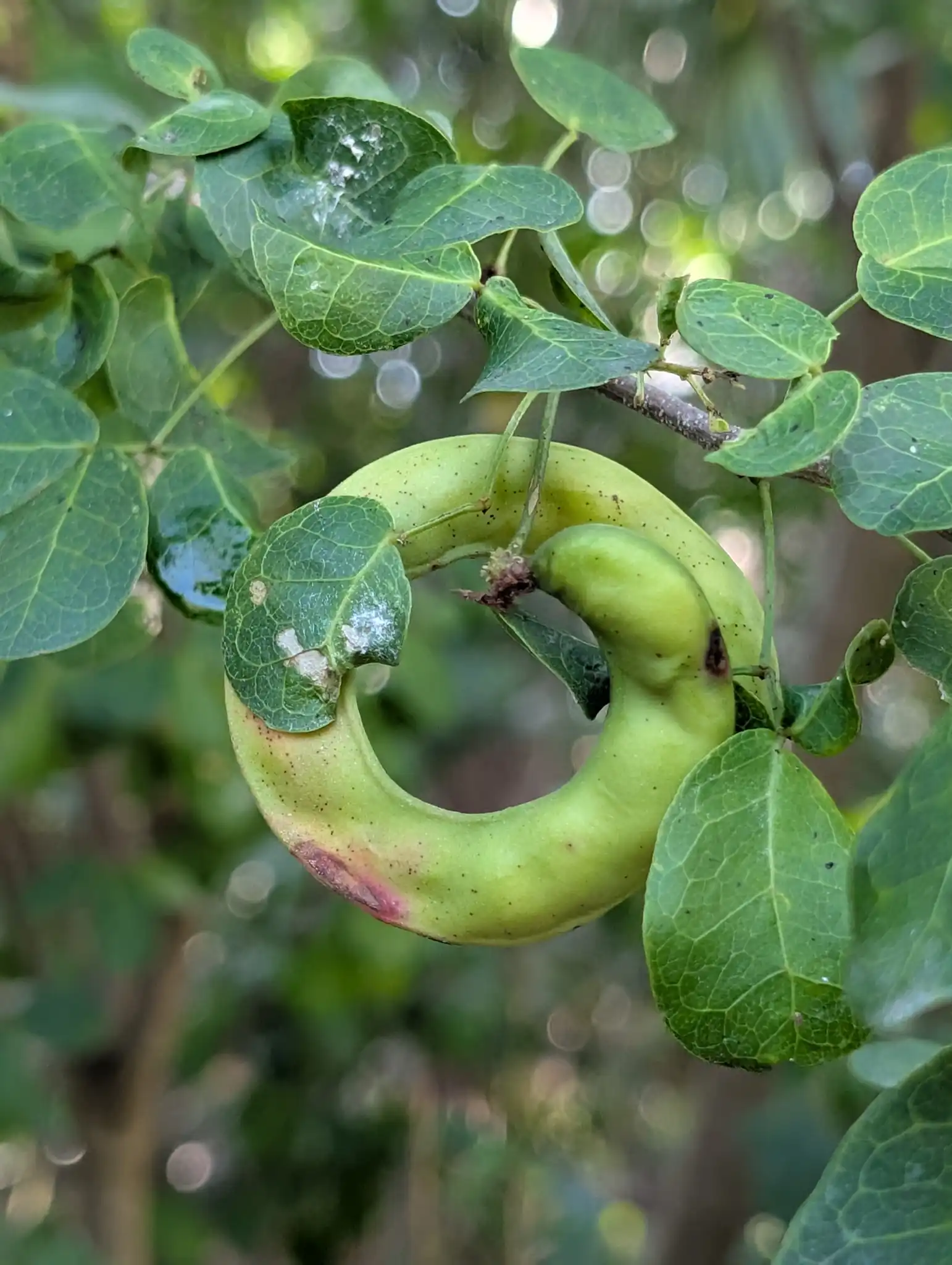
This species is recognized by its slender-stalked flower heads followed by twisted red pods two to five inches long that split to reveal four to six shiny black seeds. It grows as an armed shrub, not a vine, so it differs from cat's claw creeper with yellow trumpet flowers, and in the Florida Keys it is separated from blackbead by range and leaflet detail rather than habit alone.
Uses & Benefits:
Essentials
At a Glance
Plant Type
Shrub
Height
180"
Width
180"
Light
Full Sun
Zones
9, 10
Water
Low
Humidity
Tolerant of salt spray
Lifespan
Long-lived shrub
Native To
Florida, Mexico, Central America, Caribbean to Colombia and Venezuela
Toxicity
Toxic seeds
Bloom period
Spring – Summer
In flower about 6 months of the year
Planting
How to Grow
- Plant in full sun with at least six hours of direct sun in sand or limestone with a humusy top.
- Set the root ball level with the soil in a well-drained hole twice as wide as the pot.
- Water in deeply, then water until established and taper off; established plants take dryish soils and salt spray.
- Mulch lightly with leaf mulch, keeping mulch back from the spiny stems.
- Leave space for a ten to fifteen foot arching canopy and train as shrub or small tree.
Pro Tip
Give it full sun in sand or limestone and room for arching growth; site it where the spines form a barrier and do not shear it hard, as regrowth from old cut wood is slow.
Keep It Thriving
Care Guide
Do
- Do plant in full sun in moist but well-drained sand or calcareous soil.
- Do use its spines as a living fence along hammock edges and coastal strands.
- Do leave spent pods for birds if seed toxicity is not a concern on site.
Don't
- Do not plant where children or pets handle the shiny black seeds, which are toxic.
- Do not over-prune or shear into old bare stems.
- Do not site in wet or poorly drained soil.
Seasonal Care Calendar
| Task | Jan | Feb | Mar | Apr | May | Jun | Jul | Aug | Sep | Oct | Nov | Dec |
|---|---|---|---|---|---|---|---|---|---|---|---|---|
| Mulch | ||||||||||||
| Pest Check | ||||||||||||
| Plant | ||||||||||||
| Prune |
Watch Out For
Pests & Diseases
Common Pests
In the Garden
Landscape Uses & Companions
Landscape Uses
Companion Plants
Multiply
Propagation Methods
Good to Know
Common Questions
Catclaw Blackbead questions
What zones can Catclaw Blackbead grow in?
Catclaw Blackbead is hardy in USDA Zones 9–10: in that range it survives winter in the ground. Colder than Zone 9, grow it in a container you can move to shelter for the winter.
When does Catclaw Blackbead bloom?
Catclaw Blackbead typically blooms from spring to summer. Exact timing shifts a week or two with your zone — Sow's bloom calendar maps it to your garden.
Does Catclaw Blackbead need full sun?
Catclaw Blackbead does best in full sun (6+ hours).
Is Catclaw Blackbead drought tolerant?
Yes — once established (usually after the first full season), Catclaw Blackbead handles dry spells with minimal watering. Water deeply its first year to build the root system that makes that possible.
More Pithecellobium to compare
Keep exploring
Explore the genus
Hardy in your zone?
Grow Catclaw Blackbead with confidence
See it in a design of your actual yard, get zone-matched care reminders, and track it season by season in your garden journal.