The Story
Plant Bio
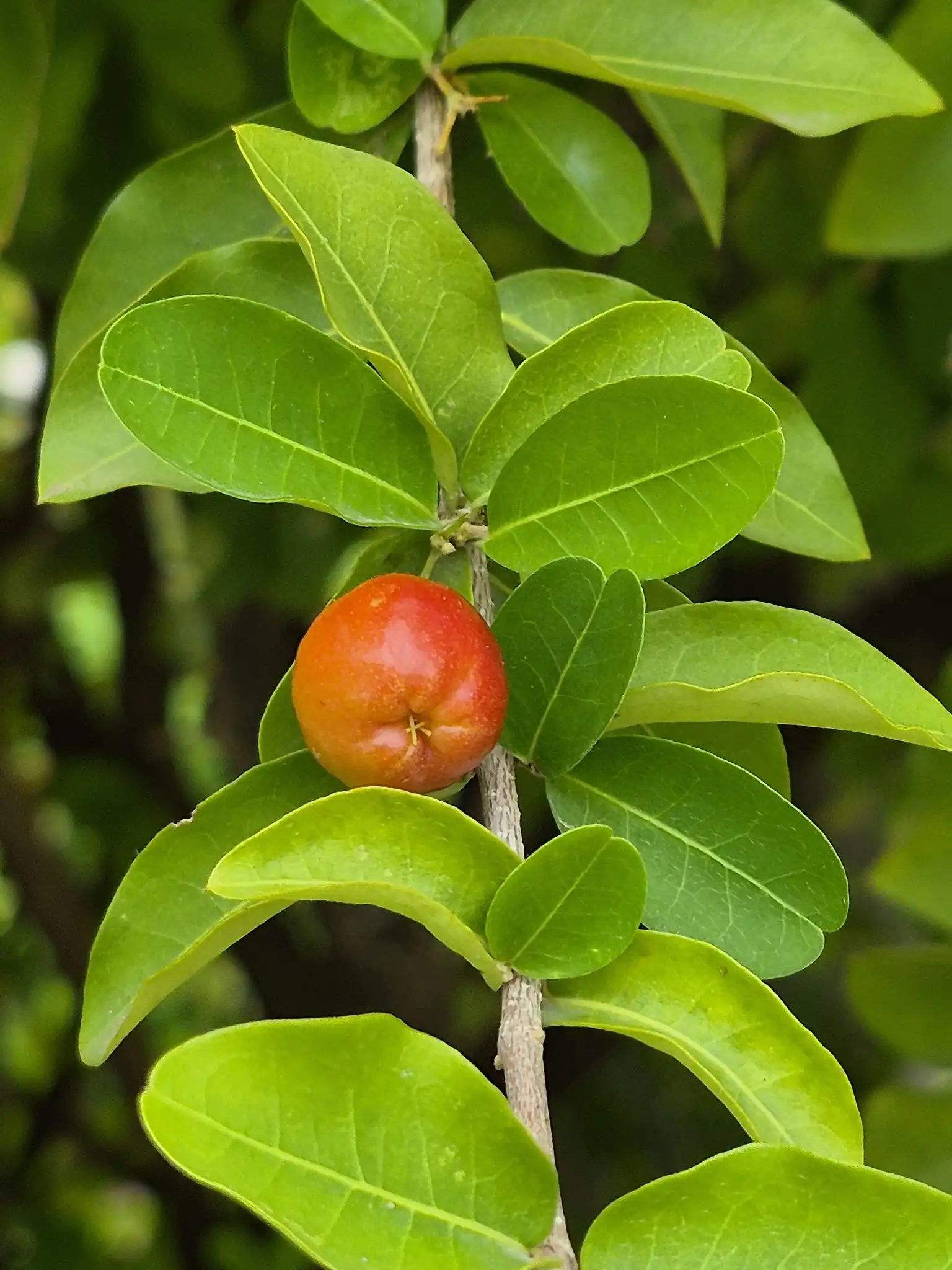
Malpighia emarginata, the Barbados cherry, is an evergreen shrub to small tree reaching 10 to 12 feet tall with a thick rounded canopy and opposite lance-shaped leaves 2 to 4 inches long. The flowers have five pink to lavender-pink petals borne in small clusters, followed by red cherry-like fruit that ripens three to four weeks after flowering.
Young stems and leaves carry minute stinging hairs that can irritate skin on handling. Plants sold as Malpighia glabra in the nursery trade are almost always this species; true M. glabra flowers heavily but sets little fruit, while M. emarginata selections fruit repeatedly from spring to fall where frost-free.
Uses & Benefits:
Essentials
At a Glance
Plant Type
Shrub
Height
144"
Width
118"
Light
Full Sun, Partial Sun
Zones
9, 10
Water
Moderate
Humidity
Tolerates humid subtropics
Lifespan
Long-lived evergreen shrub
Native To
Mexico, Central America, Caribbean and northern South America
Toxicity
Fruit edible; stinging hairs irritate skin
Bloom period
Spring – Fall
In flower about 9 months of the year
Planting
How to Grow
- Plant in full sun to part shade after last frost, allowing 10 feet for the rounded canopy and good air circulation.
- Set into fertile, porous, well-drained soil free of root-knot nematodes and enrich with organic matter.
- Water regularly through the first seasons and during flowering and fruiting; established plants handle dry spells but crop better with steady moisture.
- Mulch to hold moisture and keep roots cool, and feed lightly only if growth is poor.
- Shape lightly to thin crowded growth and keep containers within bounds.
Pro Tip
Buy a named fruiting selection such as 'Florida Sweet' by name; seedlings sold as M. glabra often flower without setting a useful crop.
Keep It Thriving
Care Guide
Do
- Plant in nematode-free soil and mulch with organic matter
- Provide full sun and good air circulation at the roots
- Water regularly for fruit set even once established
Don't
- Do not plant where frost settles or winter drops below freezing
- Do not over-prune into old bare wood
- Do not let containers sit wet or in salty exposure
Seasonal Care Calendar
| Task | Jan | Feb | Mar | Apr | May | Jun | Jul | Aug | Sep | Oct | Nov | Dec |
|---|---|---|---|---|---|---|---|---|---|---|---|---|
| Harvest | ||||||||||||
| Mulch | ||||||||||||
| Pest Check | ||||||||||||
| Plant | ||||||||||||
| Prune |
Watch Out For
Pests & Diseases
Common Pests
Common Diseases
In the Garden
Landscape Uses & Companions
Landscape Uses
Multiply
Propagation Methods
Good to Know
Common Questions
Barbados Cherry questions
What zones can Barbados Cherry grow in?
Barbados Cherry is hardy in USDA Zones 9–10: in that range it survives winter in the ground. Colder than Zone 9, grow it in a container you can move to shelter for the winter.
When does Barbados Cherry bloom?
Barbados Cherry typically blooms from spring to fall. Exact timing shifts a week or two with your zone — Sow's bloom calendar maps it to your garden.
Does Barbados Cherry need full sun?
Barbados Cherry does best in full sun to part shade. In hot climates, afternoon shade keeps blooms fresher longer.
Is Barbados Cherry drought tolerant?
Yes — once established (usually after the first full season), Barbados Cherry handles dry spells with minimal watering. Water deeply its first year to build the root system that makes that possible.
Keep exploring
Explore the genus
Hardy in your zone?
Grow Barbados Cherry with confidence
See it in a design of your actual yard, get zone-matched care reminders, and track it season by season in your garden journal.