The Story
Plant Bio
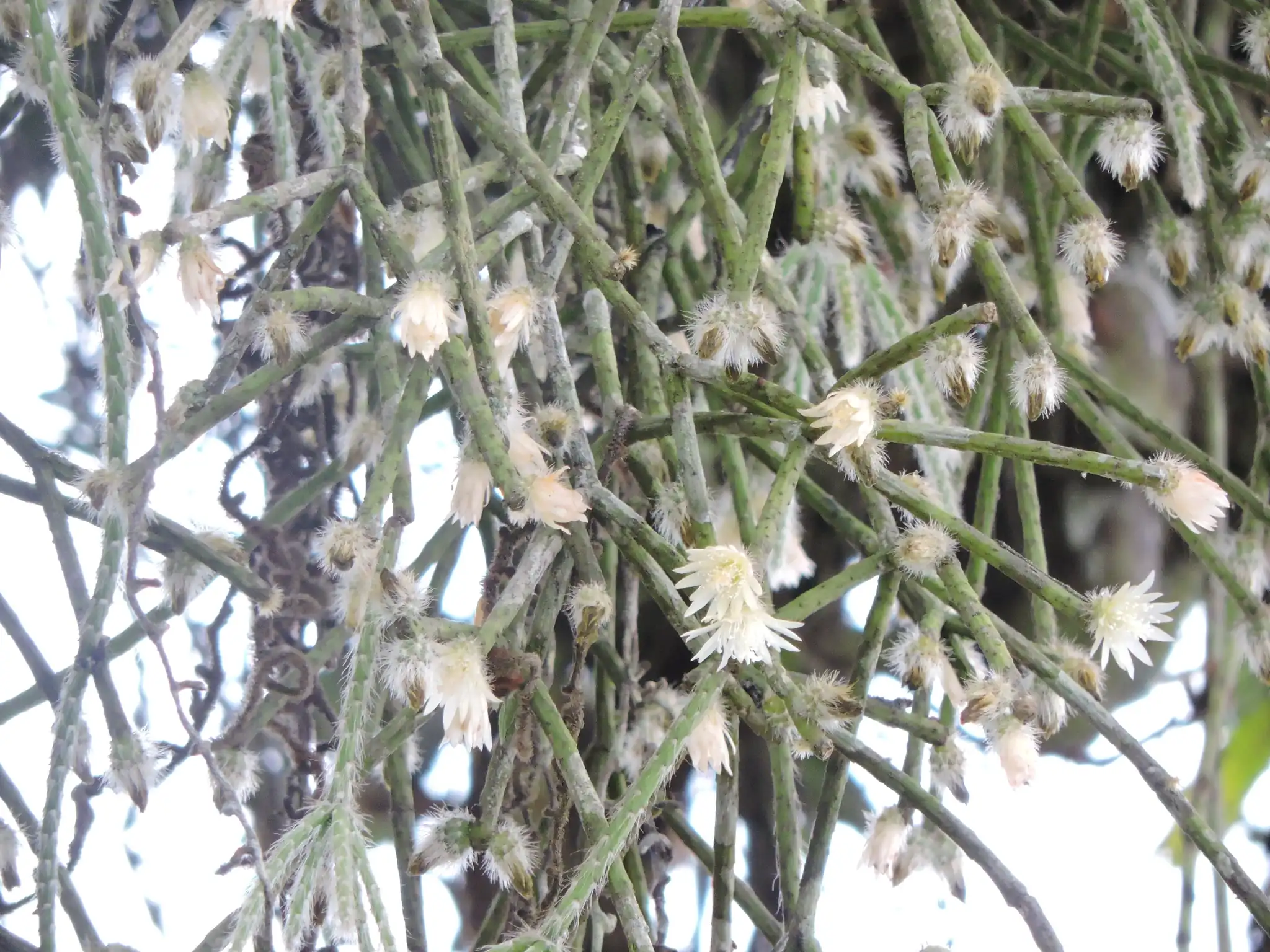
Rhipsalis pilocarpa is a Brazilian epiphytic cactus that grows in tree forks in moist forest rather than in desert soil. It forms a branching clump of cylindrical succulent stems, erect at first then pendent, to about 16 inches long, rooting where stems rest on bark and humus.
Sold as Rhipsalis x pilocarpa, it is not a hybrid but the species R. pilocarpa; the 'x' is a nursery error. It is distinguished by woolly areoles bearing 3 to 10 soft white bristles, fragrant white star flowers with a pink eye at the stem tips, followed by round deep-red berries covered in fine hairs.
Uses & Benefits:
Essentials
At a Glance
Plant Type
Cactus Succulent
Height
16"
Width
24"
Light
Partial Sun, Shade
Zones
9, 10
Water
Medium
Humidity
High
Lifespan
Long-lived perennial
Native To
Brazil
Toxicity
Non-toxic; bristles irritate skin
Bloom period
Fall – Early spring
In flower about 7 months of the year
Planting
How to Grow
- Pot in a loose epiphytic mix of bark, perlite and coir that drains fast but holds humidity.
- Place in bright indirect light for 8 to 10 hours, such as an east or west window with some morning sun and no harsh midday sun.
- Water when the top 1 inch is dry, more in spring and summer and drier in winter, never leaving the pot waterlogged.
- Hold above 50F, ideally 60 to 75F, with good air movement and indoor humidity.
Pro Tip
Grow it like a Christmas cactus in open bark-perlite-coir mix with humidity and bright indirect light, not in desert cactus sand in full sun.
Keep It Thriving
Care Guide
Do
- Do water when the top 2 to 3 cm is dry and empty the saucer.
- Do give bright indirect light; stems redden with more light.
- Do clean up spent flowers and berries in early spring.
Don't
- Do not plant in desert cactus soil or garden clay.
- Do not overwater or let roots sit wet.
- Do not prune hard into old bare stems or place in harsh direct sun.
Seasonal Care Calendar
| Task | Jan | Feb | Mar | Apr | May | Jun | Jul | Aug | Sep | Oct | Nov | Dec |
|---|---|---|---|---|---|---|---|---|---|---|---|---|
| Fertilize | ||||||||||||
| Pest Check | ||||||||||||
| Propagate | ||||||||||||
| Spring Cleanup | ||||||||||||
| Winter Prep |
Watch Out For
Pests & Diseases
Common Pests
Common Diseases
In the Garden
Landscape Uses & Companions
Landscape Uses
Multiply
Propagation Methods
Good to Know
Common Questions
Hairy Stemmed Jungle Cactus questions
What zones can Hairy Stemmed Jungle Cactus grow in?
Hairy Stemmed Jungle Cactus is hardy in USDA Zones 9–10: in that range it survives winter in the ground. Colder than Zone 9, grow it in a container you can move to shelter for the winter, or as an annual.
When does Hairy Stemmed Jungle Cactus bloom?
Hairy Stemmed Jungle Cactus typically blooms from early fall to early spring. Exact timing shifts a week or two with your zone — Sow's bloom calendar maps it to your garden.
Does Hairy Stemmed Jungle Cactus need full sun?
Hairy Stemmed Jungle Cactus does best in part shade.
More Rhipsalis to compare
Keep exploring
Explore the genus
Hardy in your zone?
Grow Hairy Stemmed Jungle Cactus with confidence
See it in a design of your actual yard, get zone-matched care reminders, and track it season by season in your garden journal.