The Story
Plant Bio
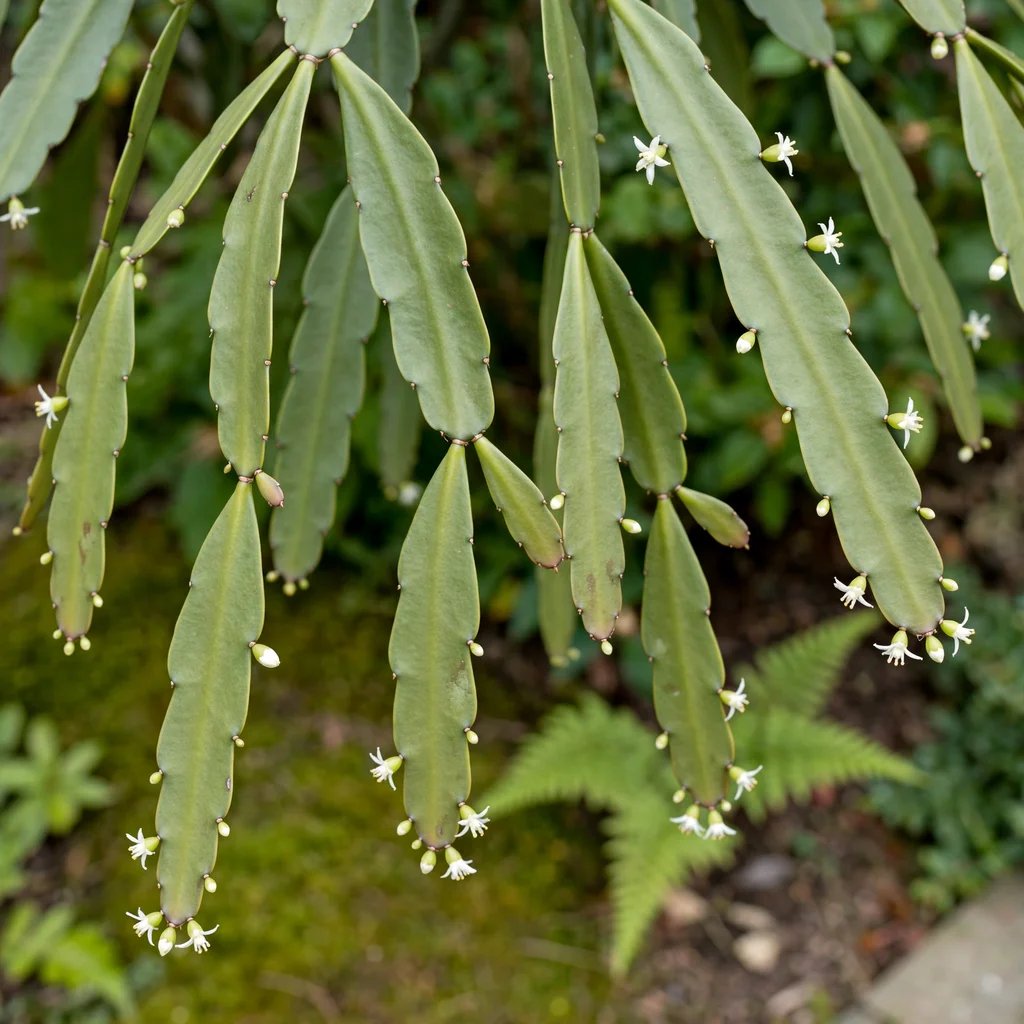
Kimnachia ramulosa, still sold as Rhipsalis ramulosa, is a spineless epiphytic cactus from wet tropical rainforest in Mexico, Central and South America and the Caribbean, where it roots on tree branches beneath the canopy. It forms a shrubby, freely branching mass of pendent stems that hang two feet or more, grown in mix only when cultivated in a basket or pot.
Its flattened ribbon stems are spineless and stay green in low light, blushing violet-red in bright light and turning yellow with too much sun. Small greenish-white to pinkish flowers to about half an inch line the stem margins in mid-spring to summer, followed by small white berries set along both edges.
Uses & Benefits:
Essentials
At a Glance
Plant Type
Cactus Succulent
Height
16"
Width
59"
Light
Partial Sun, Shade
Zones
10
Water
Medium - water when top 1-2 in dry
Humidity
High - needs 50%+
Lifespan
Perennial, long-lived epiphyte
Native To
Mexico, Central America, Caribbean and South America
Toxicity
Non-toxic, pet safe
Bloom period
Mid-spring – Summer
In flower about 5 months of the year
Planting
How to Grow
- Pot in loose, fast-draining orchid or cactus mix amended with bark and perlite; drainage is critical.
- Hang in bright indirect light or partial shade with morning sun and afternoon shade; it takes more sun than other Rhipsalis.
- Water when the top 1-2 in is dry, keeping the mix lightly moist but never soggy; maintain 50%+ humidity and 70-90F.
- Keep outdoors year-round only in zones 10-11; elsewhere grow as a houseplant and bring inside before frost.
- Feed lightly with slow-release fertilizer in late winter or early spring, repeating in fall only if growth is pale.
Pro Tip
Grow it like an orchid or Christmas cactus, not a desert cactus; red stems signal strong light, yellow signals too much sun, and dense soggy mix kills faster than dryness.
Keep It Thriving
Care Guide
Do
- Water when the top 1-2 in is dry and empty the saucer so roots never sit wet
- Grow in an airy bark-based mix in a hanging basket with drainage holes
- Give bright indirect light to develop the red blush without sunburn
Don't
- Do not grow it like a desert cactus in full sun and sand
- Do not overwater a dense peat soil; yellow mushy stems and crown rot follow fast
- Do not expose to frost; damage starts near 40F
Seasonal Care Calendar
| Task | Jan | Feb | Mar | Apr | May | Jun | Jul | Aug | Sep | Oct | Nov | Dec |
|---|---|---|---|---|---|---|---|---|---|---|---|---|
| Fertilize | ||||||||||||
| Pest Check | ||||||||||||
| Propagate | ||||||||||||
| Prune | ||||||||||||
| Winter Prep |
Watch Out For
Pests & Diseases
Common Pests
Common Diseases
In the Garden
Landscape Uses & Companions
Landscape Uses
Multiply
Propagation Methods
Good to Know
Common Questions
Red Mistletoe Cactus questions
What zones can Red Mistletoe Cactus grow in?
Red Mistletoe Cactus is hardy in USDA Zone 10: in that range it survives winter in the ground. Colder than Zone 10, grow it in a container you can move to shelter for the winter, or as an annual.
When does Red Mistletoe Cactus bloom?
Red Mistletoe Cactus typically blooms from mid-spring to late summer. Exact timing shifts a week or two with your zone — Sow's bloom calendar maps it to your garden.
Does Red Mistletoe Cactus need full sun?
Red Mistletoe Cactus does best in part shade.
Is Red Mistletoe Cactus drought tolerant?
Yes — once established (usually after the first full season), Red Mistletoe Cactus handles dry spells with minimal watering. Water deeply its first year to build the root system that makes that possible.
More Rhipsalis to compare
Keep exploring
Explore the genus
Hardy in your zone?
Grow Red Mistletoe Cactus with confidence
See it in a design of your actual yard, get zone-matched care reminders, and track it season by season in your garden journal.