The Story
Plant Bio
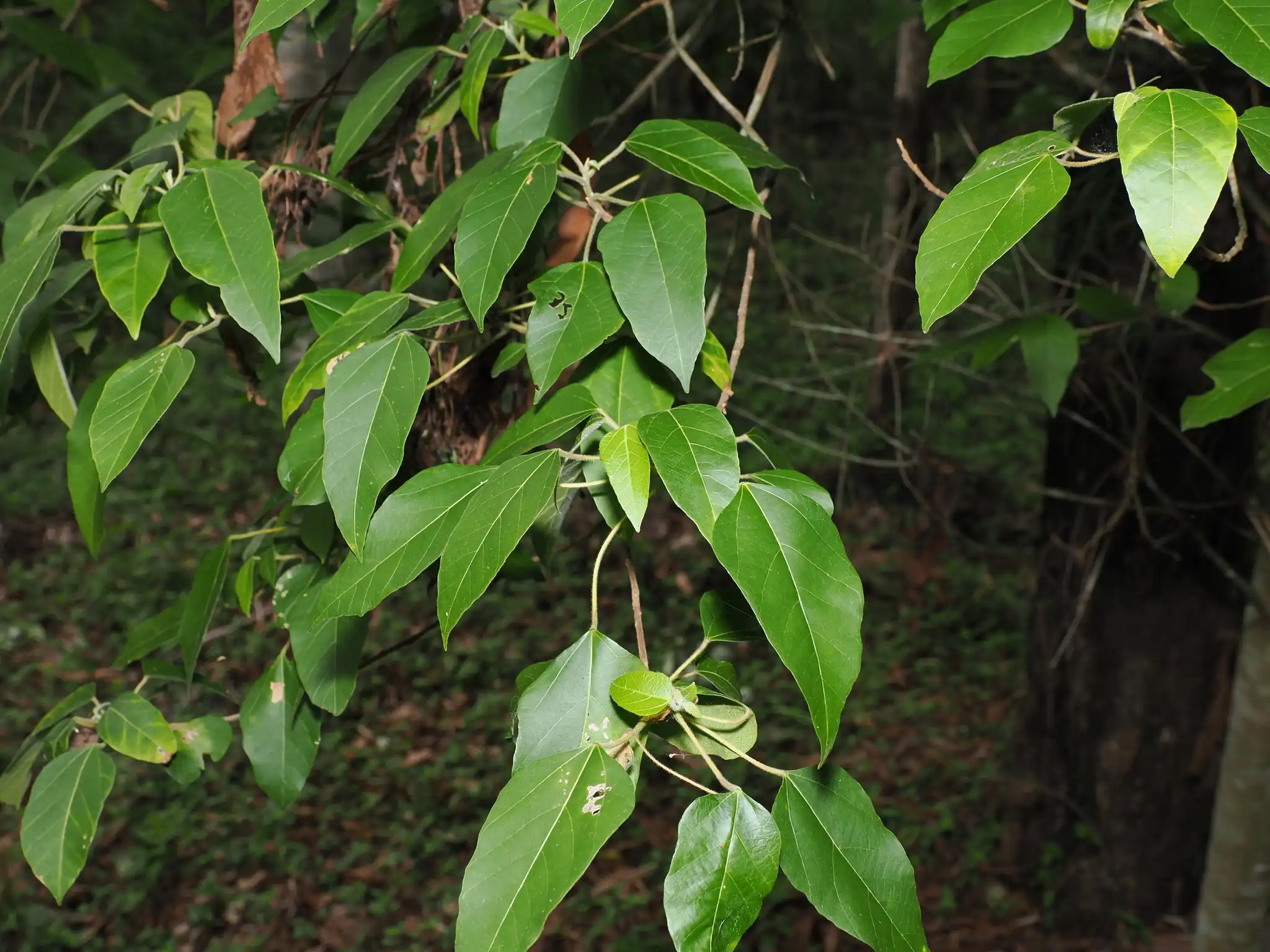
Mallotus discolor is an evergreen rainforest tree native to eastern Australia, developing a compact, dense crown up to forty feet tall in cultivation. Its alternate leaves are dark green above and coated with a distinctive soft, greyish-yellow down beneath.
The species is dioecious, bearing separate male and female trees that produce slender sprays of small greyish flowers in spring. Female specimens form bright yellow-orange capsules whose outer coating yields a natural yellow dye.
Uses & Benefits:
Essentials
At a Glance
Plant Type
Tree
Height
472"
Width
315"
Light
Full Sun, Partial Sun
Zones
10
Water
Moderate
Humidity
High
Lifespan
Long-lived
Native To
Eastern Australia
Toxicity
Mild skin irritant
Bloom period
Spring – Summer
In flower about 6 months of the year
Planting
How to Grow
- Select a planting location in full sun to partial shade with deep, organic-rich soil.
- Ensure the soil drains freely, as roots deteriorate in lingering water.
- Water regularly during establishment to encourage a deep, resilient root system.
- Apply an organic mulch layer around the root zone to conserve soil moisture.
Pro Tip
Prune only to shape young specimens or clear dead wood; cutting back into old bare stems produces poor, slow recovery.
Keep It Thriving
Care Guide
Do
- Plant both male and female specimens nearby if fruit set and seed production are desired.
- Maintain a thick layer of organic mulch over the root zone.
- Provide supplemental irrigation during extended hot, dry spells.
Don't
- Do not allow soil around the roots to become saturated or waterlogged.
- Avoid heavy pruning into old leafless wood.
- Do not leave harvested seeds stored dry, as viability decreases rapidly.
Seasonal Care Calendar
| Task | Jan | Feb | Mar | Apr | May | Jun | Jul | Aug | Sep | Oct | Nov | Dec |
|---|---|---|---|---|---|---|---|---|---|---|---|---|
| Fertilize | ||||||||||||
| Mulch | ||||||||||||
| Pest Check | ||||||||||||
| Prune |
Watch Out For
Pests & Diseases
Common Pests
Common Diseases
In the Garden
Landscape Uses & Companions
Landscape Uses
Companion Plants
Multiply
Propagation Methods
Good to Know
Common Questions
Yellow Kamala questions
What zones can Yellow Kamala grow in?
Yellow Kamala is hardy in USDA Zone 10: in that range it survives winter in the ground. Colder than Zone 10, winters are too cold for it to survive outdoors.
When does Yellow Kamala bloom?
Yellow Kamala typically blooms from spring to summer. Exact timing shifts a week or two with your zone — Sow's bloom calendar maps it to your garden.
Does Yellow Kamala need full sun?
Yellow Kamala does best in full sun to part shade. In hot climates, afternoon shade keeps blooms fresher longer.
Is Yellow Kamala drought tolerant?
Yes — once established (usually after the first full season), Yellow Kamala handles dry spells with minimal watering. Water deeply its first year to build the root system that makes that possible.
More Mallotus to compare
Keep exploring
Explore the genus
Hardy in your zone?
Grow Yellow Kamala with confidence
See it in a design of your actual yard, get zone-matched care reminders, and track it season by season in your garden journal.