The Story
Plant Bio
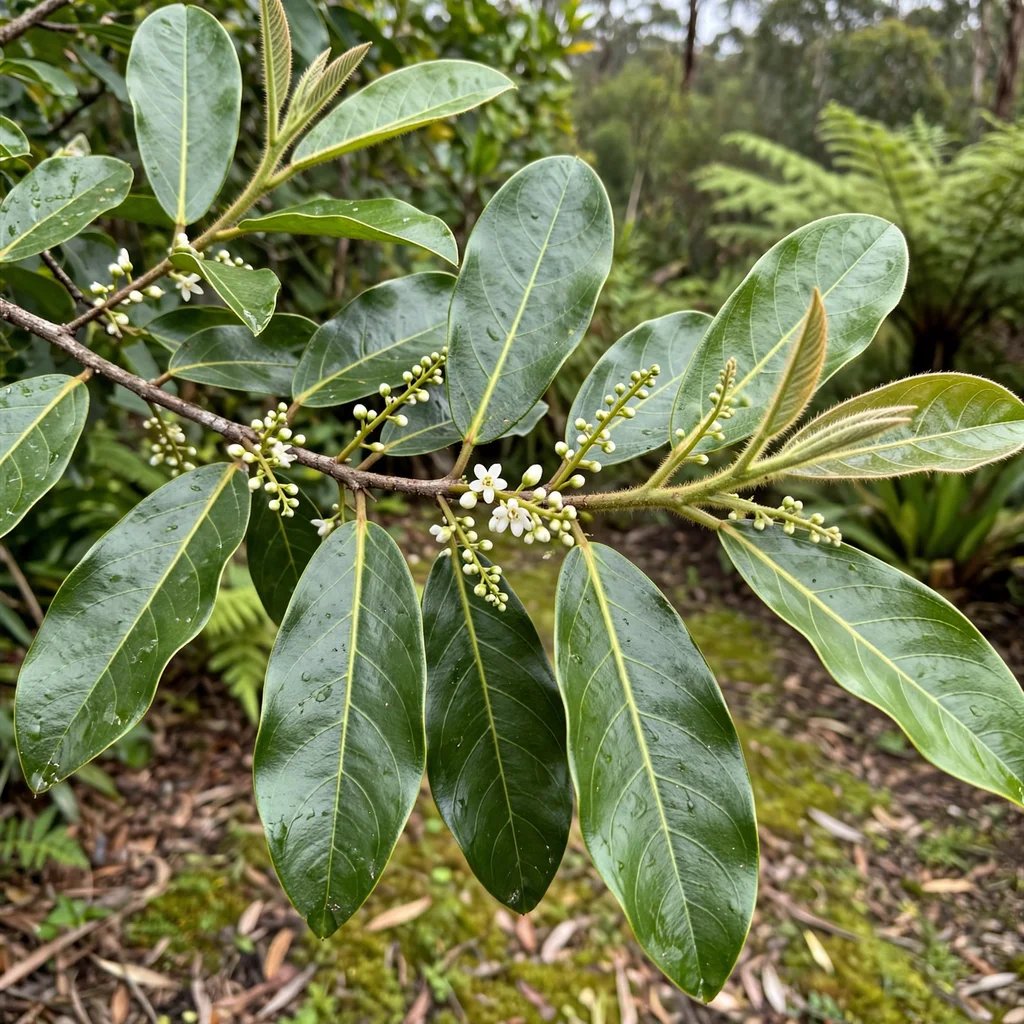
Diploglottis campbellii is an evergreen rainforest tree native to eastern Australia, developing a dense, rounded crown supported by a smooth grey-brown trunk. Its glossy pinnate foliage consists of asymmetric leaflets, preceded by softly hairy emerging shoots.
Small white-to-pink flowers emerge on axillary panicles from spring through fall, followed by large woody fruit capsules containing edible, brightly colored arils. The tree forms a deep, extensive root system that requires ample space away from underground infrastructure.
Uses & Benefits:
Essentials
At a Glance
Plant Type
Tree
Height
315"
Width
197"
Light
Full Sun, Partial Sun
Zones
10
Water
Moderate
Humidity
High
Lifespan
Long-lived
Native To
Australia
Toxicity
Non-toxic
Bloom period
Spring – Fall
In flower about 9 months of the year
Planting
How to Grow
- Choose a warm location in full sun to partial shade protected from freezing temperatures.
- Plant in rich, well-draining soil amended with organic matter.
- Water regularly to keep the soil evenly moist, especially during active growth periods.
- Apply a balanced native or organic fertilizer sparingly in spring.
Pro Tip
Avoid cutting back into old leafless wood during routine maintenance, as bare branches lack latent buds and fail to regenerate growth.
Keep It Thriving
Care Guide
Do
- Keep soil consistently moist without saturating the root zone.
- Shelter young specimens from strong winds and frost.
- Provide high humidity levels when grown in containers indoors.
Don't
- Do not prune heavily into old, leafless wood.
- Do not allow the roots to stand in waterlogged soil.
- Do not plant close to underground drainage pipes or foundations.
Seasonal Care Calendar
| Task | Jan | Feb | Mar | Apr | May | Jun | Jul | Aug | Sep | Oct | Nov | Dec |
|---|---|---|---|---|---|---|---|---|---|---|---|---|
| Fertilize | ||||||||||||
| Mulch | ||||||||||||
| Pest Check | ||||||||||||
| Prune | ||||||||||||
| Winter Prep |
Watch Out For
Pests & Diseases
Common Pests
Common Diseases
In the Garden
Landscape Uses & Companions
Landscape Uses
Multiply
Propagation Methods
Good to Know
Common Questions
Small-leaved Tamarind questions
What zones can Small-leaved Tamarind grow in?
Small-leaved Tamarind is hardy in USDA Zone 10: in that range it survives winter in the ground. Colder than Zone 10, winters are too cold for it to survive outdoors.
When does Small-leaved Tamarind bloom?
Small-leaved Tamarind typically blooms from spring to fall. Exact timing shifts a week or two with your zone — Sow's bloom calendar maps it to your garden.
Does Small-leaved Tamarind need full sun?
Small-leaved Tamarind does best in full sun to part shade. In hot climates, afternoon shade keeps blooms fresher longer.
More Diploglottis to compare
Keep exploring
Explore the genus
Hardy in your zone?
Grow Small-leaved Tamarind with confidence
See it in a design of your actual yard, get zone-matched care reminders, and track it season by season in your garden journal.