The Story
Plant Bio
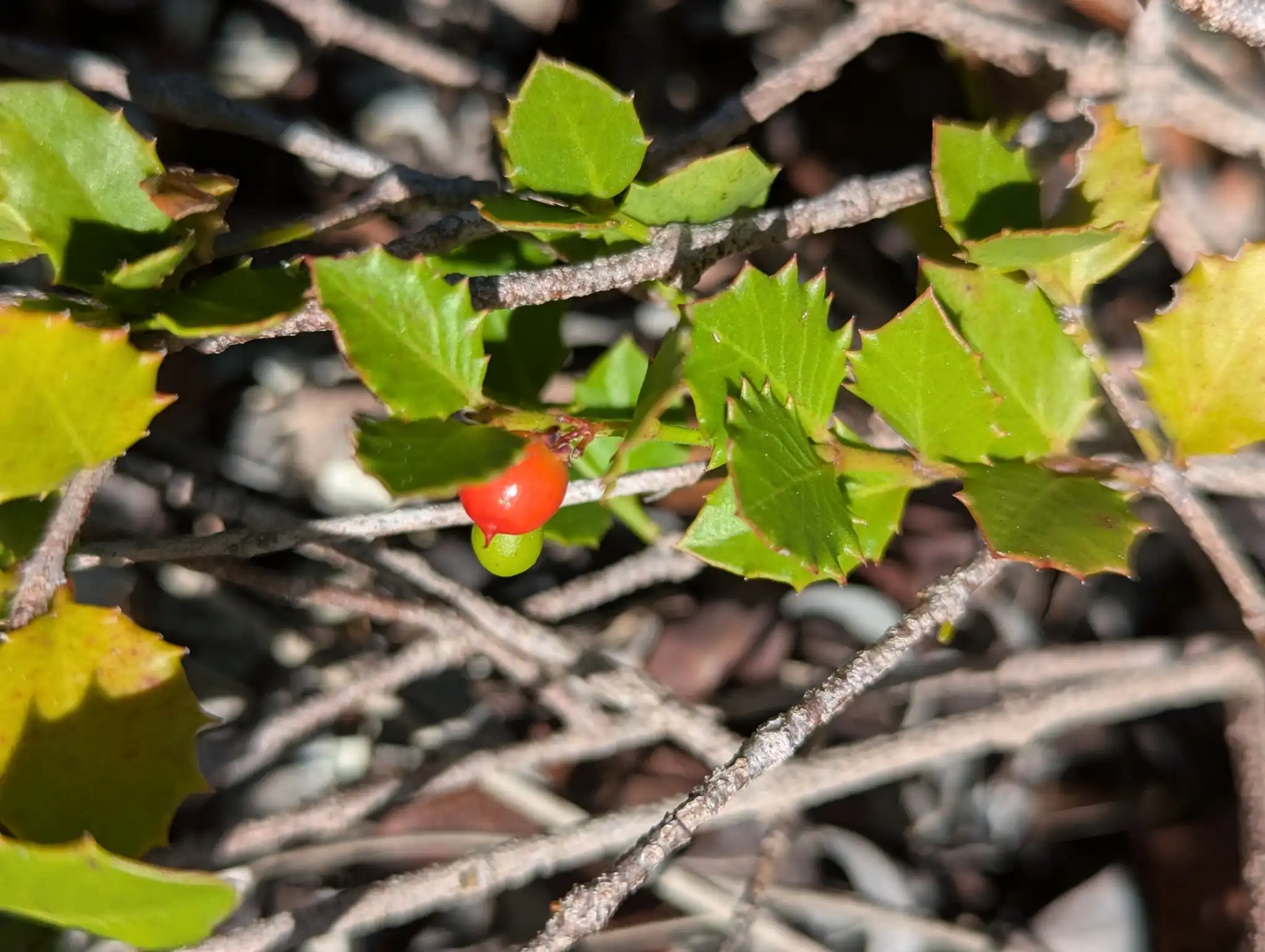
Crossopetalum ilicifolium is a low evergreen shrub in the staff-tree family, forming a stiff mat 6 to 24 inches tall and 18 to 36 inches wide on spreading woody stems. Leaves are opposite, small and ovate with spiny teeth like miniature holly, with new growth flushing reddish before hardening.
It bears tiny white to pale green flowers in few-flowered clusters in the leaf axils through the year, peaking in late winter and early spring, followed by bright red drupes. It is set apart by its prostrate groundcover habit, holly-like foliage, and requirement for dry, highly alkaline limerock instead of moist garden loam.
Uses & Benefits:
Essentials
At a Glance
Plant Type
Groundcover
Height
24"
Width
36"
Light
Full Sun, Partial Sun
Zones
10
Water
Low
Humidity
High
Lifespan
Long-lived perennial
Native To
Southern Florida and Caribbean
Toxicity
Non-toxic; spiny leaf margins can scratch
Bloom period
Year round
In flower about 12 months of the year
Planting
How to Grow
- Set plants in full sun to partial shade in sand, limestone, or rocky pine-land soil with high alkaline pH.
- Plant at the same depth as in the container in a hole that drains freely and never holds water.
- Water to settle in, then cut back sharply; established plants survive long dry periods.
- Feed rarely if at all, using only a light application of balanced organic fertilizer in poor soil.
Pro Tip
Plant it in lean crushed limerock and sand and leave it dry; rich loam and frequent irrigation rot the crown.
Keep It Thriving
Care Guide
Do
- Grow in well-drained calcareous sand or crushed limerock.
- Leave established plantings dry between rains.
- Remove only dead or damaged wood.
Don't
- Do not plant in moisture-retentive organic loam.
- Do not overwater or site where water stands.
- Do not shear heavily into old leafless wood.
Seasonal Care Calendar
| Task | Jan | Feb | Mar | Apr | May | Jun | Jul | Aug | Sep | Oct | Nov | Dec |
|---|---|---|---|---|---|---|---|---|---|---|---|---|
| Pest Check | ||||||||||||
| Plant | ||||||||||||
| Propagate | ||||||||||||
| Prune |
Watch Out For
Pests & Diseases
Common Pests
Common Diseases
In the Garden
Landscape Uses & Companions
Landscape Uses
Companion Plants
Multiply
Propagation Methods
Good to Know
Common Questions
Christmasberry questions
What zones can Christmasberry grow in?
Christmasberry is hardy in USDA Zone 10: in that range it survives winter in the ground. Colder than Zone 10, grow it in a container you can move to shelter for the winter, or as an annual.
When does Christmasberry bloom?
Christmasberry typically blooms year-round. Exact timing shifts a week or two with your zone — Sow's bloom calendar maps it to your garden.
Does Christmasberry need full sun?
Christmasberry does best in full sun to part shade. In hot climates, afternoon shade keeps blooms fresher longer.
Is Christmasberry drought tolerant?
Yes — once established (usually after the first full season), Christmasberry handles dry spells with minimal watering. Water deeply its first year to build the root system that makes that possible.
More Crossopetalum to compare
Keep exploring
Explore the genus
Hardy in your zone?
Grow Christmasberry with confidence
See it in a design of your actual yard, get zone-matched care reminders, and track it season by season in your garden journal.