The Story
Plant Bio
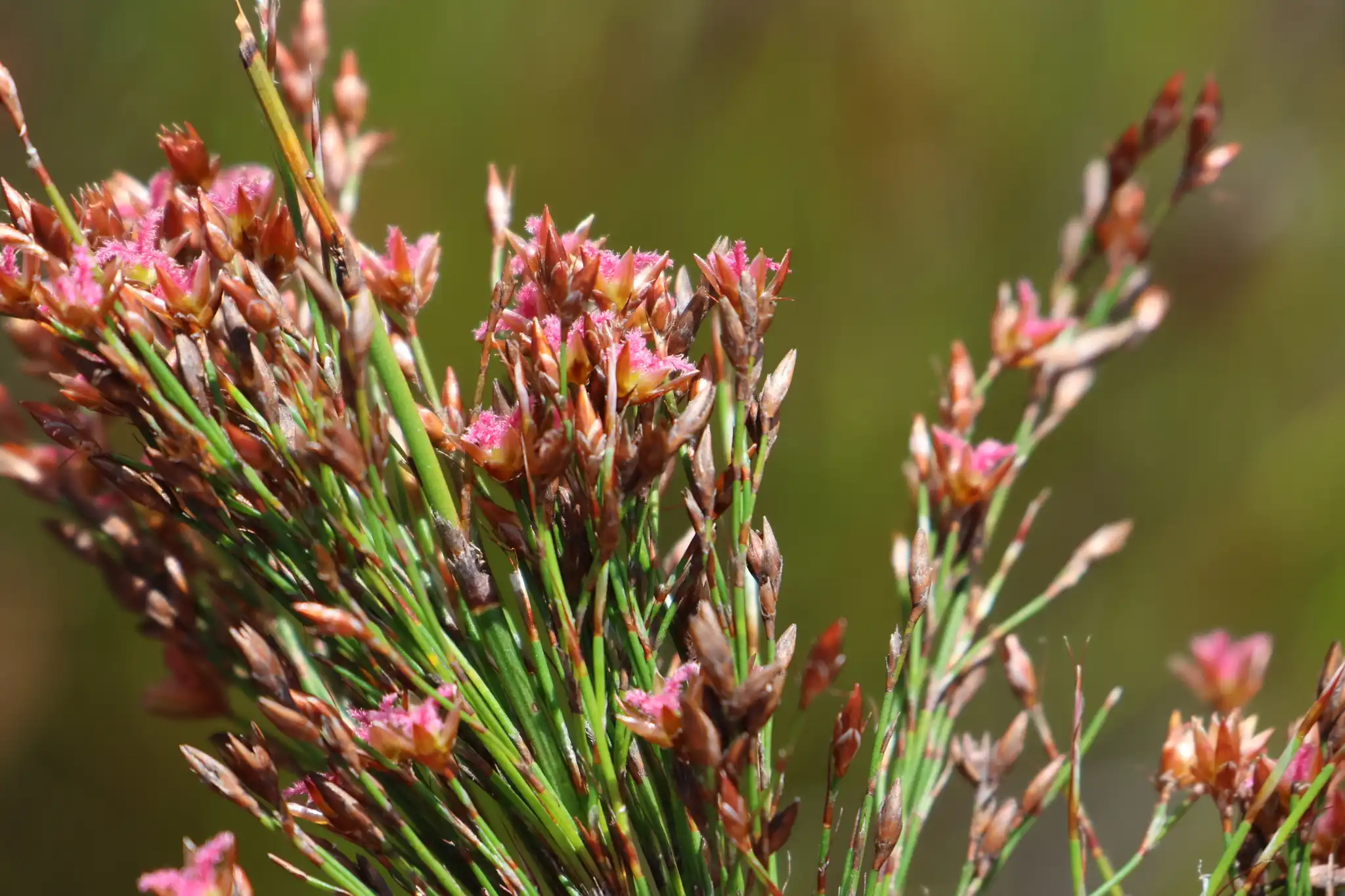
Rhodocoma capensis is a rhizomatous reed-like perennial from South Africa that forms a dense tuft of arching jointed culms to about six feet tall and three feet wide. Leaves are reduced to scales and photosynthesis is carried out by deep green whorled feathery branchlets that feather out from each node.
Plants are male or female, with females carrying deep pink tufts and males carrying pale yellow-green tassels at the branchlet tips in spring. It holds in wind and salt air on poor acidic loam, and like most restios it fails fast in rich soil or with phosphate fertilizer.
Uses & Benefits:
Essentials
At a Glance
Plant Type
Perennial
Height
72"
Width
36"
Light
Full Sun, Partial Sun
Zones
8, 9, 10
Water
Low to moderate
Humidity
Low
Lifespan
Long-lived perennial
Native To
South Africa: Western Cape to Eastern Cape
Toxicity
No toxicity reported
Bloom period
Spring
In flower about 3 months of the year
Planting
How to Grow
- Plant in full sun to light shade in well-drained acidic loam with open air movement.
- Set the crown at soil level with room to spread to three feet and water in deep.
- Water regularly the first season, then reduce to occasional deep watering once established.
- Top with pine bark or rough mulch kept off the crown and apply no high-phosphate fertilizer.
- Remove dead stems and fuel buildup by hand and do not cut into old leafless bases.
Pro Tip
Keep it lean and airy with no fertilizer, pine-bark mulch and open air movement, and never hold the crown constantly wet.
Keep It Thriving
Care Guide
Do
- Give full sun, air movement and drained acidic soil
- Mulch with pine bark or rough mulch
- Water regularly the first year, then low to moderate
Don't
- Do not apply high-phosphate fertilizer
- Do not hold soil constantly saturated or crowded
- Do not cut back into old leafless bases
Seasonal Care Calendar
| Task | Jan | Feb | Mar | Apr | May | Jun | Jul | Aug | Sep | Oct | Nov | Dec |
|---|---|---|---|---|---|---|---|---|---|---|---|---|
| Mulch | ||||||||||||
| Pest Check | ||||||||||||
| Plant | ||||||||||||
| Propagate | ||||||||||||
| Winter Prep |
Watch Out For
Pests & Diseases
Common Pests
Common Diseases
In the Garden
Landscape Uses & Companions
Landscape Uses
Multiply
Propagation Methods
Good to Know
Common Questions
Cape Restio questions
What zones can Cape Restio grow in?
Cape Restio is hardy in USDA Zones 8–10: in that range it survives winter in the ground. Colder than Zone 8, grow it in a container you can move to shelter for the winter, or as an annual.
When does Cape Restio bloom?
Cape Restio typically blooms in spring. Exact timing shifts a week or two with your zone — Sow's bloom calendar maps it to your garden.
Does Cape Restio need full sun?
Cape Restio does best in full sun to part shade. In hot climates, afternoon shade keeps blooms fresher longer.
Is Cape Restio drought tolerant?
Yes — once established (usually after the first full season), Cape Restio handles dry spells with minimal watering. Water deeply its first year to build the root system that makes that possible.
More Rhodocoma to compare
Keep exploring
Explore the genus
Hardy in your zone?
Grow Cape Restio with confidence
See it in a design of your actual yard, get zone-matched care reminders, and track it season by season in your garden journal.