The Story
Plant Bio
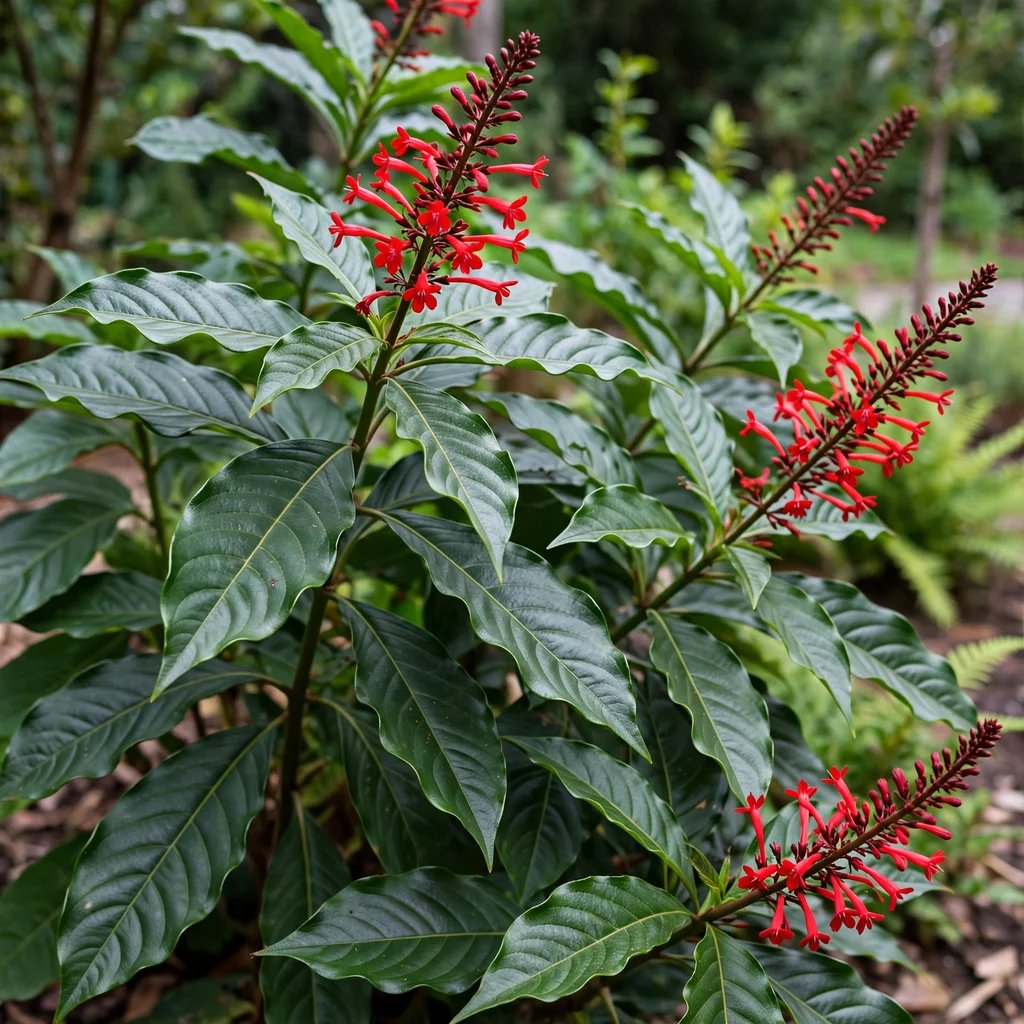
Odontonema tubaeforme is an upright herbaceous perennial from Central America to Panama that builds a thicket of thick, sparsely branched stems from underground sprouts. The foliage is opposite, large and glossy dark green with wavy margins, evergreen where frost never cuts it back.
It is sold in almost every nursery as Odontonema strictum, a heterotypic synonym for the same plant, and is grown for upright terminal spikes nine to twelve inches long of waxy brilliant-red tubular flowers. Flowering runs from late summer into early winter and is heaviest in part shade, with plants dying to the ground in zones 8 to 9 and turning semi-woody and evergreen in zones 10 to 11.
Uses & Benefits:
Essentials
At a Glance
Plant Type
Perennial
Height
60"
Width
36"
Light
Full Sun, Partial Sun
Zones
8, 9, 10
Water
Moderate
Humidity
Average
Lifespan
Perennial, evergreen in zones 10-11
Native To
Central America to Colombia and Panama
Toxicity
Not known - presumed low risk
Bloom period
Late summer – Early winter
In flower about 5 months of the year
Planting
How to Grow
- Plant in spring after frost in full sun to part shade in well-drained sand, loam or clay.
- Space 24 to 36 inches apart and water in deeply, then keep soil evenly moist but never waterlogged.
- Spread 2 to 3 inches of mulch to hold moisture, keeping it off the stems.
- Cut freeze-killed stems to the ground in early spring; shape lightly after the flowering flush.
- Divide underground sprouts in spring to contain the thicket and replant divisions at the same depth.
Pro Tip
Cut freeze-killed stems to the ground in early spring and shape lightly after flowering; the heaviest fall spikes form in part shade with steady moisture.
Keep It Thriving
Care Guide
Do
- Plant in well-drained soil in part shade for heaviest fall bloom
- Water deeply during dry spells and avoid wetting the leaves
- Mulch to conserve moisture and insulate roots in zone 8
Don't
- Do not leave the crown in waterlogged soil
- Do not prune hard into old leafless wood beyond shaping after flowering
- Do not expect evergreen stems where freezes cut it to the ground
Seasonal Care Calendar
| Task | Jan | Feb | Mar | Apr | May | Jun | Jul | Aug | Sep | Oct | Nov | Dec |
|---|---|---|---|---|---|---|---|---|---|---|---|---|
| Mulch | ||||||||||||
| Pest Check | ||||||||||||
| Plant | ||||||||||||
| Prune | ||||||||||||
| Spring Cleanup |
Watch Out For
Pests & Diseases
Common Pests
Common Diseases
In the Garden
Landscape Uses & Companions
Landscape Uses
Companion Plants
Multiply
Propagation Methods
Good to Know
Common Questions
Firespike questions
What zones can Firespike grow in?
Firespike is hardy in USDA Zones 8–10: in that range it survives winter in the ground. Colder than Zone 8, grow it in a container you can move to shelter for the winter, or as an annual.
Is Firespike deer resistant?
Not reliably. Deer may browse Firespike, especially tender spring growth — plan on repellents or fencing where pressure is high.
When does Firespike bloom?
Firespike typically blooms from late summer to early winter. Exact timing shifts a week or two with your zone — Sow's bloom calendar maps it to your garden.
Does Firespike need full sun?
Firespike does best in full sun to part shade. In hot climates, afternoon shade keeps blooms fresher longer.
Is Firespike drought tolerant?
Yes — once established (usually after the first full season), Firespike handles dry spells with minimal watering. Water deeply its first year to build the root system that makes that possible.
More Odontonema to compare
Keep exploring
Explore the genus
Hardy in your zone?
Grow Firespike with confidence
See it in a design of your actual yard, get zone-matched care reminders, and track it season by season in your garden journal.