The Story
Plant Bio
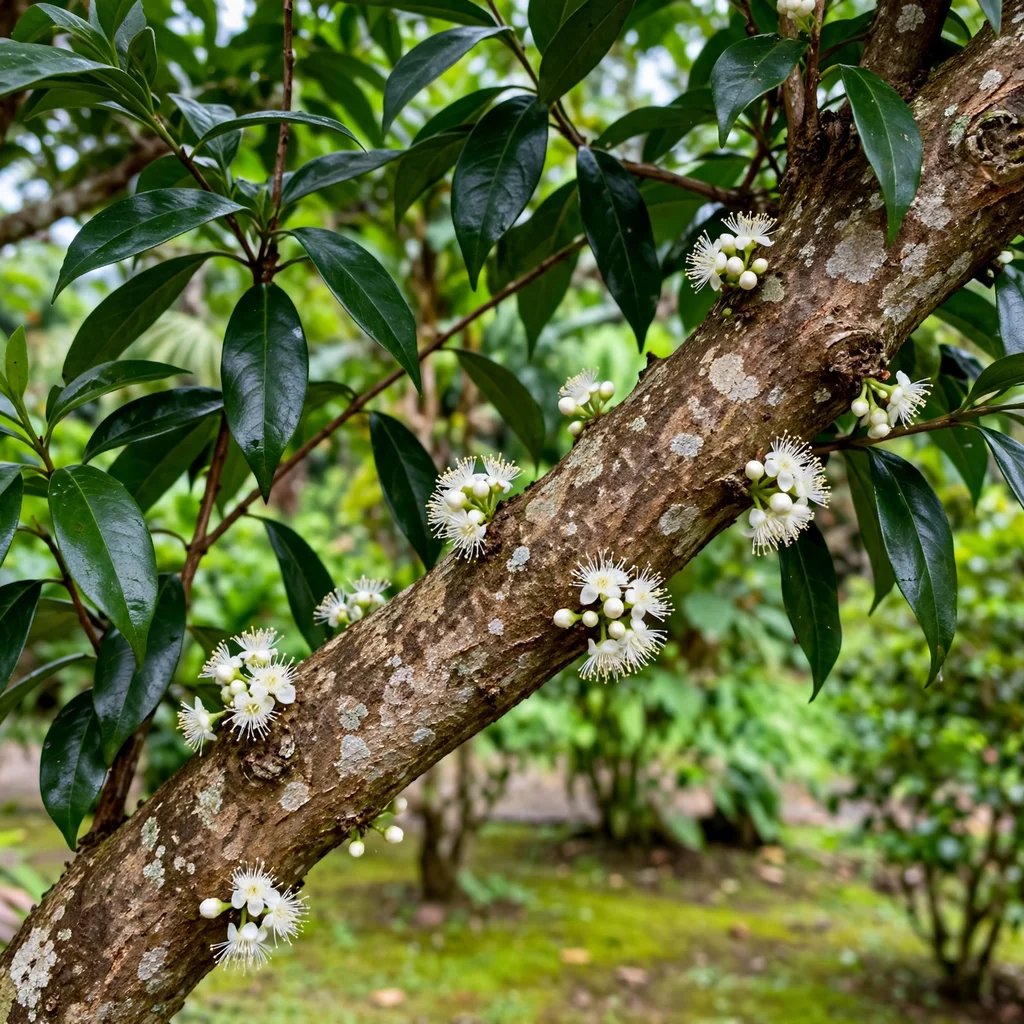
Plinia phitrantha is a slow-growing semi-deciduous tree from southeast Brazil with a short crooked bole and a dense pyramidal crown of dark green glossy leaves. Flowers and fruit form directly on the trunk and older branches, with small white self-fertile flowers giving way to grape-sized fruit.
Unlike common black jaboticaba, it ripens pale green to red-purple fruit to about 4 cm with sweet low-acid pulp and tannic skins. Selected forms sold as Costada and ESALQ grow 10 to 16 feet in gardens and can fruit in 3 to 5 years from grafted stock, versus 6 to 8 years from seed.
Uses & Benefits:
Essentials
At a Glance
Plant Type
Tree
Height
236"
Width
157"
Light
Full Sun, Partial Sun
Zones
9, 10
Water
Moderate to high
Humidity
High
Lifespan
Long-lived tree
Native To
Southeast Brazil
Toxicity
Non-toxic; skins high in tannin
Bloom period
Year round
In flower about 12 months of the year
Planting
How to Grow
- Plant in full sun to part shade in rich, deep, moist but well-drained acid soil, with afternoon shade for the first year or two.
- Water deeply and frequently to keep roots evenly moist and maintain a 3-inch organic mulch ring clear of the trunk.
- Feed with an organic fertilizer at least twice per year during the growing season.
- Prune lightly only to shape or limit size to 6 to 10 feet; cauliflorous bloom on old wood is normal and not disease.
- Move pots indoors or to shelter if frost below 27F threatens; mature trees tolerate only brief frost to 26-29F.
Pro Tip
Keep the root zone evenly moist under mulch on acid soil; on alkaline soil use chelated iron for yellow new leaves rather than extra fertilizer.
Keep It Thriving
Care Guide
Do
- Do keep soil consistently moist and mulched.
- Do feed organically at least twice a year.
- Do net ripening fruit against birds, raccoons and opossums.
- Do provide chelated iron if leaves yellow on higher pH soil.
Don't
- Do not plant in alkaline or salty soil without amendment.
- Do not let young plants dry out during establishment.
- Do not cut back hard every year; it is slow to regrow.
- Do not eat large quantities of the tannic skins.
Seasonal Care Calendar
| Task | Jan | Feb | Mar | Apr | May | Jun | Jul | Aug | Sep | Oct | Nov | Dec |
|---|---|---|---|---|---|---|---|---|---|---|---|---|
| Fertilize | ||||||||||||
| Harvest | ||||||||||||
| Mulch | ||||||||||||
| Pest Check | ||||||||||||
| Prune |
Watch Out For
Pests & Diseases
Common Pests
Common Diseases
In the Garden
Landscape Uses & Companions
Landscape Uses
Companion Plants
Multiply
Propagation Methods
Good to Know
Common Questions
White Jaboticaba questions
What zones can White Jaboticaba grow in?
White Jaboticaba is hardy in USDA Zones 9–10: in that range it survives winter in the ground. Colder than Zone 9, winters are too cold for it to survive outdoors.
Is White Jaboticaba deer resistant?
Not reliably. Deer may browse White Jaboticaba, especially tender spring growth — plan on repellents or fencing where pressure is high.
When does White Jaboticaba bloom?
White Jaboticaba typically blooms year-round. Exact timing shifts a week or two with your zone — Sow's bloom calendar maps it to your garden.
Does White Jaboticaba need full sun?
White Jaboticaba does best in full sun to part shade. In hot climates, afternoon shade keeps blooms fresher longer.
More Myrciaria to compare
Keep exploring
Explore the genus
Hardy in your zone?
Grow White Jaboticaba with confidence
See it in a design of your actual yard, get zone-matched care reminders, and track it season by season in your garden journal.