The Story
Plant Bio
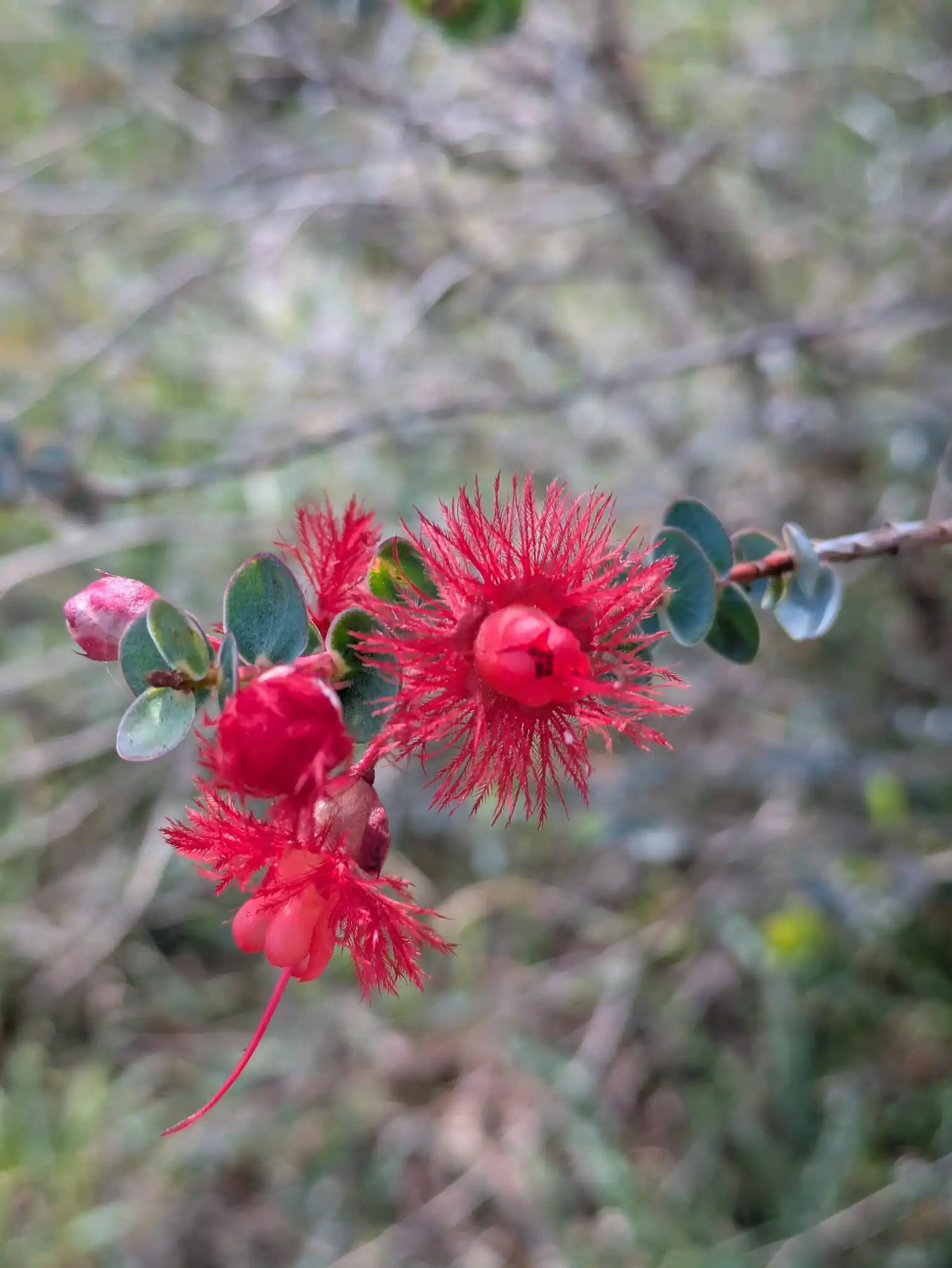
Verticordia grandis, known as the scarlet featherflower, is an open, slender woody shrub native to the sandy heathlands of southwestern Australia. It produces striking scarlet blooms along its upper stems, characterized by deeply fringed, feathery calyx lobes framing rounded grey-green leaves.
The flowers open to nearly an inch across with broad red petals surrounded by intricately branched floral structures. Unlike many woody shrubs, it flowers continuously from late winter into early summer while maintaining small, stem-clasping glaucous foliage.
Uses & Benefits:
Essentials
At a Glance
Plant Type
Shrub
Height
79"
Width
59"
Light
Full Sun
Zones
9, 10
Water
Low
Humidity
Low
Lifespan
Perennial
Native To
Western Australia
Toxicity
Non-toxic
Bloom period
Late winter – Early summer
In flower about 5 months of the year
Planting
How to Grow
- Plant in a coarse, sharply draining substrate composed primarily of sand or fine gravel.
- Position in full sun with open air circulation to prevent high humidity buildup around foliage.
- Water sparingly once established, allowing the soil medium to dry out significantly between irrigations.
- Avoid standard fertilizers, applying only low-phosphorus formulations if necessary.
- Tip-prune lightly after the spring bloom finishes, avoiding any cuts into old, leafless wood.
Pro Tip
Tip-prune lightly behind spent flowers to encourage branching, but never cut into bare, leafless wood because dormant buds on mature timber will fail to re-sprout.
Keep It Thriving
Care Guide
Do
- Grow in straight gravel or sharply draining sandy mixes.
- Provide full sun and excellent air movement.
- Prune lightly into green growth only after flowering.
Don't
- Do not fertilize with phosphorus-rich or standard complete plant foods.
- Do not cut back into old leafless stems.
- Do not overwater or allow standing water near roots during warm weather.
Seasonal Care Calendar
| Task | Jan | Feb | Mar | Apr | May | Jun | Jul | Aug | Sep | Oct | Nov | Dec |
|---|---|---|---|---|---|---|---|---|---|---|---|---|
| Fertilize | ||||||||||||
| Pest Check | ||||||||||||
| Prune | ||||||||||||
| Winter Prep |
Watch Out For
Pests & Diseases
Common Pests
Common Diseases
In the Garden
Landscape Uses & Companions
Landscape Uses
Companion Plants
Multiply
Propagation Methods
Good to Know
Common Questions
Scarlet Featherflower questions
What zones can Scarlet Featherflower grow in?
Scarlet Featherflower is hardy in USDA Zones 9–10: in that range it survives winter in the ground. Colder than Zone 9, grow it in a container you can move to shelter for the winter.
Is Scarlet Featherflower deer resistant?
Not reliably. Deer may browse Scarlet Featherflower, especially tender spring growth — plan on repellents or fencing where pressure is high.
When does Scarlet Featherflower bloom?
Scarlet Featherflower typically blooms from late winter to early summer. Exact timing shifts a week or two with your zone — Sow's bloom calendar maps it to your garden.
Does Scarlet Featherflower need full sun?
Scarlet Featherflower does best in full sun (6+ hours).
Is Scarlet Featherflower drought tolerant?
Yes — once established (usually after the first full season), Scarlet Featherflower handles dry spells with minimal watering. Water deeply its first year to build the root system that makes that possible.
More Verticordia to compare
Keep exploring
Explore the genus
Hardy in your zone?
Grow Scarlet Featherflower with confidence
See it in a design of your actual yard, get zone-matched care reminders, and track it season by season in your garden journal.