The Story
Plant Bio
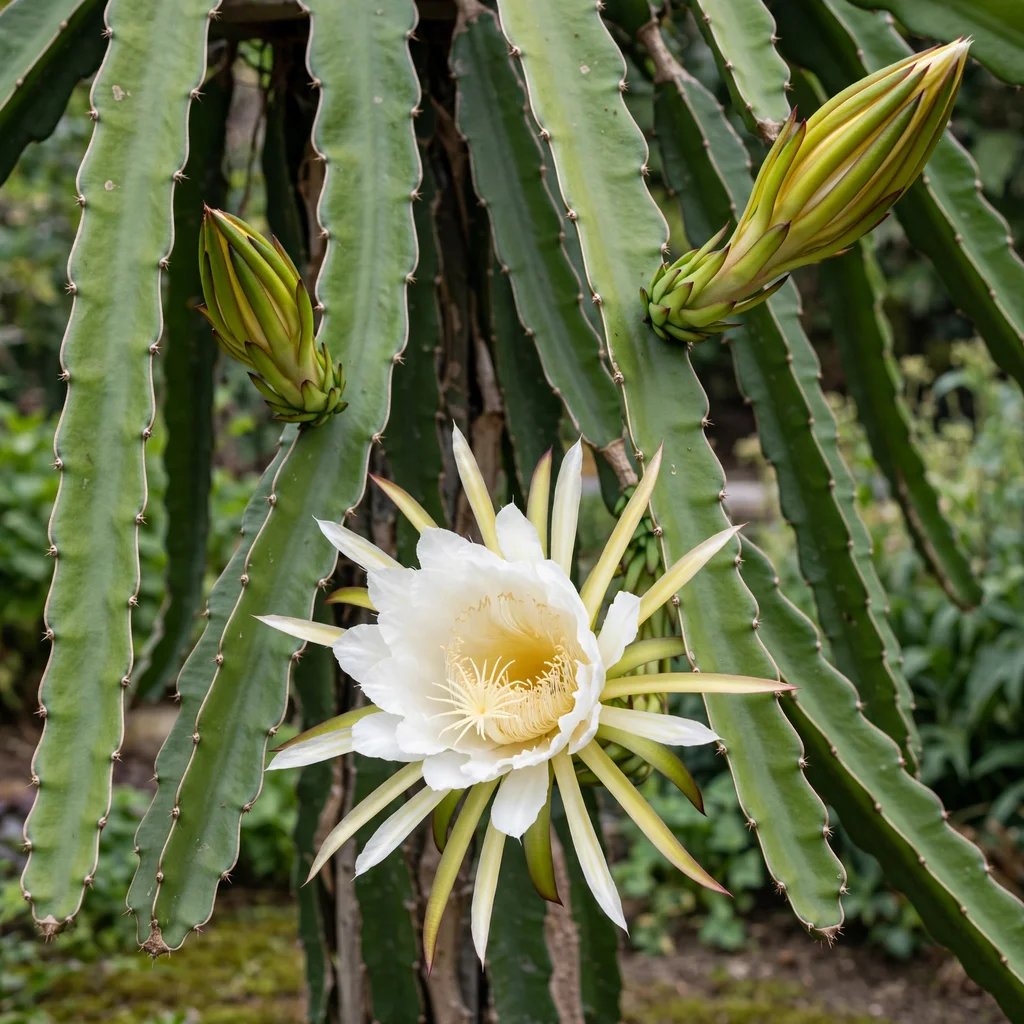
Hylocereus undatus is a fast-growing climbing cactus from seasonally dry tropical America, scrambling 10 to 20 feet by aerial roots when given a stout support. It makes no true leaves; photosynthesis takes place in jointed three-ribbed green stems with undulating horny margins.
This white-fleshed form opens solitary fragrant bells to 12 inches across, white tinged green-yellow, that expand after dark and wither by morning. Plants are self-incompatible, so flowers set pink-skinned fruit with white black-seeded flesh only when pollen comes from a genetically different clone.
Uses & Benefits:
Essentials
At a Glance
Plant Type
Cactus Succulent
Height
240"
Width
72"
Light
Full Sun, Partial Sun
Zones
9, 10
Water
Low to moderate
Humidity
Average
Lifespan
Long-lived perennial
Native To
Mexico to Honduras
Toxicity
Non-toxic
Bloom period
Late spring – Fall
In flower about 7 months of the year
Marketplace
Where to Buy
Shipping costs Year-round shipping Free shipping
Planting
How to Grow
- Plant after last frost in full sun with at least 6 hours of direct sun; light afternoon shade is tolerated in hot interiors.
- Set in a rich yet open mix amended with coarse sand, pH 6.0 to 7.0, in a mound or raised bed that never ponds.
- Anchor a 4x4 post with crossarm or trellis before planting and tie one or two stems to the post with soft ties.
- Water deeply then let the upper mix dry; cut back in cool or wet spells because waterlogging rots stems and drops buds.
- Thin and tip-prune one to three times per year to keep about 15 cladodes per yard of trellis and remove soil-touching or damaged stems.
- Hand-pollinate on the night of opening with pollen from a different clone, then harvest fruit when skin colors fully pink.
Pro Tip
Grow two different clones on one anchored post and hand-pollinate after dark; a single clone and wet feet account for most failures.
Keep It Thriving
Care Guide
Do
- Provide a stout anchored post or trellis and tie growth up from the start.
- Plant in fast-draining organic sand mix with pH 6.0 to 7.0.
- Grow two or more different clones and hand-pollinate night flowers.
- Sterilize tools and prune out spotted or rotted stems promptly.
Don't
- Do not overwater or leave plants in soil that stays wet.
- Do not grow a single self-incompatible clone and expect fruit.
- Do not let vines scramble unmanaged into trees or native vegetation.
- Do not cut into prolonged cold without frost protection.
Seasonal Care Calendar
| Task | Jan | Feb | Mar | Apr | May | Jun | Jul | Aug | Sep | Oct | Nov | Dec |
|---|---|---|---|---|---|---|---|---|---|---|---|---|
| Harvest | ||||||||||||
| Pest Check | ||||||||||||
| Plant | ||||||||||||
| Prune | ||||||||||||
| Winter Prep |
Watch Out For
Pests & Diseases
Common Pests
Common Diseases
In the Garden
Landscape Uses & Companions
Landscape Uses
Multiply
Propagation Methods
Good to Know
Common Questions
Dragon Fruit questions
What zones can Dragon Fruit grow in?
Dragon Fruit is hardy in USDA Zones 9–10: in that range it survives winter in the ground. Colder than Zone 9, grow it in a container you can move to shelter for the winter, or as an annual.
When does Dragon Fruit bloom?
Dragon Fruit typically blooms from late spring to late fall. Exact timing shifts a week or two with your zone — Sow's bloom calendar maps it to your garden.
Does Dragon Fruit need full sun?
Dragon Fruit does best in full sun to part shade. In hot climates, afternoon shade keeps blooms fresher longer.
Is Dragon Fruit drought tolerant?
Yes — once established (usually after the first full season), Dragon Fruit handles dry spells with minimal watering. Water deeply its first year to build the root system that makes that possible.
More Hylocereus to compare
Keep exploring
Explore the genus
Hardy in your zone?
Grow Dragon Fruit with confidence
See it in a design of your actual yard, get zone-matched care reminders, and track it season by season in your garden journal.