The Story
Plant Bio
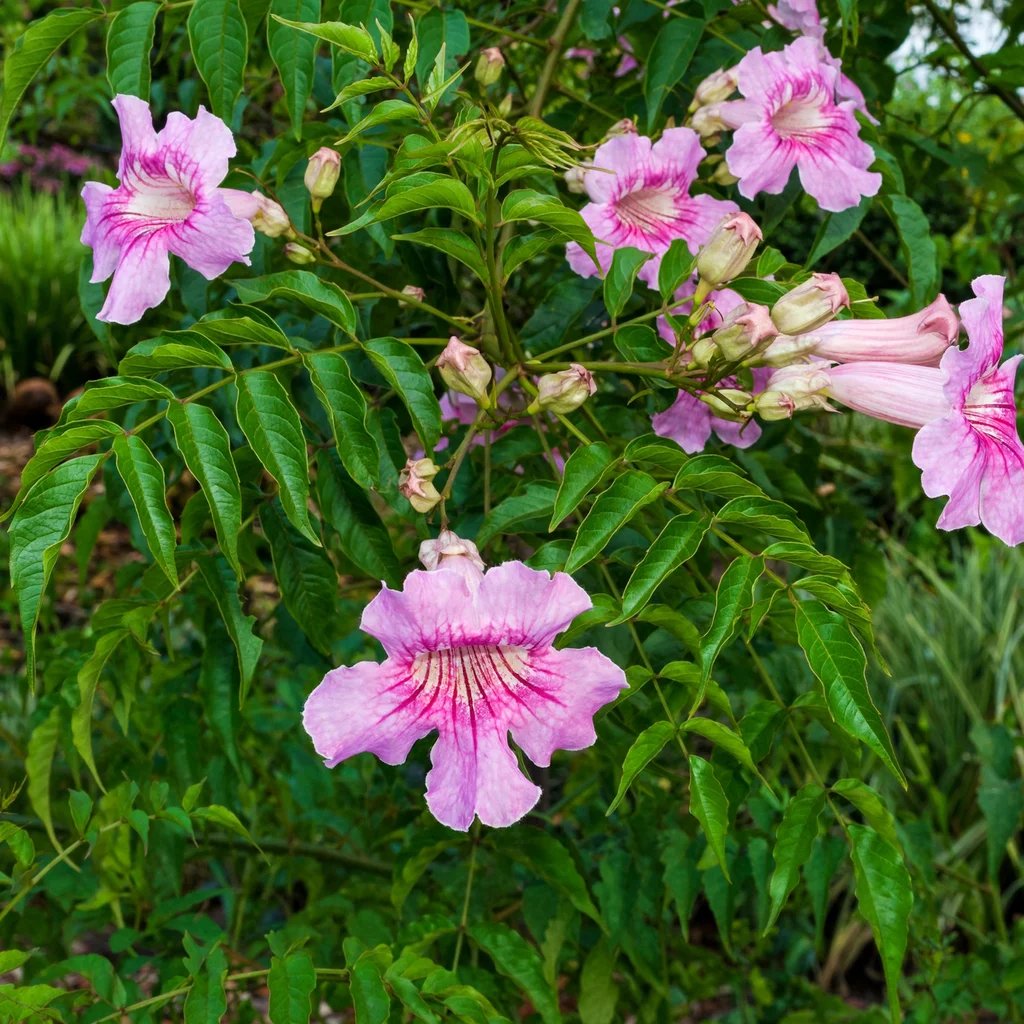
Podranea ricasoliana is a vigorous evergreen woody climber from riverine forest margins in southeastern Africa, scrambling to 20 feet by long stems that root where they touch soil. It carries large glossy dark green pinnate leaves and bears terminal clusters of pink trumpet-shaped flowers with a red-striped throat.
It flowers from summer to first frost, with fragrant lilac-pink bells opening in bunches at the branch tips. Mature wood survives to about 20F and resprouts after top dieback in zone 8, but young plants are frost-tender and drought tolerance develops only after the first year or two.
Uses & Benefits:
Essentials
At a Glance
Plant Type
Vine
Height
240"
Width
240"
Light
Full Sun, Partial Sun
Zones
8, 9, 10
Water
Moderate to low once established
Humidity
Average
Lifespan
Woody perennial vine
Native To
South Africa, Malawi, Mozambique, Zambia
Toxicity
Non-toxic; sap may irritate sensitive skin
Bloom period
Summer – Autumn
In flower about 6 months of the year
Planting
How to Grow
- Plant in spring after frost in full sun in rich, well-draining soil with a strong trellis or pergola in place.
- Water deeply at planting and through the first two growing seasons, then reduce to occasional deep watering once established.
- Train long stems to the support and tie as needed; prune after flowering and cut back hard in late winter to control size and induce bloom.
- Mulch in fall in zone 8 and overwinter young plants in pots where hard frosts occur; avoid waterlogged soil.
- Inspect new growth in summer for aphids, mites and whitefly and treat early to keep foliage clean.
Pro Tip
Give it a large, strong pergola from the start and cut it hard every late winter; neglected plants reach 20 feet and overwhelm the structure.
Keep It Thriving
Care Guide
Do
- Plant in full sun with sharp drainage and a load-bearing support.
- Prune yearly after flowering to keep size in check.
- Water deeply during establishment, then only in extended dry spells.
Don't
- Do not plant near natural areas or neglect pruning - stems reach 20 feet and overwhelm structures.
- Do not dump prunings; stems root where thrown.
- Do not overwater or plant in soggy soil where root rot develops.
Seasonal Care Calendar
| Task | Jan | Feb | Mar | Apr | May | Jun | Jul | Aug | Sep | Oct | Nov | Dec |
|---|---|---|---|---|---|---|---|---|---|---|---|---|
| Mulch | ||||||||||||
| Pest Check | ||||||||||||
| Plant | ||||||||||||
| Prune | ||||||||||||
| Winter Prep |
Watch Out For
Pests & Diseases
Common Pests
Common Diseases
In the Garden
Landscape Uses & Companions
Landscape Uses
Multiply
Propagation Methods
Good to Know
Common Questions
Pink Trumpet Vine questions
What zones can Pink Trumpet Vine grow in?
Pink Trumpet Vine is hardy in USDA Zones 8–10: in that range it survives winter in the ground. Colder than Zone 8, grow it in a container you can move to shelter for the winter, or as an annual.
When does Pink Trumpet Vine bloom?
Pink Trumpet Vine typically blooms from summer to fall. Exact timing shifts a week or two with your zone — Sow's bloom calendar maps it to your garden.
Does Pink Trumpet Vine need full sun?
Pink Trumpet Vine does best in full sun to part shade. In hot climates, afternoon shade keeps blooms fresher longer.
Is Pink Trumpet Vine drought tolerant?
Yes — once established (usually after the first full season), Pink Trumpet Vine handles dry spells with minimal watering. Water deeply its first year to build the root system that makes that possible.
More Podranea to compare
Keep exploring
Explore the genus
Hardy in your zone?
Grow Pink Trumpet Vine with confidence
See it in a design of your actual yard, get zone-matched care reminders, and track it season by season in your garden journal.