The Story
Plant Bio
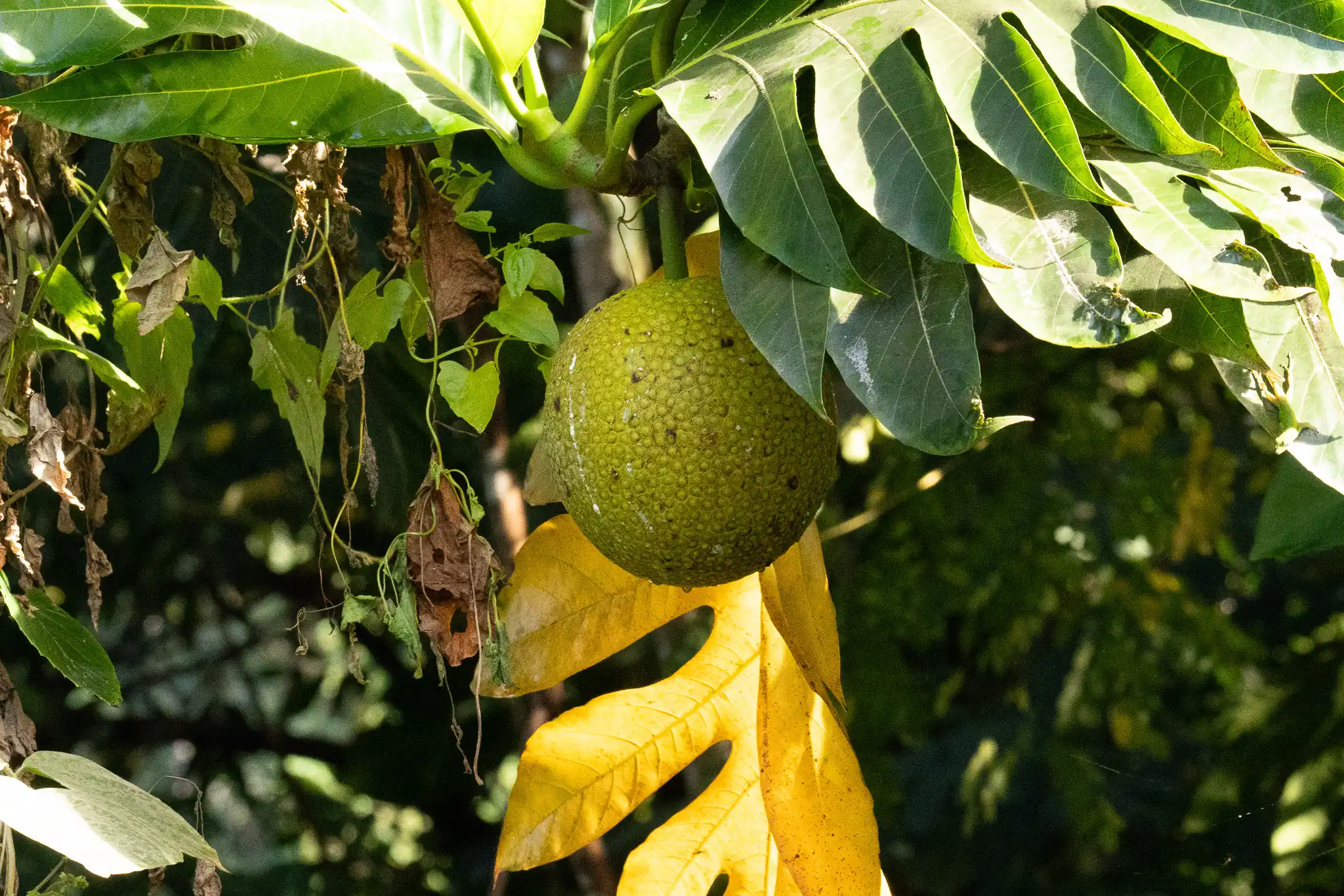
Artocarpus altilis is a fast-growing evergreen tree in the mulberry family that reaches 30 to 50 feet in cultivation with a spreading rounded crown and milky latex in all green parts. Its leaves are thick, leathery and glossy, 10 to 35 inches long and deeply cut into 5 to 11 lobes on stout shoots with large enclosing stipules.
Flowers are borne directly on the trunk and large limbs, with pendant yellow male spikes to 10 inches and rounded female heads that fuse into large starchy syncarp fruits. It demands frost-free full sun and deep well-drained soil, and it collapses quickly below 40 degrees or in waterlogged ground where root rot takes hold.
Uses & Benefits:
Essentials
At a Glance
Plant Type
Tree
Height
591"
Width
591"
Light
Full Sun
Zones
10
Water
High moisture with sharp drainage
Humidity
High (70-80%)
Lifespan
Long-lived tree
Native To
Oceania (Northwest Pacific)
Toxicity
Skin irritant from latex; fruit edible
Bloom period
Spring – Summer
In flower about 6 months of the year
Planting
How to Grow
- Plant only in frost-free USDA Zones 10-12 in full sun with room for a 30-foot crown.
- Dig into deep, fertile, well-drained soil and plant at the nursery depth, then water in thoroughly.
- Mulch 3 to 4 inches deep to hold root moisture, keeping mulch off the trunk.
- Water consistently the first two years; established trees take short dry spells but drop leaves and fruit if kept dry.
Pro Tip
Head back only leafy shoots to control height for harvest and never cut into thick leafless wood, which resprouts poorly.
Keep It Thriving
Care Guide
Do
- Give full sun and shelter from wind and any frost.
- Keep soil evenly moist with sharp drainage.
- Clear fallen ripe fruit promptly to break fruit-fly cycles.
Don't
- Do not plant where temperatures fall near freezing.
- Do not overwater heavy clay or let roots sit in standing water.
- Do not prune hard into old leafless wood to reduce size.
Seasonal Care Calendar
| Task | Jan | Feb | Mar | Apr | May | Jun | Jul | Aug | Sep | Oct | Nov | Dec |
|---|---|---|---|---|---|---|---|---|---|---|---|---|
| Fertilize | ||||||||||||
| Harvest | ||||||||||||
| Mulch | ||||||||||||
| Pest Check | ||||||||||||
| Prune |
Watch Out For
Pests & Diseases
Common Pests
Common Diseases
In the Garden
Landscape Uses & Companions
Landscape Uses
Companion Plants
Multiply
Propagation Methods
Good to Know
Common Questions
Breadfruit questions
What zones can Breadfruit grow in?
Breadfruit is hardy in USDA Zone 10: in that range it survives winter in the ground. Colder than Zone 10, winters are too cold for it to survive outdoors.
When does Breadfruit bloom?
Breadfruit typically blooms from spring to summer. Exact timing shifts a week or two with your zone — Sow's bloom calendar maps it to your garden.
Does Breadfruit need full sun?
Breadfruit does best in full sun (6+ hours).
More Artocarpus to compare
Keep exploring
Explore the genus
Hardy in your zone?
Grow Breadfruit with confidence
See it in a design of your actual yard, get zone-matched care reminders, and track it season by season in your garden journal.