The Story
Plant Bio
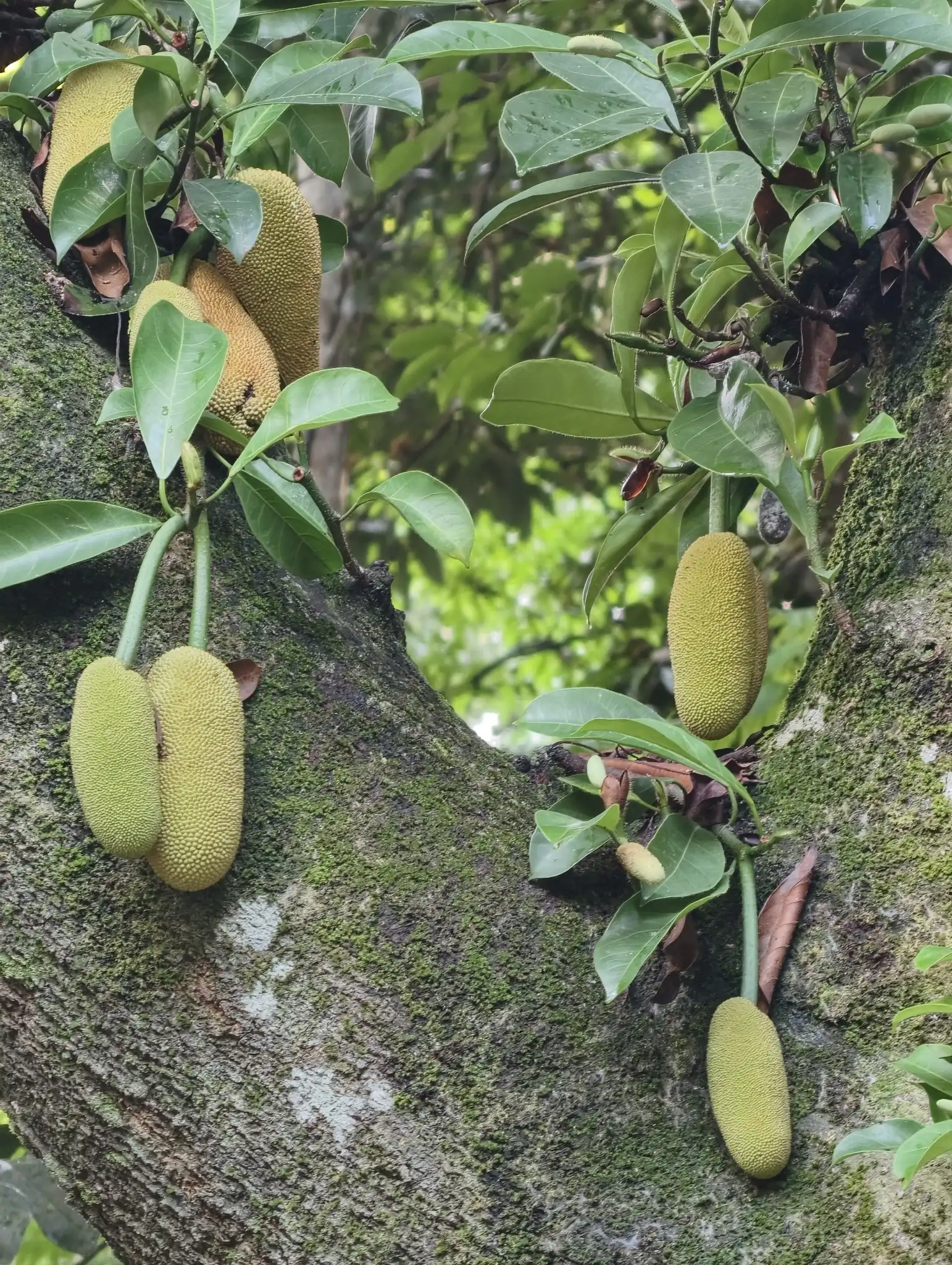
Artocarpus integer is an evergreen Southeast Asian tree reaching 30 to 115 feet in the tropics, with alternate obovate leaves 2 to 10 inches long and milky white latex in every twig and leaf. Male and female flowers are borne in separate dense heads, the whitish-yellow males in cylinders 1 to 2 inches long on the outer canopy and the females directly on the trunk and limbs where the fruit later develops.
Young shoots, stipules and unfolding leaves carry stiff brown hairs, and saplings often produce larger partly lobed leaves before maturing to entire obovate blades. Female heads form directly on the trunk and main branches, developing into heavy syncarps with a rind of firm blunt processes.
Uses & Benefits:
Essentials
At a Glance
Plant Type
Tree
Height
1378"
Width
787"
Light
Full Sun
Zones
10
Water
High
Humidity
High
Lifespan
Long-lived evergreen tree
Native To
Southeast Asia
Toxicity
Skin irritant from latex
Bloom period
Year round
In flower about 12 months of the year
Planting
How to Grow
- Plant in full sun in a frost-free microclimate, greenhouse, or large container that can be protected near 32 degrees F.
- Set into fertile, moist yet well-drained sandy, loam, or clay soil with acidic to neutral pH.
- Water deeply and regularly year-round; do not allow a long dry period or standing water around the roots.
- Feed mature trees twice a year with balanced NPK plus magnesium during active growth and maintain a deep mulch ring.
- Keep trees 10 to 16 feet by light structural pruning and remove fallen fruit promptly.
Pro Tip
Keep pruning to dead wood and light height control; cutting deep into old leafless wood bleeds latex heavily and closes poorly.
Keep It Thriving
Care Guide
Do
- Water consistently to keep the root zone evenly moist in heat.
- Mulch widely and keep mulch off the trunk.
- Feed twice a year with balanced fertilizer plus magnesium.
Don't
- Do not let fresh seed dry out before sowing.
- Do not cut back into thick old leafless wood.
- Do not plant in poorly drained or waterlogged soil.
Seasonal Care Calendar
| Task | Jan | Feb | Mar | Apr | May | Jun | Jul | Aug | Sep | Oct | Nov | Dec |
|---|---|---|---|---|---|---|---|---|---|---|---|---|
| Fertilize | ||||||||||||
| Harvest | ||||||||||||
| Mulch | ||||||||||||
| Pest Check | ||||||||||||
| Prune |
Watch Out For
Pests & Diseases
Common Pests
Common Diseases
In the Garden
Landscape Uses & Companions
Landscape Uses
Companion Plants
Multiply
Propagation Methods
Good to Know
Common Questions
Chempedak questions
What zones can Chempedak grow in?
Chempedak is hardy in USDA Zone 10: in that range it survives winter in the ground. Colder than Zone 10, winters are too cold for it to survive outdoors.
When does Chempedak bloom?
Chempedak typically blooms year-round. Exact timing shifts a week or two with your zone — Sow's bloom calendar maps it to your garden.
Does Chempedak need full sun?
Chempedak does best in full sun (6+ hours).
More Artocarpus to compare
Keep exploring
Explore the genus
Hardy in your zone?
Grow Chempedak with confidence
See it in a design of your actual yard, get zone-matched care reminders, and track it season by season in your garden journal.