The Story
Plant Bio
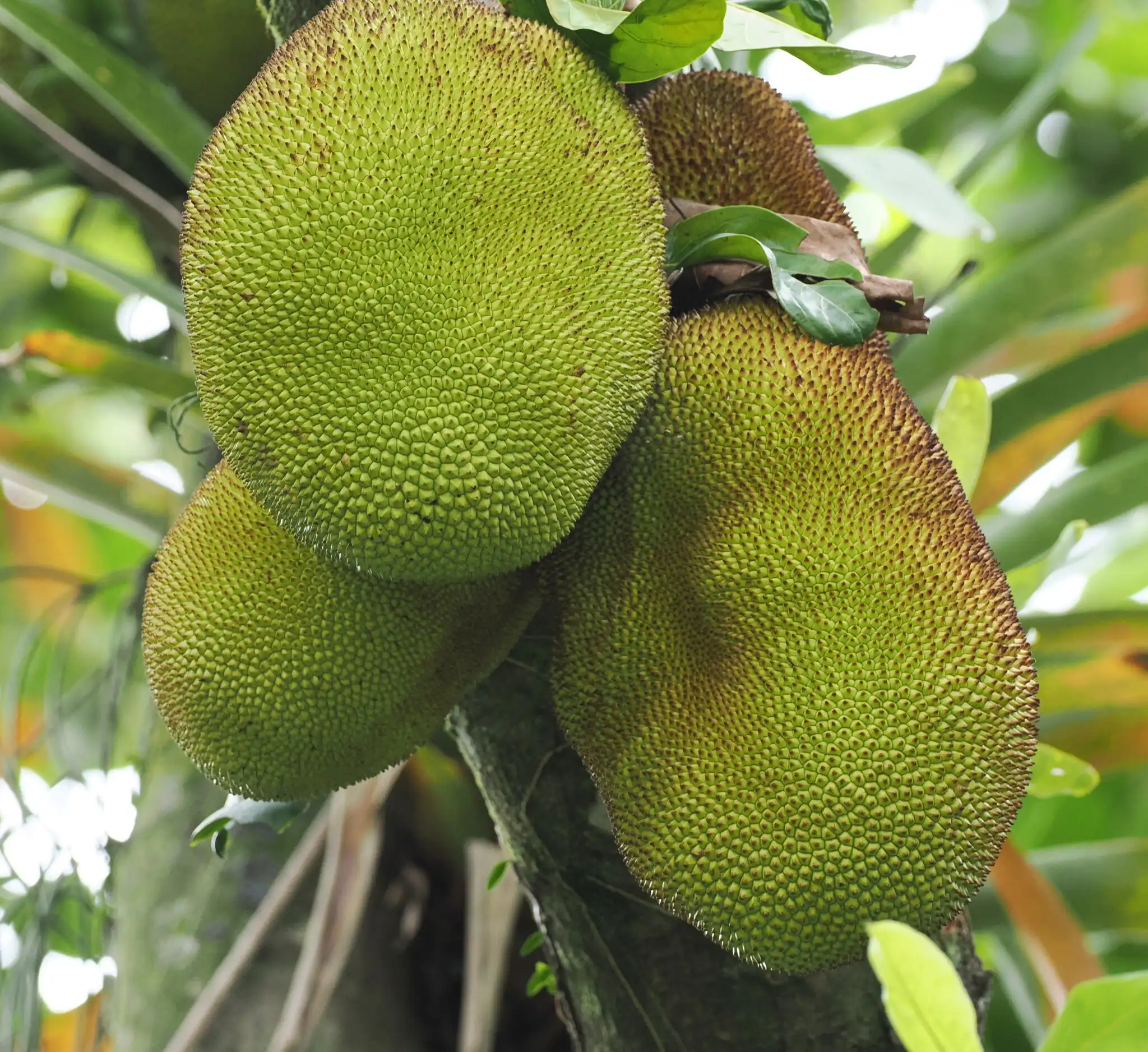
Artocarpus heterophyllus is an erect evergreen tree in the mulberry family reaching 30 to 40 feet in Florida gardens, with large alternate dark green glossy leathery leaves that are oval on mature wood and deeply lobed on young shoots. All parts exude sticky white latex when cut, and separate male and female flowers form on short stout twigs from the trunk and large branches.
This species is cauliflorous, flowering and fruiting directly from the trunk and large limbs on short stalks, and forms a strong central leader when unpruned. Fruits are heavy enough to be a drop hazard and are judged ripe by strong aroma with flattened spines and a hollow sound when tapped rather than by skin color alone.
Uses & Benefits:
Essentials
At a Glance
Plant Type
Tree
Height
420"
Width
300"
Light
Full Sun
Zones
10
Water
Moderate
Humidity
High
Lifespan
Long-lived tree
Native To
India to Malaysia
Toxicity
Unknown
Bloom period
Summer – Fall
In flower about 6 months of the year
Marketplace
Where to Buy
Shipping costs Year-round shipping Free shipping
Planting
How to Grow
- Plant in full sun in the warmest frost-free spot, 25 to 30 feet from buildings and other trees.
- Dig in well-drained sand or sandy loam, including high-pH calcareous rock; do not plant where water stands after rain.
- Set the root ball level, mulch 2 to 6 inches deep kept 8 to 12 inches off the trunk, and keep grass 2 to 5 feet clear.
- Water young trees regularly and water mature trees through bloom and fruit development for yield.
- Feed with 6-6-6 every 8 weeks the first year, then 2 to 3 times from bloom to harvest plus foliar minors 4 to 6 times April to September.
- Prune to maintain 8 to 14 feet, thinning upright shoots and old flowering shoots after harvest.
Pro Tip
Plant two different cultivars for heavier set and check ripeness by scent and hollow sound, not by skin color.
Keep It Thriving
Care Guide
Do
- Wear gloves and oil hands and tools to handle sticky white latex.
- Plant a second cultivar nearby to improve fruit set.
- Mulch and keep mower and string trimmer away from the trunk.
- Thin young trees to one fruit per limb.
Don't
- Do not plant where soil stays wet or floods; decline follows 2 to 3 days of wet feet.
- Do not buy a root-bound tree with a large top in a small pot.
- Do not overwater lawn around the tree or let grass grow to the trunk.
- Do not judge ripeness by color alone.
Seasonal Care Calendar
| Task | Jan | Feb | Mar | Apr | May | Jun | Jul | Aug | Sep | Oct | Nov | Dec |
|---|---|---|---|---|---|---|---|---|---|---|---|---|
| Fertilize | ||||||||||||
| Harvest | ||||||||||||
| Mulch | ||||||||||||
| Pest Check | ||||||||||||
| Prune |
Watch Out For
Pests & Diseases
Common Pests
Common Diseases
In the Garden
Landscape Uses & Companions
Landscape Uses
Companion Plants
Multiply
Propagation Methods
Good to Know
Common Questions
Jackfruit questions
What zones can Jackfruit grow in?
Jackfruit is hardy in USDA Zone 10: in that range it survives winter in the ground. Colder than Zone 10, winters are too cold for it to survive outdoors.
When does Jackfruit bloom?
Jackfruit typically blooms from summer to fall. Exact timing shifts a week or two with your zone — Sow's bloom calendar maps it to your garden.
Does Jackfruit need full sun?
Jackfruit does best in full sun (6+ hours).
Is Jackfruit drought tolerant?
Yes — once established (usually after the first full season), Jackfruit handles dry spells with minimal watering. Water deeply its first year to build the root system that makes that possible.
More Artocarpus to compare
Keep exploring
Explore the genus
Hardy in your zone?
Grow Jackfruit with confidence
See it in a design of your actual yard, get zone-matched care reminders, and track it season by season in your garden journal.