Quick answer
Grow vining cucumbers on a support 5 to 6 feet (1.5 to 1.8 m) tall: 4-inch (10 cm) mesh, or one twine per plant from a tight top wire, on posts driven 1 to 2.5 feet (30 to 75 cm) deep. Build it before sowing, thin plants to 8 to 12 inches (20 to 30 cm) apart, and weave or clip vines in every few days. Bush types need none.
Key facts
- Height above ground
- 5 to 6 ft (1.5 to 1.8 m) for vining types; 3 to 4 ft (0.9 to 1.2 m) for a short support
- Post depth
- At least 1 ft (30 cm); 2 to 2.5 ft (60 to 75 cm) for long wire rows
- Mesh
- 4 in (10 cm) grid wire panels or plastic netting
- Plant spacing
- Thin to 8 to 12 in (20 to 30 cm) along the trellis
- Sow when
- At least 60°F (16°C); 65–70°F (18–21°C) at 1 in (2.5 cm) is ideal
- Water
- About 1 in (2.5 cm) a week, at the base, in the morning
- Pick
- Every 2 to 3 days: picklers at 2 to 4 in (5 to 10 cm), slicers at 6 to 8 in (15 to 20 cm)
- Bush varieties
- No trellis needed; 'Spacemaster' grows 8 in (20 cm) tall
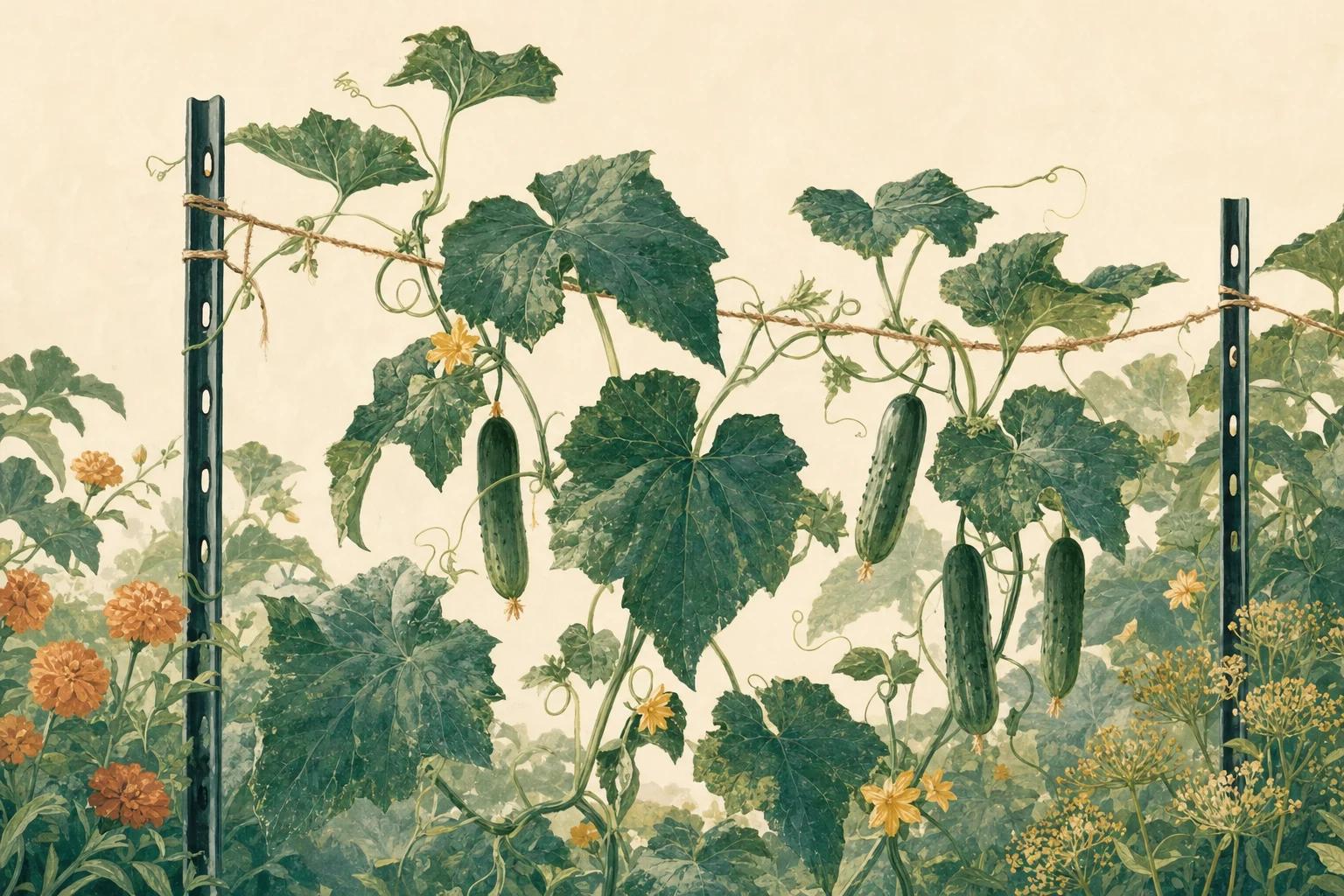
A cucumber vine climbs by tendrils, so a trellis has only two jobs: give those tendrils something thin to grab, and stay upright under a summer's worth of wet leaves in a thunderstorm. A frame 5 to 6 feet (1.5 to 1.8 m) tall, on posts sunk 1 to 2.5 feet (30 to 75 cm) into the ground and set up before you sow, does both.
What you gain is cleaner, straighter fruit hanging at eye level, foliage that dries quickly, and a crop that fits in a strip of bed instead of sprawling across it. What you take on is a little regular work: steering young vines onto the support and picking every few days.
Why trellis cucumbers, and what it will not do
Trellising improves fruit quality, airflow and space use; it does not reliably raise the yield per plant.
Straighter, cleaner fruit. Cucumbers that hang free grow straight, which matters most for long slicing types that curl when they lie on the soil. They also come off the vine clean, with no muddy side.
Drier leaves. Vines held up in moving air dry off faster after rain and dew, which cuts soil-borne fruit rot and can lower disease pressure.
Easier picking. Fruit hangs at arm's length and in plain view, and nobody steps on the vines to reach it.
Far less ground. Sprawling vining cucumbers are grown in hills 3 to 5 feet (0.9 to 1.5 m) apart, in rows 4 to 5 feet (1.2 to 1.5 m) apart. On a trellis the same plants stand in a single line, 8 to 12 inches (20 to 30 cm) apart, so the yield per square foot of bed goes up even when the yield per plant does not.
In a small trial in Alaska's short season, with three plants in each of three plots, trellised and sprawling 'Early Pride' plants gave statistically similar yields, the sprawling ones slightly ahead. Other plantings have produced more than five times as much fruit on a trellis as on the ground. Season length, variety and spacing drive the difference, so treat extra fruit as a possible bonus, and count on the quality, space and convenience gains.
Vining or bush: which cucumbers need a trellis
Vining cucumbers need a trellis; bush cucumbers do not.
Most cucumber varieties make long, vigorous vines, and those are the ones to grow vertically. Bush types have very short vines, and gardeners plant them 2 to 3 feet (60 to 90 cm) apart in rows or hills without support. A bush plant on a 6-foot frame simply never uses it.
How a variety sets fruit matters as much as its habit. Standard (monoecious) plants carry male and female flowers and need bees, with each female flower needing 8 to 12 visits, so fruit set drops whenever bees are scarce. Parthenocarpic varieties set fruit without pollination. Gynoecious varieties bear mostly female flowers and need a standard variety planted nearby as a pollen source, unless they are also parthenocarpic.
| Variety | Type | Fruit at harvest | Pollination | On a trellis |
|---|---|---|---|---|
| 'Gateway' | Vining slicer | 8 to 9 in (20 to 23 cm) | Standard (monoecious) | Recommended for outdoor trellis growing; intermediate resistance to powdery and downy mildew |
| 'Suyo Long' | Specialty long type | 10 to 15 in (25 to 38 cm) | Standard | Long fruit hang straight instead of curling |
| 'Corinto' | Slicer | 7 to 8 in (18 to 20 cm) | Gynoecious, parthenocarpic | Sets fruit without bees |
| 'Diva' | Slicer | 5 to 7 in (13 to 18 cm) | Parthenocarpic | Sets fruit without bees |
| 'H-19 Little Leaf' | Pickler | 3 to 5 in (8 to 13 cm) | Parthenocarpic | Small fruit; sets without bees; high bacterial wilt resistance |
| 'Spacemaster' | Bush slicer | About 7.5 in (19 cm) | Not stated | No trellis: 8 in (20 cm) tall, 26 in (66 cm) wide |
Fruit lengths and flower types from seed company grower data; Standard means no gynoecious or parthenocarpic trait is listed. 'Bush Champion' is another compact bush slicer that suits containers.
Trellis designs that work
Any frame that holds mesh, wire or twine taut will carry cucumbers; choose by row length and how permanent you want it.
| Design | Height above ground | Posts | What the vines climb |
|---|---|---|---|
| Two-stake mesh panel | About 5 ft (1.5 m) | 6-ft (1.8 m) stakes, 1 ft (30 cm) deep, 5 to 6 ft (1.5 to 1.8 m) apart | Mesh nailed, stapled or tied on; add a middle stake for a wider panel |
| Wire and twine row | About 5.5 to 6 ft (1.7 to 1.8 m) | 8-ft (2.4 m) T-posts, 2.5 ft (75 cm) deep, about 10 ft (3 m) apart | One twine per plant between a top and a bottom wire |
| Post and mesh row | Post tops about 6 ft (1.8 m) | Posts about 2 ft (60 cm) deep, 12 to 20 ft (3.7 to 6.1 m) apart | Hog wire or other 4-in (10 cm) grid wire |
| Zigzag string | About 5.5 ft (1.7 m) on 8-ft T-posts | Two steel T-posts | Plastic tomato twine zigzagged between them, rows 6 to 8 in (15 to 20 cm) apart |
| Ready-made A-frame | 48 in (1.2 m) per side | Self-supporting | Two 29-in (74 cm) wide mesh sides with an open underside for picking |
Dimensions from published extension trellis plans and one manufacturer's A-frame. A wire-and-twine row can run up to 15 ft (4.6 m) between posts if the top wire is pulled very tight.
Height. A 3- to 4-foot (90 to 120 cm) trellis keeps the planting compact; a 5- to 6-foot (1.5 to 1.8 m) frame gives long-vined varieties room to keep climbing. For mixed plantings, build to 5 or 6 feet and you will not run short.
Mesh. Hog wire, woven-wire panels and concrete reinforcing wire come with a 4-inch (10 cm) square grid. Plastic netting and chicken wire also work, and heavier mesh suits the most vigorous vines. Whatever the mesh, look along it every time you harvest: fruit sometimes grows through an opening and swells until it is wedged between the wires.
Fences and arbors. An existing wire fence works as a ready-made trellis, and so does an arbor. For a new mesh row, stretch hog wire between driven posts as in the table above.
How strong to build it and how deep to anchor
Build for wind rather than fruit weight, with the whole frame sturdy enough to ride out sustained winds of 40 mph (64 km/h). Sink posts at least 1 foot (30 cm) deep, or 2 to 2.5 feet (60 to 75 cm) for long wire rows, and brace the ends.
A trellis covered in cucumber leaves behaves like a sail. The fruit adds little load; wind pushing on that leafy wall, levering the posts over, is what topples a trellis, which is why depth and bracing matter more than how thick the mesh is.
Brace the ends of a wire row. A tight top wire pulls the end posts toward each other. Tie a wire from the top of each end post down to a 3-foot (90 cm) stake driven at an angle beyond the row, and the pull is transferred into the ground.
Keep the top wire tight. A sagging wire lets the twine and vines slide toward the middle of the span. Doubling the top wire holds each strand in place as the wire stretches over the season.
Use cord that does not stretch. Polypropylene or nylon twine holds its length when wet. Cotton and hemp stretch, so a loaded vine slowly sinks toward the soil.
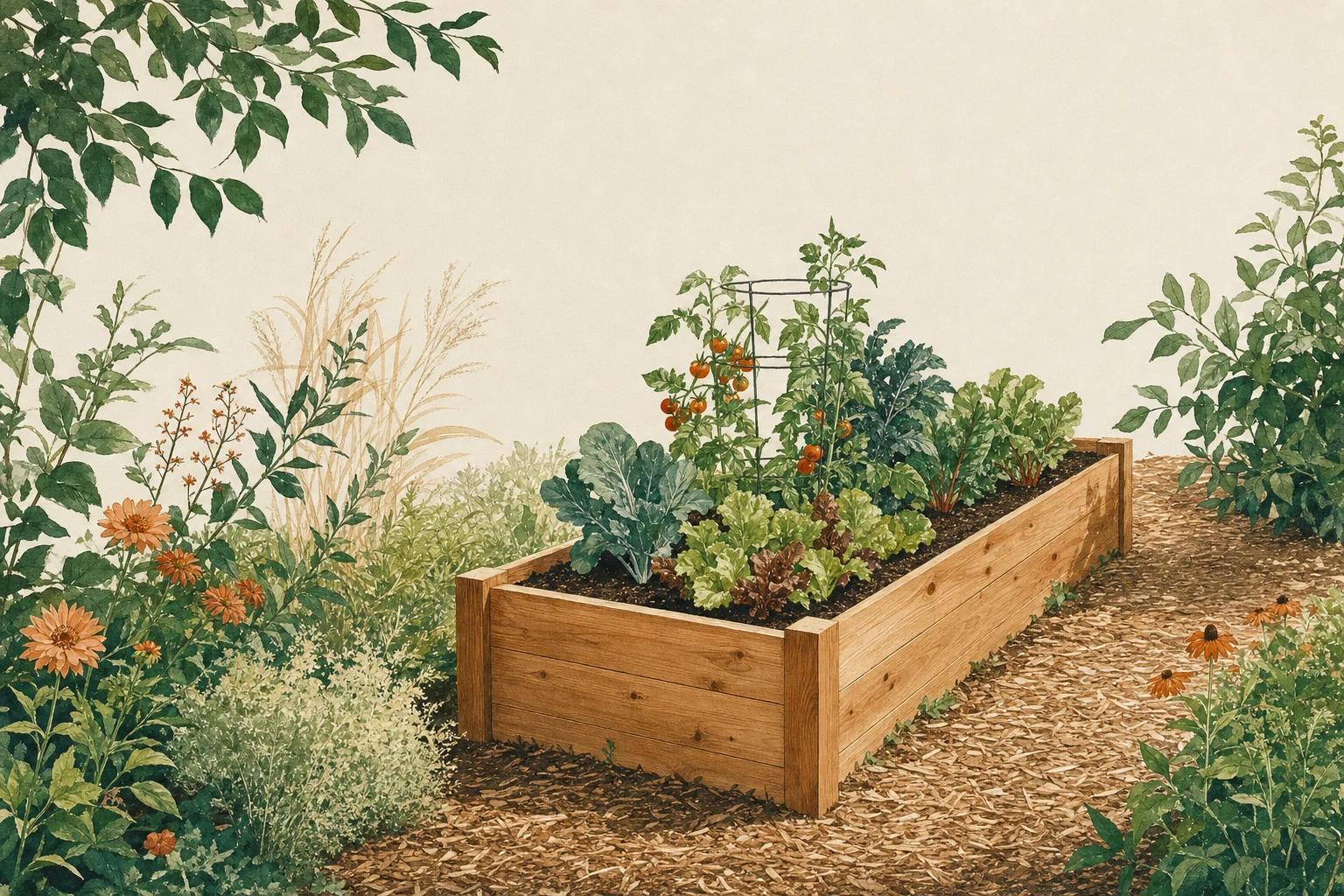
In a raised bed, anchor below it. A post's holding power comes from firm ground, not loose bed mix, so drive posts through the bed into the soil beneath. The guides to raised bed gardening and building a raised garden bed cover soil mix and bed construction.
Driving steel T-posts throws grit and can slip. Wear gloves and safety glasses, keep your hands clear of the driver, and fit plastic caps on the post tops afterward, because the bare tops sit near eye level and are easy to walk into.
Build a T-post and twine trellis, step by step
Drive two 8-foot (2.4 m) T-posts 2.5 feet (75 cm) deep about 10 feet (3 m) apart, brace the ends, string a tight top wire and a low wire, and hang one twine per plant; a 10-foot row holds 10 to 15 plants. You need the two T-posts, two 3-foot (90 cm) stakes for bracing, galvanized wire, polypropylene or nylon twine, 1-inch (25 mm) plastic clips and a post driver.
- Choose a sunny, well-drained spot. Cucumbers need at least 6 hours of direct sun and do best with 8 to 10, and the site should not have grown squash, melons or cucumbers recently, because the family shares soil-borne problems.
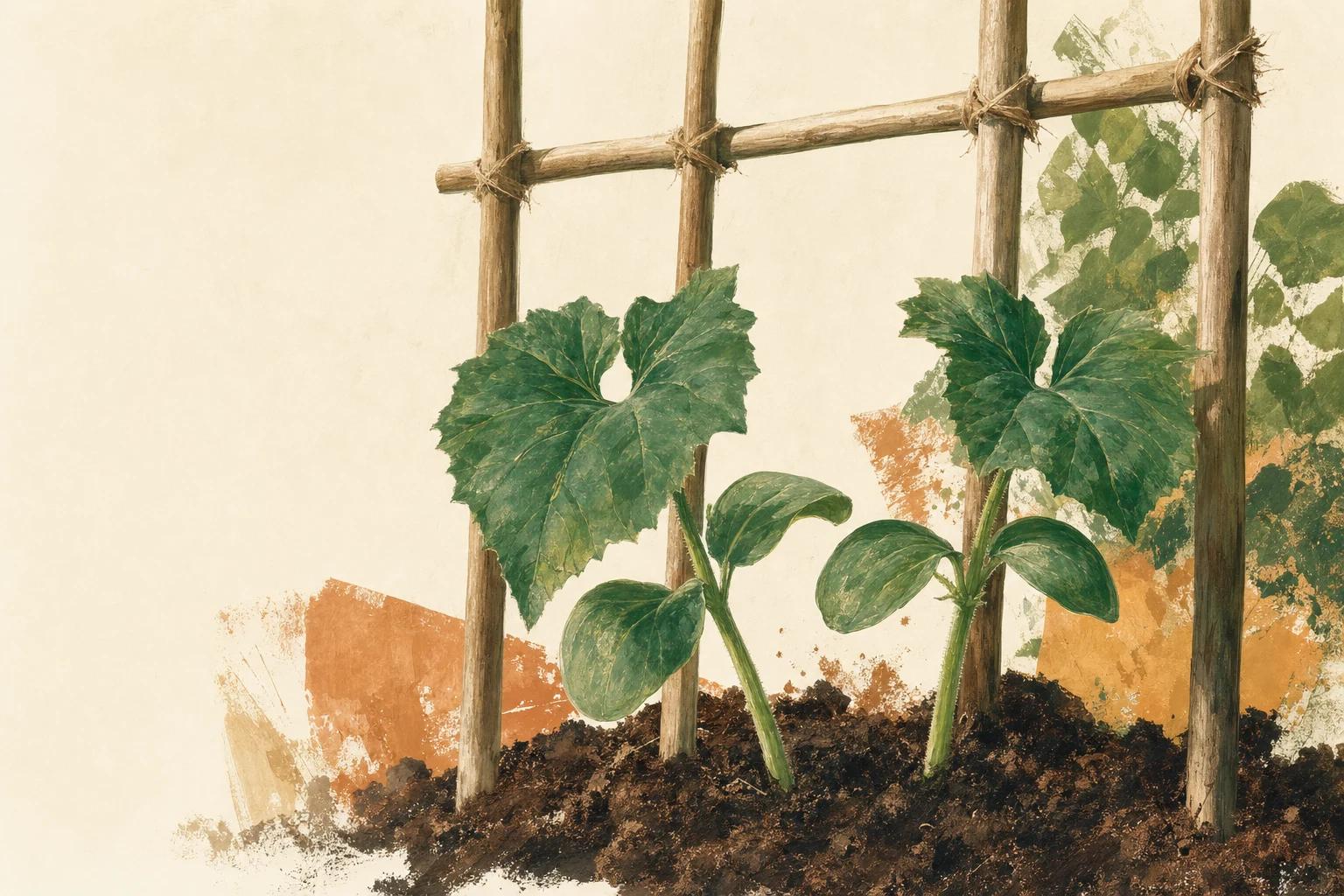
- Drive the end posts. Sink the T-posts 2.5 feet (75 cm) deep and about 10 feet (3 m) apart, leaving roughly 5.5 feet (1.7 m) above ground. Deep posts resist the pull of a leafy wall in wind.
- Brace the ends. Drive a 3-foot (90 cm) stake at an angle beyond each end post and wire the post top to it, so the end posts stay upright.
- String the wires. Stretch a doubled top wire tight between the post tops and a single wire a few inches above the soil, so each twine has fixed anchor points.
- Hang one twine per plant. Tie a strand from the top wire to the bottom wire at each planting spot, 8 to 12 inches (20 to 30 cm) apart. Each vine gets its own line, which makes clipping and picking simpler.
- Sow or plant at the base. Sow a few seeds 1/2 to 1 inch (1.3 to 2.5 cm) deep under each strand and thin to the strongest, or set one transplant per strand. Planting after the frame is up means you never drive a post through roots.
- Clip the vines as they grow. Once a vine is about 1 foot (30 cm) tall, clip it to its twine. Add a clip once or twice a week until it reaches the top wire.
Planting and training the vines
Plant along the base of a finished trellis once the soil is warm, then guide the vines on every few days until the tendrils hold.
Timing. Sow cucumber seed once the soil holds at least 60°F (16°C), and preferably 65 to 70°F (18 to 21°C) at 1 inch (2.5 cm) deep. Set out transplants after the last frost date, once the soil has warmed. That means late May in Minnesota and mid-May in central Iowa, where the last practical sowing date falls in mid-July. The South also gets a fall crop: the Piedmont of South Carolina sows from August 1 to September 30. The cucumber planting calendar gives dates by region.
Spacing. Sow 4 or 5 seeds per foot (30 cm) of row, then thin when seedlings are 4 to 5 inches (10 to 13 cm) tall, leaving one plant every 8 inches to 1 foot (20 to 30 cm). Set transplants 12 to 24 inches (30 to 60 cm) apart. The plant spacing calculator turns those distances into a plant count for your row.
Guiding. Tendrils coil around a wire or string several times in less than an hour once they touch it, so the work is getting young vines to the support in the first place. Lead each seedling to its strand or mesh, then every few days weave the growing tips through the openings or add a clip. Through the season, tuck any vine that wanders off the trellis back onto it.
Cover new plantings with floating row cover to keep cucumber beetles off seedlings, then remove it when the first female flowers open, the ones with a tiny cucumber behind the petals. Leave it on longer and bees cannot reach the flowers, so standard varieties set little fruit.
Water and feed a vertical crop
Give trellised plants about 1 inch (2.5 cm) of water a week, rain included, and feed once before planting and again after flowering starts. Plants on a trellis may need water more often than sprawling vines.
Watering. Cucumber roots reach 3 to 4 feet (90 to 120 cm) deep in open soil, so soak deeply rather than sprinkling daily. Water at the base in the morning, ideally through a soaker hose laid along the row, and skip overhead sprinklers, which wet the leaves and spread disease. Mulch holds moisture and keeps the lowest leaves off bare soil.
Feeding. Base fertilizer on a soil test. Without one, work 1 to 2 pounds of 10-10-10 per 100 square feet (0.45 to 0.9 kg per 9.3 m²) into the bed before planting. Side-dress one week after the first blossoms open and, if growth is slowing, again 3 weeks later; one option is 1.5 ounces (43 g) of ammonium sulfate per 10 feet (3 m) of row. Too much nitrogen produces a lush wall of leaves with few cucumbers.
Cucumber beetles, bacterial wilt and mildew
The pest to plan for is the cucumber beetle, because it spreads bacterial wilt, a disease with no cure; protect seedlings from the day they come up.
How wilt spreads. Striped and spotted cucumber beetles carry the wilt bacterium, Erwinia tracheiphila, in their guts and infect plants as they feed. Leaves wilt on single runners first, then whole vines collapse. To check, cut a wilted stem crosswise near the ground and squeeze it, then touch the cut surface and draw your finger slowly away: fine, shiny strands of ooze point to bacterial wilt. The test does not always show strands, so a county extension office can confirm a doubtful case.
Scouting and thresholds. Check plants two or three times a week while they are small, then weekly. On cucumbers, control is warranted at about 1 beetle per plant. If you spray, do it in the evening when bees are not working the flowers, and not when it is above 85°F (29°C). Varieties without the bitter compounds attract fewer beetles than bitter ones. Resistance is rare: 'H-19 Little Leaf' is rated highly resistant to bacterial wilt by its seed company, and 'County Fair 83' and 'Saladin' tolerate it better than most.
Once a plant has bacterial wilt, nothing saves it. Pull wilted plants out as soon as the stem test points to the disease and put them in the trash, not the compost pile, because beetles feeding on discarded vines carry the bacterium back into the garden. Then put the effort into beetle control early in the season, before plants are infected.
Powdery mildew. White, powdery patches on leaves and stems mark powdery mildew, which favors moderate temperatures and shade. A trellis helps by moving the canopy up into open air. Keep sprinklers off the foliage and choose varieties with resistance, such as 'Gateway'. Sulfur controls it but injures some cucurbits, so check the product label for cucumbers before using it.
Downy mildew. On cucumbers it starts as pale green to yellow spots on the upper side of the leaves, boxed in by the veins, that later turn brown. In humid weather a purplish-gray fuzz grows underneath. The spores blow in on air currents from the south, so the disease skips Minnesota in many years, while in South Carolina it is worst from midsummer through fall. No home-garden spray controls it. Rely on the airflow a trellis gives, drip irrigation and resistant varieties: 'Gateway' is rated intermediate for downy mildew, and 'Bristol' tolerates it.
Harvest and what to expect
Most varieties start bearing 50 to 70 days from seed; from then on, pick every 2 to 3 days.
Size. Pick picklers at 2 to 4 inches (5 to 10 cm) and slicers at 6 to 8 inches (15 to 20 cm) for most varieties, up to 10 inches (25 cm) for longer slicing and burpless types. Specialty long types such as 'Suyo Long' are ready at 10 to 15 inches (25 to 38 cm). A cucumber left to swell and yellow on the vine slows the production of new fruit, so a missed one costs you more than itself.
Technique. Snap each fruit off by turning it parallel to the vine. Stay out of the planting while the leaves are wet, because handling wet vines spreads disease.
Yield. One 30-foot (9 m) double row of 'Bristol' on T-posts and twine gave 10 to 25 pounds (4.5 to 11 kg) a week for about six weeks before leaf diseases, cucumber beetles and squash bugs took over. A late-season decline from disease and pests is common, so pull spent vines once production stops.
Next year. A permanent trellis can stay in place if the crop on it changes. Rotate cucumbers, squash, pumpkins, muskmelons and watermelons on a three-year cycle so the same family does not return to that soil for two seasons. To work out where next year's trellis and crops will go, sketch the beds in Sow's design studio.
Frequently asked questions
Do cucumbers have to grow up a trellis?
No. Vining cucumbers grow well on the ground if they get the room: hills 3 to 5 feet (0.9 to 1.5 m) apart in rows 4 to 5 feet (1.2 to 1.5 m) apart. A trellis trades that floor space for height and gives straighter, cleaner fruit that is easier to find, but it does not guarantee more cucumbers per plant. Bush varieties such as 'Spacemaster' never need one.
What's the best way to trellis cucumbers?
For most home gardens, the best value is twine or 4-inch (10 cm) mesh hung from a tight top wire on steel T-posts driven 2 to 2.5 feet (60 to 75 cm) deep. It stands 5 to 6 feet (1.5 to 1.8 m) tall, costs little, and gives each plant its own strand to climb. Put it up before sowing, then clip or weave the vines in once or twice a week until they reach the top.
How tall should a cucumber trellis be?
Give vining cucumbers 5 to 6 feet (1.5 to 1.8 m) of climbing height above ground, which keeps the top within reach for picking. A 3- to 4-foot (90 to 120 cm) trellis also works and keeps the planting compact. Allow for the buried part: a 6-foot (1.8 m) stake driven 1 foot (30 cm) deep leaves 5 feet (1.5 m), and an 8-foot (2.4 m) T-post set 2.5 feet (75 cm) deep leaves about 5.5 feet (1.7 m).
How far apart should cucumber trellis posts be?
It depends on what the posts carry. Stakes holding a mesh panel go 5 to 6 feet (1.5 to 1.8 m) apart. Steel T-posts carrying a top wire and twine go about 10 feet (3 m) apart, or up to 15 feet (4.6 m) if the top wire is pulled very tight. Posts holding hog wire or other 4-inch (10 cm) grid wire can stand 12 to 20 feet (3.7 to 6.1 m) apart. Brace the end posts of any wire row.
How do you grow cucumbers in a bucket?
Choose a compact bush variety such as 'Spacemaster' or 'Bush Champion' and a container that holds at least 5 gallons (19 L) and is 8 to 12 inches (20 to 30 cm) deep. 'Spacemaster' grows about 8 inches (20 cm) tall and 26 inches (66 cm) across, so it needs no trellis. Give the bucket full sun and check the soil often: in open ground a cucumber sends roots 3 to 4 feet (90 to 120 cm) deep, and a bucket holds a fraction of that reservoir.
Can I grow cucumbers on a trellis in a raised bed?
Yes, and the pairing is efficient: growing upward saves space, so the same few square feet of bed carry more plants and more fruit per square foot. Run the trellis along one long side, thin plants to 8 to 12 inches (20 to 30 cm) apart at its base, and choose a vining variety, since a bush type never climbs. Trellised plants may need water more often, so check the bed during hot spells.
Can I use chicken wire for a cucumber trellis?
Yes. Chicken wire works, as do plastic netting and 4-inch (10 cm) grid panels such as hog wire or concrete reinforcing wire; heavier mesh suits the most vigorous vines. Stretch it taut between posts sunk at least 1 foot (30 cm) deep. Whatever the mesh, look along it each time you pick, because a fruit can grow through an opening and swell until it is wedged between the wires.
Do cucumbers need slings on a trellis?
No. Cucumbers hold firmly to the vine and do not slip off, so they need no slings or hammocks. Trellising suits any fruit up to about 3 pounds (1.4 kg), and cucumbers fall well under that. The real structural load is the mass of leafy vines, which catches wind, so put your effort into deep posts and braced ends instead.
Why are my trellised cucumbers bitter?
Stress. Fruit turns bitter when temperatures fall below 60°F (16°C) or climb above 90°F (32°C), when the soil dries out, or when the plants run short of nutrients. Plants on a trellis may need water more often than sprawling ones, so check soil moisture during hot spells, water at the base to about 1 inch (2.5 cm) a week, and keep mulch in place.
References
- University of Maryland Extension. Cucumbers. Accessed October 16, 2026.
- University of Maryland Extension. Climbing Cucumbers (Maryland Grows). Accessed October 16, 2026.
- North Dakota State University Extension. Dakota Gardener: Growing cucumbers on a trellis. Accessed October 16, 2026.
- University of Minnesota Extension. Trellises and cages. Accessed October 16, 2026.
- University of Minnesota Extension. Growing cucumbers. Accessed October 16, 2026.
- Iowa State University Extension and Outreach. Growing cucumbers in the home garden. Accessed October 16, 2026.
- Clemson Cooperative Extension Home and Garden Information Center. Cucumber. Accessed October 16, 2026.
- Oregon State University Extension. Grow your own cucumbers. Accessed October 16, 2026.
- University of Wisconsin-Madison Division of Extension Horticulture. Trellising, staking and caging. Accessed October 16, 2026.
- University of Wisconsin-Madison Division of Extension Horticulture. Cucumber beetles. Accessed October 16, 2026.
- University of Nebraska-Lincoln Extension. Bacterial wilt of cucurbits (G2023). Accessed October 16, 2026.
- UC IPM, University of California Agriculture and Natural Resources. Powdery mildew on cucurbits. Accessed October 16, 2026.
- University of Alaska Fairbanks School of Natural Resources and Extension. Cucumbers: Does Trellising Improve Yield? (Georgeson Botanical Notes 65). Accessed October 16, 2026.
- University of Minnesota Extension. Downy mildew of cucumber, melon and squash. Accessed October 16, 2026.
- Johnny's Selected Seeds. H-19 Little Leaf Organic Cucumber Seed. Accessed October 16, 2026.
- Johnny's Selected Seeds. Gateway F1 cucumber. Accessed October 16, 2026.
- Johnny's Selected Seeds. Field-Grown Cucumber Comparison Chart. Accessed October 16, 2026.
- University of Wisconsin-Madison Division of Extension, Milwaukee County. Gardening Tips: Best Container Gardening Vegetable Varieties. Accessed October 16, 2026.
- Johnny's Selected Seeds. Cucumber Trellis 48 inch. Accessed October 16, 2026.
- Burpee. Spacemaster cucumber. Accessed October 16, 2026.
Sow Editorial
Written by the Sow team from university extension services, botanical gardens, USDA and NOAA data and plant breeders. Every source is listed under References.