Quick answer
Sow cucumber seed outdoors once frost danger is over and the soil holds at least 60°F (16°C), ideally 65–70°F (18–21°C). In most of the US that is 1 to 5 weeks after the date your spring frost risk drops to 1 in 10. For a fall crop, sow again 90 to 95 days before the median first fall frost.
Key facts
- Timing rule
- 1–5 weeks after the 1-in-10 last-frost date
- Soil temperature
- At least 60°F (16°C); 65–70°F (18–21°C) is the target
- Days to maturity
- About 50–70 days from seed for most varieties
- Frost tolerance
- None; a light frost kills the plants
- Fall crop
- Sow 90–95 days before the median first fall frost
- Indoor start
- 3–4 weeks before setting out, in peat pots or plugs
- Seed depth
- 1/2–1 in (1.3–2.5 cm)
Cucumbers go into the garden after the last frost, once the soil at seed depth holds at least 60°F (16°C). The closer it gets to 65–70°F (18–21°C), the faster and more evenly the seed comes up. Across most of the country that lands 1 to 5 weeks after the date your risk of a spring frost drops to 1 in 10.
The plant has no frost tolerance, and cold soil costs more time than it saves: seed in soil below 50°F (10°C) does not germinate. A second sowing in mid- to late summer, made 90 to 95 days before the first fall frost, gives a fall crop.
Cucumber planting dates by city
Sow 1 to 5 weeks after your 1-in-10 last-frost date, once the soil reads 60°F (16°C); the table turns that rule into dates for 16 cities. The last column counts back 90 to 95 days from the median first fall frost to give the final sowing that still ripens.
| City (USDA zone) | Median last frost | Median first frost | Direct sow or transplant | Last sowing for fall harvest |
|---|---|---|---|---|
| Fargo, ND (4a) | May 10 | Sep 30 | May 30 – Jun 27 | Jun 27 – Jul 2 |
| Minneapolis, MN (5a) | Apr 23 | Oct 18 | May 14 – Jun 11 | Jul 15 – Jul 20 |
| Chicago, IL (5b) | Apr 16 | Oct 28 | May 8 – Jun 5 | Jul 25 – Jul 30 |
| Denver, CO (6a) | May 5 | Oct 9 | May 26 – Jun 23 | Jul 6 – Jul 11 |
| Detroit, MI (6b) | Apr 20 | Oct 27 | May 15 – Jun 12 | Jul 24 – Jul 29 |
| Kansas City, MO (6b) | Apr 13 | Oct 24 | May 6 – Jun 3 | Jul 21 – Jul 26 |
| Boston, MA (7a) | Apr 4 | Nov 9 | When soil at 4 in holds 60–70°F | Aug 6 – Aug 11 |
| Salt Lake City, UT (7b) | Apr 8 | Oct 31 | May 7 – Jun 4 | Jul 28 – Aug 2 |
| New York, NY (7b) | Mar 30 | Nov 20 | When soil at 4 in holds 60–70°F | Aug 17 – Aug 22 |
| Nashville, TN (7b) | Mar 31 | Nov 3 | Apr 23 – May 21 | Jul 31 – Aug 5 |
| Raleigh, NC (8a) | Mar 31 | Nov 4 | Apr 23 – May 21 | Aug 1 – Aug 6 |
| Atlanta, GA (8a) | Mar 15 | Nov 20 | Apr 11 – May 9 | Aug 17 – Aug 22 |
| Dallas-Fort Worth, TX (8b) | Mar 8 | Nov 24 | Apr 2 – Apr 30 | Aug 21 – Aug 26 |
| Seattle, WA (9a) | Mar 2 | Nov 23 | May–Jun, when soil holds 60–70°F | By end of Jun |
| Sacramento, CA (9b) | Feb 2 | Dec 2 | Apr–Jul | By end of Jul |
| Houston, TX (9b) | Feb 13 | Dec 9 | Mar 19 – Apr 16 | Jul – early Aug (marginal) |
Frost dates are medians from NOAA 1991–2020 climate normals for each city's main weather station; in half of years the last frost falls later than the date shown.
For any other town, look up the spring date after which the chance of a 32°F (0°C) freeze falls to 1 in 10, and sow 1 to 5 weeks after it. If you only know your median last frost, the date-based spring windows above open about 3 to 5 weeks after it. For the fall column, count back 90 to 95 days from your median first fall frost.
The spring window is the target for the main crop, not a deadline: a sowing made between the two windows still has time to ripen.
Fargo is the tight case. Its spring window closes on June 27, the same day the last-sowing window opens, so the final column there is simply the last summer sowing, not a separate fall crop. With a September 30 median first frost, a sowing that late needs a fast pickler such as Boston Pickling, at 50 to 60 days.
Boston and New York get a soil reading instead of spring dates. Their recorded frost dates are early, but a cold, wet spring can hold the soil below 60°F (16°C) after frost risk has passed, so sow there only when the thermometer at 4 inches (10 cm) agrees.
Seattle and Sacramento follow soil warmth rather than frost. Sacramento sits in California's interior valleys, where cucumbers go in from April through July. Seattle's last frost is early, but cucumbers there follow the Pacific Northwest pattern of May and June planting.
Houston, like Dallas, follows the frost rule in spring, which puts sowing between mid-March and mid-April. Its fall crop is a gamble: sowings from July into the first week of August are marginal, and none is advised in September.
How to tell the soil is warm enough
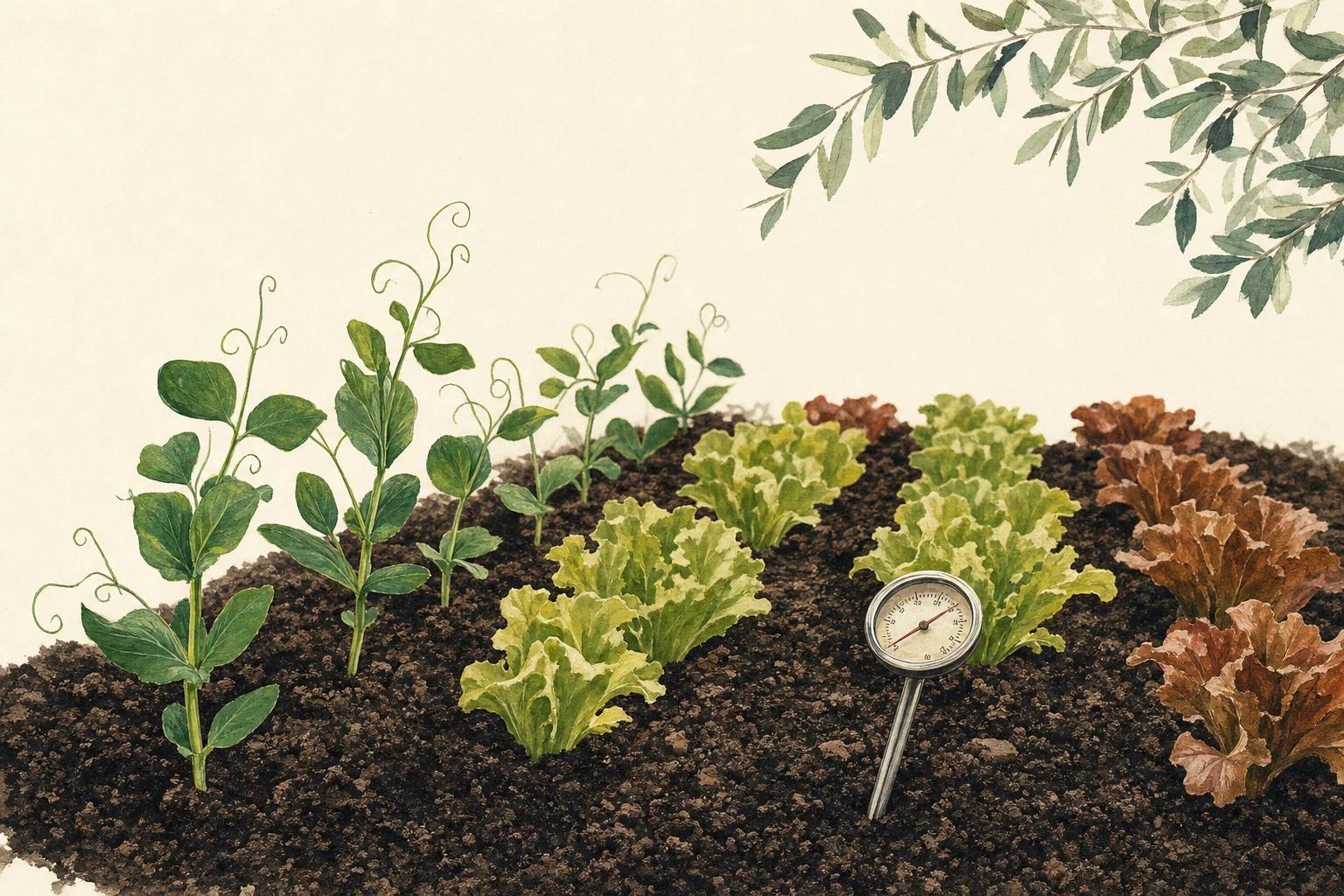
Push a soil thermometer into the bed first thing in the morning. A reading of 60°F (16°C) is the minimum, and 65–70°F (18–21°C) is the one to wait for.
Take it at 8 a.m., when the soil is coolest, at 4 inches (10 cm) deep, or at 1 inch (2.5 cm) to read the temperature right where the seed sits. Recommended thresholds run from 60°F to 70°F (16–21°C) because the number trades earliness against speed. Cucumber seed germinates fastest near 90°F (32°C), so seed sown at the bottom of the range sits longer in cool, damp soil, where it can rot instead of sprouting.
| Temperature | What happens |
|---|---|
| Soil below 50°F (10°C) | Seed does not germinate |
| Soil 60°F (16°C) at 4 in (10 cm) | Minimum for sowing |
| Soil 65–70°F (18–21°C) | Quick, even emergence |
| Air 32°F (0°C) | Frost kills plants |
| Temperatures below 60°F (16°C) | Maturity delayed up to 15 days |
| Temperatures below 50°F (10°C) | Plants severely stunted |
| Days 80–90°F (27–32°C), nights 60–70°F (16–21°C) | Fastest growth |
| Above 95–100°F (35–38°C) | Flowers switch sex; yields fall |
Soil readings decide the sowing date; air temperatures decide how fast planted cucumbers grow.
In cool regions you can gain time. Black plastic mulch laid over the bed warms the soil, and you sow or transplant through holes cut in it. A floating row cover over the young plants adds more warmth, and the two together bring the harvest earlier.
Cucumber planting times by region
In the North, frost and slow-warming soil set one late-spring window and a midsummer last sowing. Across Florida, the Gulf Coast and the low desert, summer heat splits the year into a spring crop and a separate late-summer or fall crop.
| Region | Spring planting | Late summer or fall |
|---|---|---|
| Minnesota | Late May | — |
| Central Iowa | Mid-May | Last sowing about Jul 20 |
| Missouri | Apr 25–May 30 (south); May 5–30 (central); May 10–30 (north) | — |
| Central North Carolina | Around May 1 | — |
| South Carolina | Coast Mar 15–May 15; Piedmont Apr 15–Jun 5 | Coast Aug 1–30; Piedmont Aug 1–Sep 30 |
| Florida | North Feb–Apr; Central Jan–Mar; South Sep–Feb | North Aug–Sep; Central Sep |
| Phoenix area | Feb 15–Apr 15 | Aug 15–Sep 15 |
| California coast | Apr–Jun | — |
| California interior valleys | Apr–Jul | — |
| California desert valleys | Feb–May | Aug |
| Western Oregon valleys | May–Jun | — |
| Washington | Start indoors mid-Apr; set out early Jun | — |
A dash means the regional calendar lists no separate late planting; use the fall count-back from your own first frost.
Upper Midwest and northern Plains. Soil warmth is the limit here, and Minnesota sows in late May. In Iowa, the south can plant about a week ahead of the central counties and the north a week behind.
Southeast. Coastal South Carolina can sow from March 15, a month ahead of the Piedmont's April 15 start. Central North Carolina sows around May 1.
Florida and the Gulf Coast. South Florida grows cucumbers from September through February and skips the summer. In Texas, spring sowing waits for warm soil in the seed zone, and the fall crop goes in during late summer.
Rocky Mountains. At altitude, the morning soil reading outranks the calendar date. Set transplants out only once frost is no longer possible.
California and the low desert. Frost comes early or not at all, so warm soil sets the start. California's Imperial and Coachella valleys plant from February to May and again in August. The Phoenix area sows from mid-February to mid-April and again from mid-August to mid-September, skipping the hottest months.
Pacific Northwest. Cucumbers prefer warm, dry conditions, so resist the urge to plant early in western Oregon. Oregon's Columbia and Snake river valleys can plant from about April 15. In Washington, start seed indoors in mid-April and set plants out in early June.
Sowing depth and spacing
Sow seed shallowly where the vines will grow, then thin early to the spacing your growing method needs.
- Check the soil on sowing day. Take the morning thermometer reading described above on the day you sow, not the week before, since a cold snap can drop it below the mark.
- Sow at the right depth. Set seed 1/2 to 1 inch (1.3–2.5 cm) deep. In California, sow 1 to 1.5 inches (2.5–4 cm) deep.
- Space for your growing method. Drop seed about 2 inches (5 cm) apart in a row, 4 or 5 seeds per hill, or closely along the base of a trellis. Extra seed covers losses to beetles and cold.
- Thin early. At 1 to 2 true leaves, thin to one plant every 12 inches (30 cm) in rows or 2 to 3 plants per hill. Thinning before the vines run leaves the keepers the space in the table below.
- Water steadily. Give about 1 inch (2.5 cm) of water a week through drip line or a soaker hose, keeping the leaves dry to limit leaf disease.
| Growing method | Final spacing | Between rows or hills |
|---|---|---|
| Rows | 1 plant every 12 in (30 cm) | 4–6 ft (1.2–1.8 m) |
| Hills | 2–3 plants per hill | 3–6 ft (0.9–1.8 m) |
| Trellis | 1 plant every 8–12 in (20–30 cm) | One row per trellis |
The trellis spacing assumes vines trained upward; untrained vines need the row or hill figures.
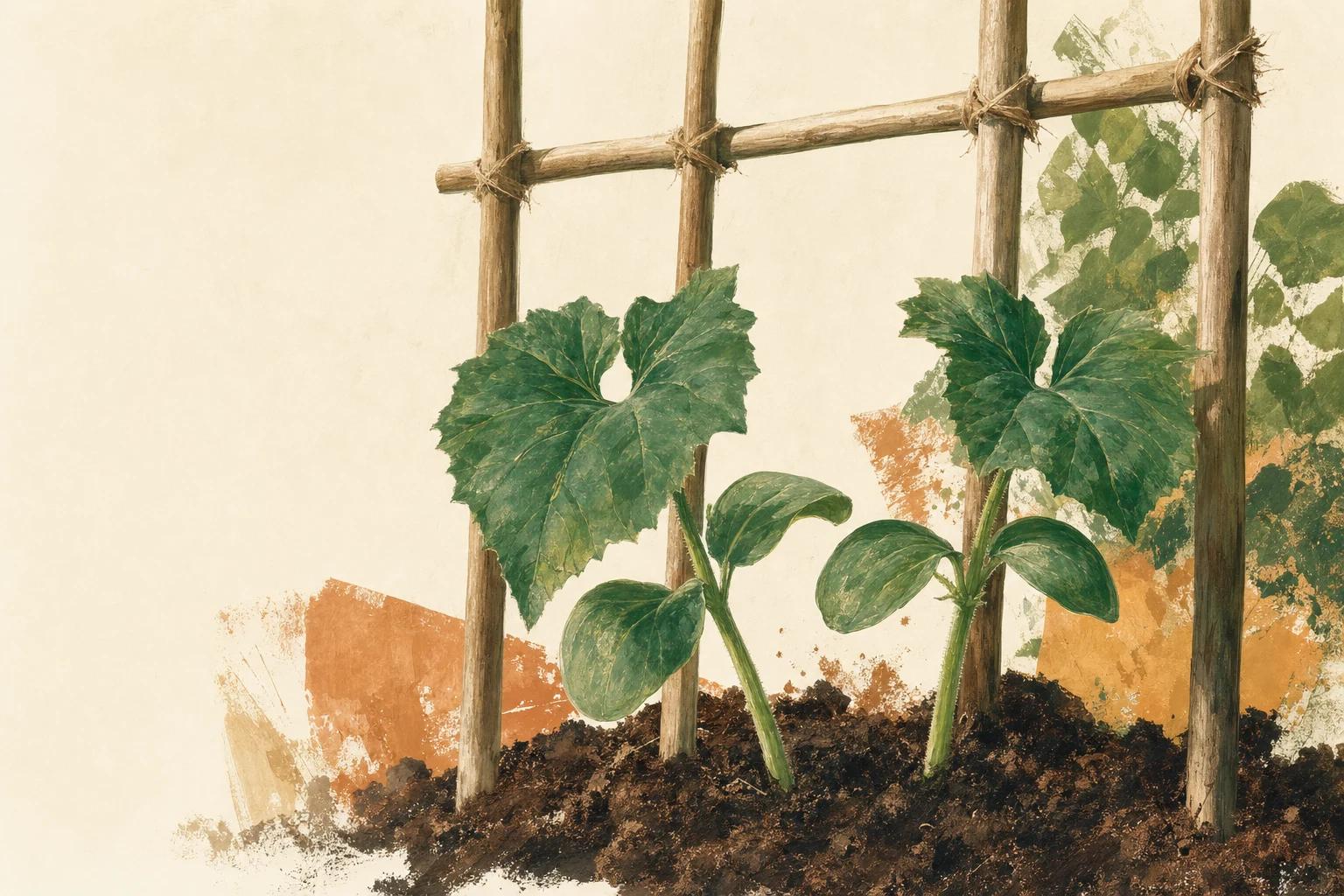
A trellis with plants 8 to 12 inches (20 to 30 cm) apart packs the most plants into a raised bed or a small plot; the cucumber trellis guide gives heights and a build. To lay out hills and rows for a bigger patch, the plant spacing calculator works out how many plants fit.
Starting cucumbers indoors
Start cucumbers indoors only when your season is short or cool, and then only about 3 to 4 weeks before the planting-out date.
Direct sowing is the better choice almost everywhere, because cucumber roots are highly intolerant of being disturbed and a damaged taproot sets the plant back. Transplants earn their place in the far North and the cool Pacific Northwest, where every week of the season counts.
Sow in peat pots or plugs that go into the ground whole, and grow the seedlings with days around 70–75°F (21–24°C) and nights around 60–65°F (16–18°C). Recommended lead times run from 2 to 5 weeks before planting out. Set plants out at 2 to 4 true leaves without breaking the root ball, and never bare-root.
Transplants follow the same calendar as seed, not an earlier one. A seedling set out early meets the same cold soil and frost that would have stopped the seed, and a large, root-bound transplant stalls after planting.
Varieties that change the timing
Days to maturity run from about 40 to 70 days from seed, so a fast pickler can fit a late or short-season sowing that a slow slicer cannot.
| Variety | Type | Days to harvest | Timing notes |
|---|---|---|---|
| Boston Pickling | Heirloom pickler | 50–60 from seed | Fast; pick at 3–6 in (7.5–15 cm) |
| Marketmore 76 | Standard slicer | 65 from seed | 8–9 in (20–23 cm) fruit |
| H-19 Little Leaf | Pickler, compact vine | 42 from transplant | Sets fruit without bees; resists bacterial wilt |
Catalogs that count from transplanting leave out the 3 to 4 weeks the seedling spent in its pot.
Parthenocarpic varieties such as H-19 Little Leaf, Diva, Excelsior and Sugar Crunch set fruit without pollination. They keep setting fruit through cool, cloudy spells that ground bees, and they can stay under row cover all season, out of reach of cucumber beetles.
All-female (gynoecious) hybrids need a standard variety nearby to supply pollen, and seed companies often mix a few pollinizer seeds into the packet. Sow them with the rest, or the female flowers will have no pollen source.
Bitter-free varieties draw fewer cucumber beetles than bitter ones, a real advantage for seedlings that emerge alongside the beetles in late spring. For late plantings, choose varieties labeled resistant to powdery mildew.
Second sowings and fall crops
For a fall harvest, sow again 90 to 95 days before your median first fall frost, with mildew-resistant varieties.
The count runs well past the days to maturity because fall weather slows the crop. Temperatures below 60°F (16°C) can delay ripening by as much as 15 days, and you want several weeks of picking before frost ends the vines. In central Iowa, the last practical sowing is July 20, about 13 weeks before the median first frost in Des Moines. Use the short end for fast picklers and the long end for slicers.
Texas cuts it a little closer: fall slicers go in about 75 to 80 days before the first fall frost. August sowings across the South also have to come through the summer heat that cuts fruit set.
Late plantings face more disease. Powdery mildew is at its worst on late-summer and fall sowings, so resistant varieties are the main defense.
Once the cucumber vines come out, the bed is free for cool-season crops; garlic planting times show what can follow in fall.
Planting too early or too late
Planting too early usually costs more than planting late: seed rots in cold soil and a single light frost kills the plants, while a late sowing mostly costs harvest days.
Seed sown on the average last-frost date risks cold soil, and below 50°F (10°C) it does not germinate. Cucumbers set into cold ground grow poorly, and a cold spell below 50°F stunts them badly.
Late sowings run out of warmth. Plants slow as the weather cools, mildew builds, and the first fall frost ends the crop.
If a late frost is forecast
Cover seedlings in the evening with floating row cover or a plastic tunnel and uncover them the next morning once the air warms. A cucumber that freezes does not recover. With harvests 50 to 70 days from seed, resowing right away still leaves time for a full crop in all but the shortest seasons.
Cucumber beetles on new seedlings
Cucumber beetles attack seedlings as they emerge, so protection has to be in place on planting day, not when you first see holes in the leaves.
Plants are most vulnerable from the seed-leaf stage to about 3 true leaves. Striped cucumber beetles become active in mid- to late May in Wisconsin, right when the northern crop goes in, so a sowing timed to the frost rule meets the beetles head-on.
Cucumber beetles carry bacterial wilt, which is usually fatal: infected vines wilt and collapse, often once the fruit is half-grown. Cover seedlings with row cover at sowing, check plants 2 to 3 times a week, and act once you find 1 beetle per plant.
Two planting-time choices reduce pressure. A trap crop of blue Hubbard squash, sown 1 to 2 weeks before the cucumbers at the edge of the patch, draws beetles away from the main crop. Rotation helps too: grow cucumbers, squash, melons and pumpkins in the same spot no more than once every 3 years. For other pairings, see companion plants.
Take row covers off when the first flowers open so bees can reach them. Parthenocarpic varieties need no bees and can stay covered all season.
If you use an insecticide, choose one labeled for cucumbers, follow the label exactly, and spray in the evening, when bees are not foraging. Avoid spraying between about 8 and 11 a.m.
What to expect after sowing
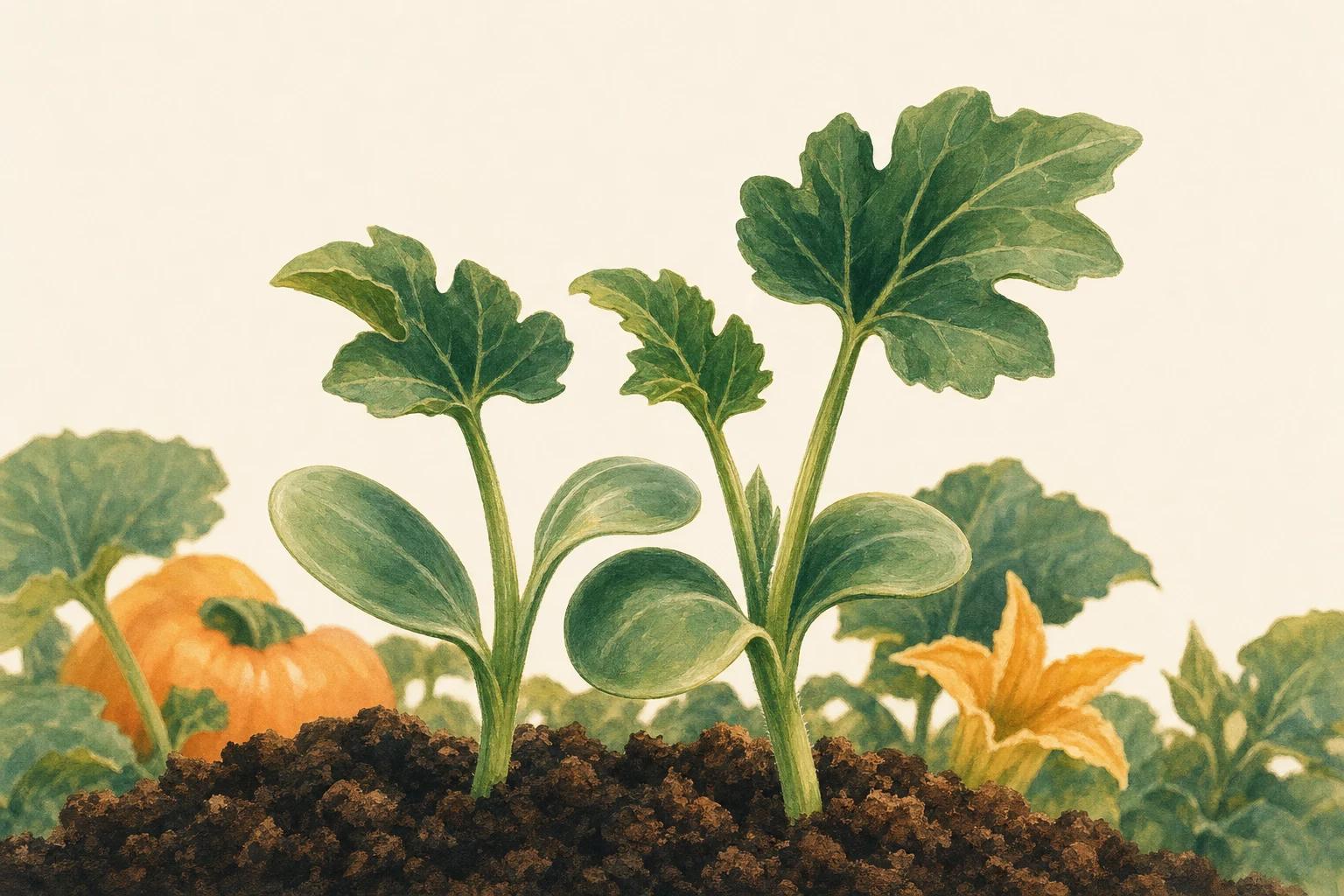
Seedlings come up in 6 to 10 days in warm soil, the first flowers are male and drop, and picking starts about 50 to 70 days after sowing.
The female flowers follow the male ones, each with a tiny cucumber at its base. Cold, rainy or cloudy weather keeps bees inactive and cuts fruit set, so the first fruit may lag in a cool spring.
Pick picklers at 2 inches (5 cm), dills at 4–6 inches (10–15 cm) and slicers at 6–8 inches (15–20 cm). Harvest at least every other day, because an overripe fruit left on the vine signals the plant to stop producing.
To plan cucumbers alongside the rest of your warm-season crops, see tomato planting times and vegetable planting dates, then add your sowing dates to Sow's garden calendar.
Frequently asked questions
How long do cucumbers take to grow?
Most cucumbers give their first fruit 50 to 70 days after sowing. Fast picklers such as Boston Pickling take 50 to 60 days and a standard slicer such as Marketmore 76 about 65. Catalogs that count from transplanting show shorter figures, around 40 days, because the seedling has already spent weeks in a pot. Cool spells below 60°F (16°C) can add up to 15 days.
What should not be planted next to cucumbers?
The plants to keep apart from cucumbers are their own relatives: squash, pumpkins and melons share cucumber beetles and the bacterial wilt the beetles spread. Grow the family in the same spot no more than once every 3 years. Cross-pollination is not a worry, since cucumbers do not cross with muskmelons or watermelons, whatever the garden lore says.
Do cucumbers like sun or shade?
Cucumbers need full sun. They grow fastest with hot days of 80–90°F (27–32°C) and warm nights of 60–70°F (16–21°C), so give them the warmest, most open spot you have. In the hottest parts of Texas and the Southwest, heat becomes the limit: above 95–100°F (35–38°C) flowers can switch sex and yields fall, and those regions plant in spring and again in late summer.
Do cucumbers grow better in pots or in the ground?
Either works. The ground gives a vining cucumber room to run, while a pot suits compact types such as H-19 Little Leaf, with its short, branching vines and half-size leaves, or the bush variety Salad Bush. A pot follows the same planting date as the garden bed, since the plant is just as tender to frost, and a small trellis keeps a vining type off the patio.
What is the trick to growing cucumbers?
Keep growth even and unbroken. Temperature swings of more than 20°F (11°C) can turn the fruit bitter, so a spring of hot days and cold nights is worth waiting out rather than sowing into. After that, water about 1 inch (2.5 cm) a week at the base of the plants and pick at least every other day, because a fruit left to grow oversized slows the vine down.
Is July too late to plant cucumbers?
Not in most of the country. A July sowing still ripens wherever the median first fall frost is at least 90 to 95 days away. That puts the last sowing around July 2 in Fargo, July 20 in Minneapolis and August 22 in Atlanta, in line with central Iowa's last practical sowing of July 20. Choose powdery mildew resistant varieties, because mildew is worst on late plantings.
Can I plant cucumbers before the last frost?
Generally no. Seedlings that come up before the last frost are killed by it, and seed sown into cold soil can rot before it sprouts. Wait until frost risk has dropped and the soil reads at least 60°F (16°C). If you gamble on an early sowing, keep row cover ready for cold nights, and set transplants out only once frost danger has passed.
Why are my first cucumber flowers falling off?
Those are male flowers, and dropping them is normal: a vine can open 10 to 20 of them before the first female flower appears. If female flowers wither too, they were not pollinated. Pollinate by hand in the morning, before the flowers shrivel: pick a male flower, pull off its petals and rub its pollen onto the center of each female flower.
What does Epsom salt do for cucumber plants?
Usually nothing useful. Epsom salt is magnesium sulfate, and it helps only where the soil is short of magnesium, which most garden soils are not, especially those amended with organic matter. Extra magnesium can block calcium uptake, and the salt can build up around the roots. Before adding any, get a lab soil test; home test kits give inconsistent results.
References
- University of Minnesota Extension. Growing cucumbers in home gardens. Accessed October 16, 2026.
- Iowa State University Extension and Outreach. When can I plant cucumbers in the garden?. Accessed October 16, 2026.
- University of Illinois Extension. Cucumber (Home Vegetable Gardening). Accessed October 16, 2026.
- University of Wisconsin-Madison Extension. Cucumber Beetle. Accessed October 16, 2026.
- University of Missouri Extension. Vegetable Planting Calendar (G6201). Accessed October 16, 2026.
- Clemson Cooperative Extension Home & Garden Information Center. Cucumber. Accessed October 16, 2026.
- Clemson Cooperative Extension Home & Garden Information Center. Epsom Salt in the Garden: Is it truly needed?. Accessed October 16, 2026.
- University of Florida IFAS Gardening Solutions. Cucumbers. Accessed October 16, 2026.
- NC State Extension. Extension Gardener Handbook, Chapter 16: Vegetable Gardening. Accessed October 16, 2026.
- Texas A&M AgriLife Extension Service. Cucumber (slicing): Commercial and Specialty Crop Guide. Accessed October 16, 2026.
- Texas A&M AgriLife Extension Service, Fort Bend County. Fort Bend County Vegetable Garden Planting Dates. Accessed October 16, 2026.
- Colorado State University Extension. Vegetable Planting Guide. Accessed October 16, 2026.
- UC Statewide IPM Program, University of California ANR. Cultural Tips for Growing Cucumbers. Accessed October 16, 2026.
- University of Arizona Cooperative Extension. Vegetable Planting Calendar for Maricopa County (AZ1005). Accessed October 16, 2026.
- Oregon State University Extension Service. Vegetable Gardening in Oregon (EC 871). Accessed October 16, 2026.
- Washington State University Extension. Home Vegetable Gardening in Washington (EM057E). Accessed October 16, 2026.
- Johnny's Selected Seeds. H-19 Little Leaf Organic Cucumber Seed. Accessed October 16, 2026.
- High Mowing Organic Seeds. Organic Non-GMO Marketmore 76 Cucumber. Accessed October 16, 2026.
- Baker Creek Heirloom Seeds. Boston Pickling Cucumber Seeds. Accessed October 16, 2026.
- NOAA National Centers for Environmental Information. U.S. Climate Normals (1991–2020). Accessed October 16, 2026.
Sow Editorial
Written by the Sow team from university extension services, botanical gardens, USDA and NOAA data and plant breeders. Every source is listed under References.