
The Story
Plant Bio
Goeppertia roseopicta, still sold as Calathea roseopicta, is a clump-forming evergreen perennial from the upper Amazon rainforest understory reaching 12 to 24 inches tall and wide indoors. It grows from rhizomes and carries its leaves on jointed stalks that lift and lower the blades between day and night.
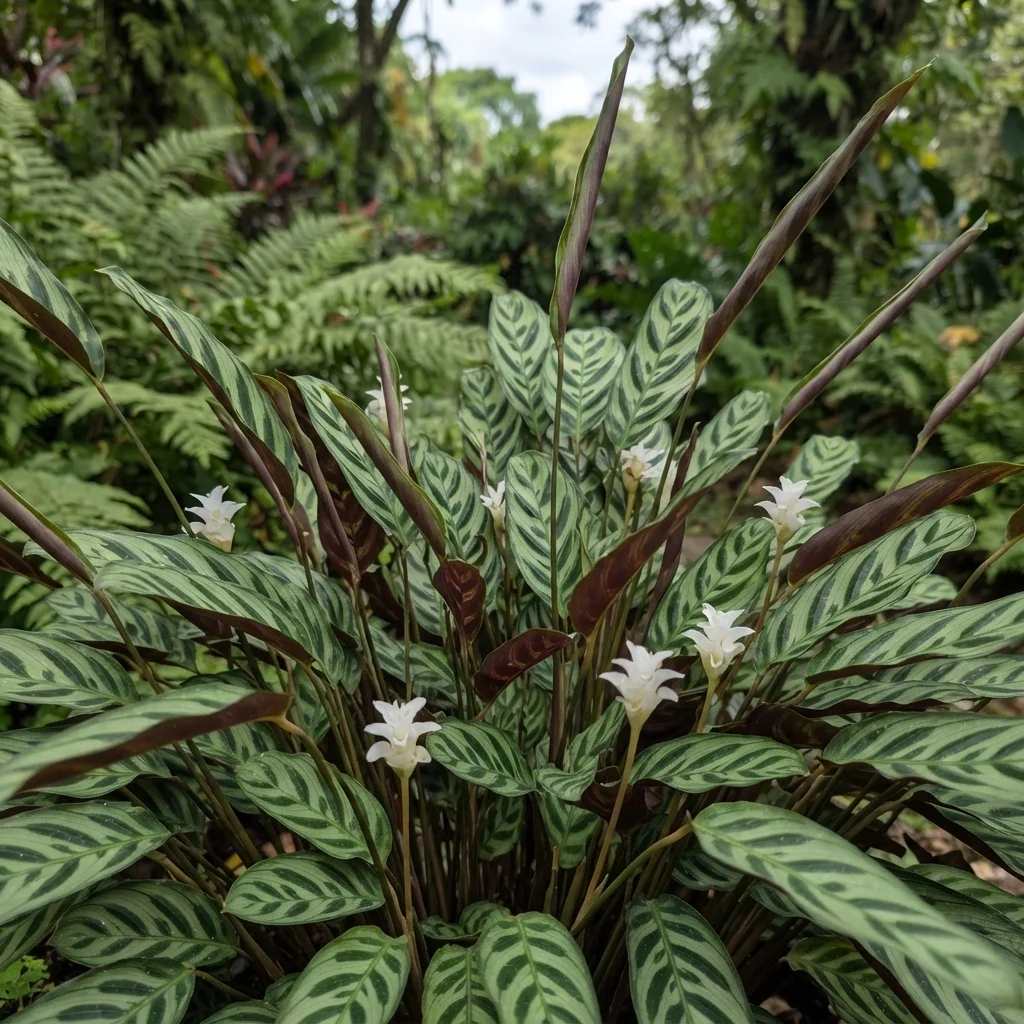
The glossy elliptical leaves are deep green with a pink to creamy-white brush-stroke along the midrib and veins and a solid reddish-purple underside. Plants rarely flower indoors, producing only small white to pale purple blooms, so the foliage pattern carries the display year round.
Uses & Benefits:
Essentials
At a Glance
Plant Type
Tropical
Height
24"
Width
24"
Light
Partial Sun, Shade
Zones
10
Water
Medium
Humidity
High
Lifespan
Perennial
Native To
Brazil, Colombia, Ecuador, Peru
Toxicity
Non-toxic to cats and dogs
Bloom period
Summer
In flower about 3 months of the year
Planting
How to Grow
- Grow indoors in bright indirect light with no direct sun; medium to low light preserves the leaf pattern.
- Pot in moist but well-drained peaty mix with perlite for air, keeping it evenly moist and never soggy.
- Hold temperatures at 65 to 75 degrees Fahrenheit with a minimum of 61 degrees and humidity above 60 percent.
- Water consistently with rain or distilled water and feed once a month in spring and summer.
- Remove only damaged leaves and wipe dust with a damp cloth to keep the foliage clean.
Pro Tip
Night-time folding is normal prayer movement, not wilt; keep humidity above 60% and water with rain or distilled water, since fluoride in tap water browns the leaf edges.
Keep It Thriving
Care Guide
Do
- Keep humidity above 60 percent with a humidifier or pebble tray
- Water with rain or distilled water to avoid fluoride browning
- Feed once a month in spring and summer during active growth
Don't
- Do not place in direct sun, which scorches and fades the leaves
- Do not overwater or leave the pot soggy, which causes root rot
- Do not let temperatures fall below 61 degrees Fahrenheit
Seasonal Care Calendar
| Task | Jan | Feb | Mar | Apr | May | Jun | Jul | Aug | Sep | Oct | Nov | Dec |
|---|---|---|---|---|---|---|---|---|---|---|---|---|
| Fertilize | ||||||||||||
| Pest Check | ||||||||||||
| Propagate | ||||||||||||
| Prune |
Watch Out For
Pests & Diseases
Common Pests
Common Diseases
In the Garden
Landscape Uses & Companions
Landscape Uses
Companion Plants
Multiply
Propagation Methods
Good to Know
Common Questions
Rose-Painted Calathea questions
What zones can Rose-Painted Calathea grow in?
Rose-Painted Calathea is hardy in USDA Zone 10: in that range it survives winter in the ground. Colder than Zone 10, grow it in a container you can move to shelter for the winter, or as an annual.
When does Rose-Painted Calathea bloom?
Rose-Painted Calathea typically blooms in summer. Exact timing shifts a week or two with your zone — Sow's bloom calendar maps it to your garden.
Does Rose-Painted Calathea need full sun?
Rose-Painted Calathea does best in part shade.
More Calathea to compare
Keep exploring
Explore the genus
Hardy in your zone?
Grow Rose-Painted Calathea with confidence
See it in a design of your actual yard, get zone-matched care reminders, and track it season by season in your garden journal.