The Story
Plant Bio
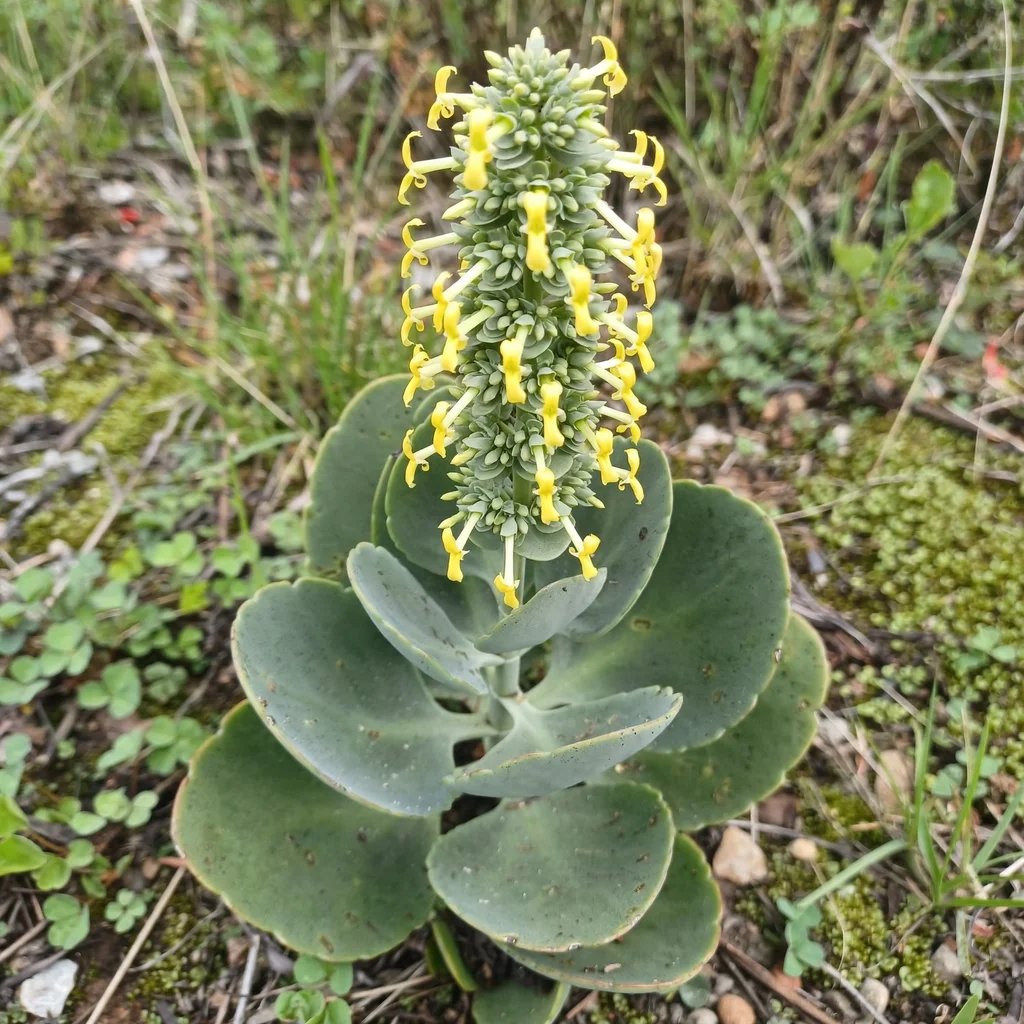
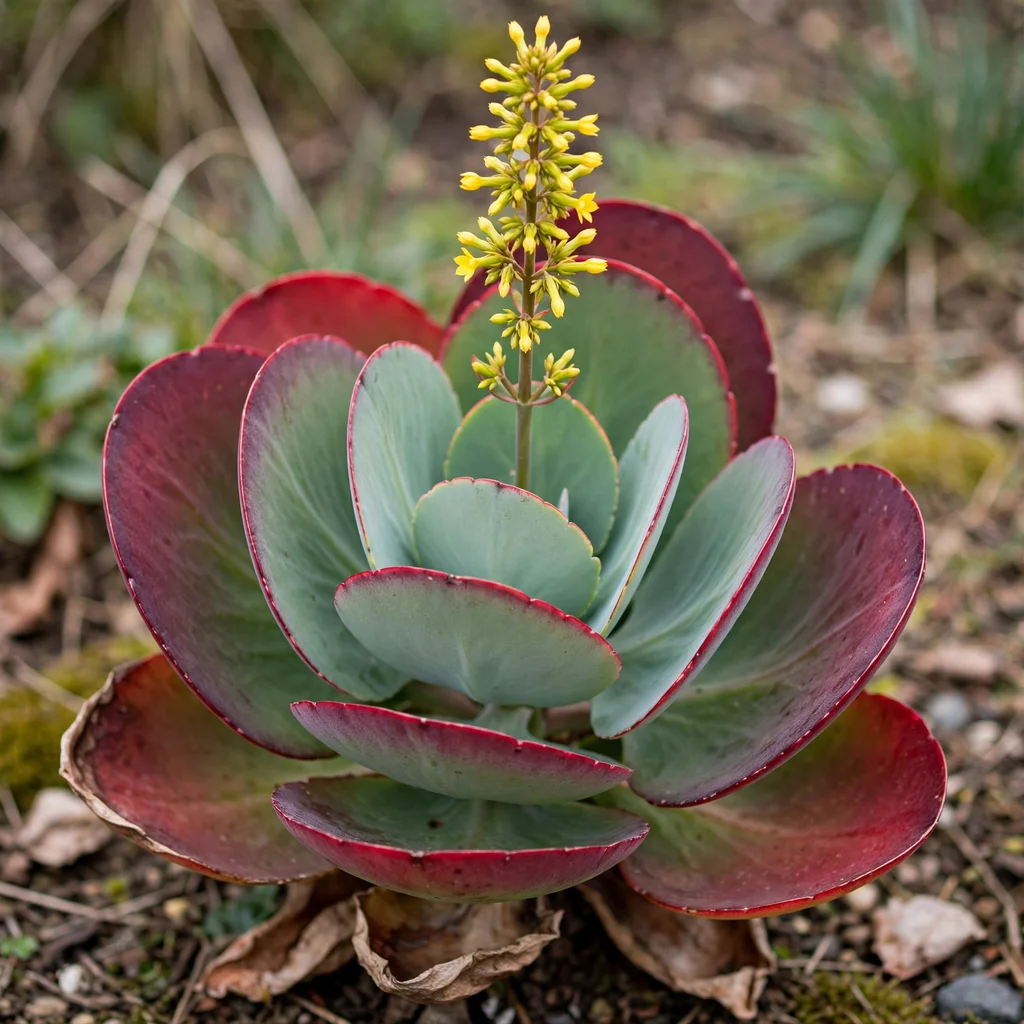
Kalanchoe thyrsiflora is a succulent herbaceous perennial that forms a basal rosette of large stalkless paddle-shaped leaves coated in a white powdery bloom. The gray-green leaves stack like pancakes and stand upright to shed sun, flushing red at the margins in full sun and dry winter air.
Mature rosettes are monocarpic, sending a tall leafy stalk from the center topped by a dense cylindrical thyrse of tubular whitish-green flowers with recurved brilliant yellow lobes that smell sweet. It takes three to four years to flower and the mother rosette dies afterward while offsets persist, which separates true K. thyrsiflora from the commonly mislabeled K. luciae.
Uses & Benefits:
Essentials
At a Glance
Plant Type
Cactus Succulent
Height
30"
Width
18"
Light
Full Sun, Partial Sun
Zones
10
Water
Low
Humidity
Average to humid
Lifespan
Perennial, monocarpic rosette with persistent offsets
Native To
South Africa, Botswana, Lesotho, Eswatini
Toxicity
Toxic if ingested
Bloom period
Spring
In flower about 3 months of the year
Planting
How to Grow
- Plant in a fast-draining cactus or succulent mix in a pot with drainage, or in sandy rocky soil outdoors after all frost danger has passed.
- Place in full sun with at least 6 hours direct sun for tight growth and red margins; tolerate part shade with less color.
- Water deeply then let the mix dry completely, watering sparingly in winter when growth slows.
- Feed lightly once in spring with diluted succulent fertilizer; do not overfeed.
- Bring containers indoors before first frost and overwinter dry and bright above freezing.
Pro Tip
Keep the offsets after the mother flowers and dies; it takes years to bloom and overwatering or cutting healthy paddles ruins the rosette.
Keep It Thriving
Care Guide
Do
- Give at least 6 hours of direct sun for compact growth and red leaf edges.
- Use gritty, fast-draining mix and a pot with drainage.
- Let soil dry completely between waterings.
Don't
- Do not overwater or leave in wet saucers; wet roots rot quickly.
- Do not cut healthy paddle leaves to shape the plant.
- Do not leave outdoors below freezing without protection.
Seasonal Care Calendar
| Task | Jan | Feb | Mar | Apr | May | Jun | Jul | Aug | Sep | Oct | Nov | Dec |
|---|---|---|---|---|---|---|---|---|---|---|---|---|
| Fertilize | ||||||||||||
| Pest Check | ||||||||||||
| Plant | ||||||||||||
| Propagate | ||||||||||||
| Winter Prep |
Watch Out For
Pests & Diseases
Common Pests
Common Diseases
In the Garden
Landscape Uses & Companions
Landscape Uses
Companion Plants
Multiply
Propagation Methods
Good to Know
Common Questions
Flapjacks questions
What zones can Flapjacks grow in?
Flapjacks is hardy in USDA Zone 10: in that range it survives winter in the ground. Colder than Zone 10, grow it in a container you can move to shelter for the winter, or as an annual.
When does Flapjacks bloom?
Flapjacks typically blooms in spring. Exact timing shifts a week or two with your zone — Sow's bloom calendar maps it to your garden.
Does Flapjacks need full sun?
Flapjacks does best in full sun to part shade. In hot climates, afternoon shade keeps blooms fresher longer.
Is Flapjacks drought tolerant?
Yes — once established (usually after the first full season), Flapjacks handles dry spells with minimal watering. Water deeply its first year to build the root system that makes that possible.
More Kalanchoe to compare
Keep exploring
Explore the genus
Hardy in your zone?
Grow Flapjacks with confidence
See it in a design of your actual yard, get zone-matched care reminders, and track it season by season in your garden journal.